



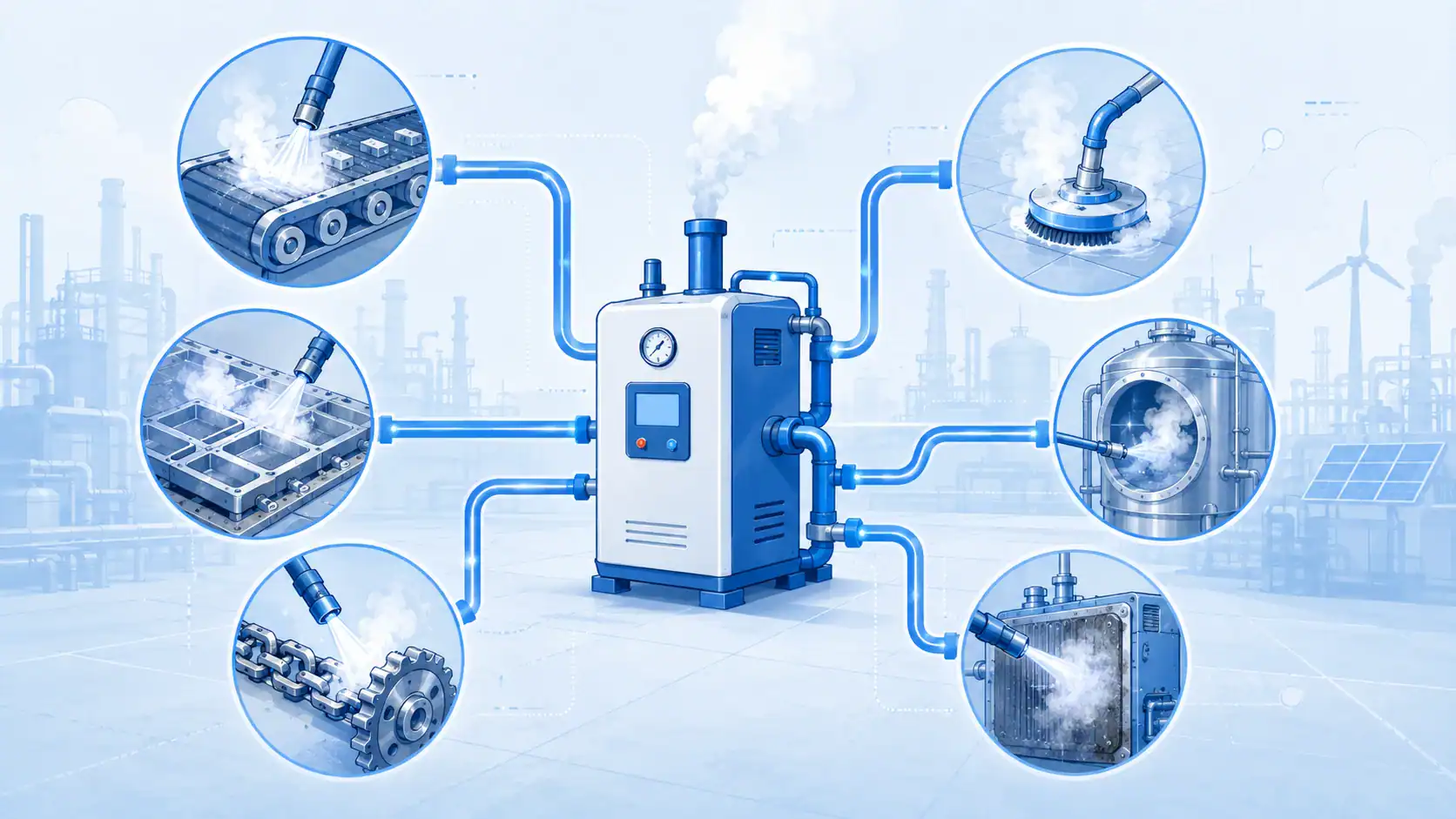
Electric industrial steam enables the cleaning, sanitizing, and electrification of processes in food processing plants and other sectors, reducing water consumption by up to 90%, eliminating the need for chemicals, and automating tasks that previously required personnel and production line stoppages.
Giconmes Ibérica, a Spanish manufacturer of electric steam generators since 1957, offers a product portfolio that covers every critical point in a plant: from manual cleaning with spray lances to automated fixed systems for canvas belts, Intralox belts, and cooling coils. In real-world applications, the time required to clean a fabric belt has been reduced from 4 hours to 1 hour, and that for a cooling coil from 8 hours to 2 hours.
What is industrial steam cleaning, and why is it replacing water and chemicals?
Industrial steam cleaning uses dry or saturated steam with high thermal energy as a sanitizing agent: the heat dissolves grease and residue, removes biofilm, and reduces the microbial load (Listeria, molds) without the need for detergents. Unlike high-pressure water cleaning, it leaves surfaces virtually dry, which shortens restart times and reduces the risk of recontamination.
Its three measurable advantages over traditional methods are:
- −90% reduction in water consumption and elimination of chemicals.
- Automated, unattended cleaning, with no staff dedicated to the task.
- More productive hours are freed up on the production floor by reducing cleaning downtime.
When steam is generated using electric generators (rather than gas boilers), there is an additional energy benefit: nearly instantaneous startup, 99% efficiency, and CO₂-neutral operation if the electricity comes from renewable sources.
Why Steam Is a Good Fit for a Food Processing Plant
Bread-making and food processing plants share critical hygiene issues that are difficult to resolve using conventional methods:
- Flour and aerosolized grease caked onto structures, frames, wiring, and high areas.
- Biofilm and microbiological risk (Listeria, molds) in joints, seams, and recurring areas.
- Intensive cleaning involving labor, water, and chemicals, with production line stoppages.
- Complex equipment such as canvas and Intralox belts, cooling coils, molds, and trays, which are difficult to sanitize.
Steam addresses all these issues with the same goal of food safety, but using less water, fewer chemicals, and fewer downtime periods.
Where to Apply Steam to Your Plant: A Solution by Application Site
Each area of a floor has a solution and a recommended generator. This is the complete map of the portfolio.
1. Structures, frames, and overhead areas — manual cleaning
Hoses, nozzles, brushes, and accessories are the most versatile way to introduce steam into a plant:
- Structural cleaning of machinery, frames, housings, and guards without disassembly.
- Cabling, cable trays, and dead zones with angled spouts.
- Electrical panels, sensors, photocells, and dry-steam motors.
- Targeted removal of biofilm and rapid response to incidents.
- High areas (beams, light fixtures) using a telescopic boom and a manual spinner with up to 1,200 strokes per minute.
Add-on: The Twister (rotating vacuum head) cleans floors and large surfaces 4–5 times faster than the handheld wand.
2. Canvas Belts — Brushless Motor
Automate the cleaning of belt conveyors without chemicals:
- Saturated/dry steam on the belt + built-in vacuum that removes all residue.
- Two modes: Brush (rotating brush) for stubborn dirt, and Brushless (non-contact) for frequent cleaning or in-production use.
- Portable and adaptable to a wide range of widths (standard: 1,150 mm).
- Installed on modular belts, with cooling slots and tunnels up to 5 levels deep.
- Recommended generator: 20 kW RGV mobile generator.
Real-life example: Cleaning a canvas conveyor belt with a brushless motor reduced the time required from 4 hours to 1 hour.
3. Canvas belts — fixed systems (Single / Dual)
Permanent static brushless system for continuous cleaning without disrupting production:
- Installation in the return section: It acts on the belt when it is not carrying any product.
- Single cleans the side that comes into contact with the product; Dual cleans both sides at the same time for lines with high hygiene risks.
- High-thermal-energy steam (≥20 kW) + vacuum extraction that collects condensate and debris and prevents recontamination.
- Compatible with existing or newly constructed lines.
- Option for cleaning the inside of the tarp (head at 30 cm) in cases of traction and slippage issues.
4. Intralox Belts / Mesh — Jet System
Streams of steam penetrating the mesh structure, without chemicals:
- Portable Jet System with a touchscreen and advanced programs; adaptable to multiple widths.
- Spinners with ~1,000 jets of saturated steam per minute and cold, safe engineering-grade plastic discs.
- 180-mm heads (large impact area) or 110-mm heads (concentrated force for tough debris).
- Alternative print heads: linear arrays (15 kW/section), V-shaped (20 kW/section), or with spinners (15 kW/spinner).
- Jet System Static version for narrow screens.
Real-world example: Automatic cleaning of a 50-meter Intralox conveyor.
5. Cooling coils and long strips — custom vapor barriers
Custom control panels or spinners to automate the most critical points:
- Custom-made frames with spinners or rotating bars that cover the entire width in a single pass, regardless of diameter or geometry.
- Lower collection trays and partial/total enclosures to reduce steam emissions into the plant.
- Multifunction spinners: steam + compressed air to speed up drying.
- Adjustable settings (number of spots, flow rate) depending on the level of dirt and the available downtime.
Real-world example: Ad-hoc steam to reduce the cleaning time for a cooling coil from 8 hours to 2 hours.
6. Trays, molds, and utensils — automatic station
Automatic station for metal trays, molds, frames, and racks. With a 180-kW generator and steam at 10 bar, it eliminates the need for labor, water, and detergent.
7. Chains and drives (>50 m)
Continuous saturated steam over the moving conveyor belt. Removes grease and contaminants without chemicals in areas that manual cleaning cannot reach.
Summary Table: Cleaning by Application Point
| Point of application on site | Giconmes Solution | Type | Recommended generator |
|---|---|---|---|
| Structures, frames, wiring, overhead areas | Hoses, nozzles, brushes, telescopic nozzle | Manual | RGV 10–30 kW |
| Floors and Large Areas | Twister (rotating head + vacuum) | Manual / mobile | RGV ≥10 kW (20 optimal) |
| Canvas Belts — Periodic Cleaning | Mobile Brush / Brushless | Mobile | RGV 20 kW |
| Canvas Belts — Continuous Hygiene | Single/Dual Fixed System | Automatic Fixed | ≥20 kW |
| Intralox Belts / Mesh | Jet System + spinners / bars | Mobile / stationary | 15–20 kW per section |
| Cooling coils | Custom vapor barriers (spinners/strips) | Custom fixed units | 20 kW per section |
| Trays, pans, and utensils | Automatic cleaning station | Automatic | NGV up to 180 kW |
| Chains and Drives (>50 m) | Fixed head on a moving chain | Continuous fixed | RGV / NGV 20 kW |
Beyond Cleaning: Electric Steam as a Driver of Electrification and a Process
Industrial steam does more than just clean: it is a driver of electrification and energy efficiency for process heat (typically below 200 °C):
- Ovens: process steam injection for crust, shine, and volume, as well as oven electrification.
- Hot Water and CIP: Rapid heating without limescale, high power, and nearly instantaneous startup.
- Ingredients and fluids: jackets, coils, and piping layouts (oils, greases, syrups).
- Fermentation: precise control of humidity and temperature in the fermentation chambers.
- Heat tunnels: preheating and pasteurization with controlled heat transfer.
- Electrification: replacement of gas boilers (Power-to-Heat), with 99% efficiency and CO₂-neutral operation.
Frequently Asked Questions About Industrial Steam Cleaning
Does steam cleaning really remove chemicals?
Yes. Dry or saturated steam acts as a heat transfer medium: the heat dissolves grease and residues and reduces the microbial load without the use of detergents. In most food-processing applications, chemicals are completely eliminated.
Is steam effective against Listeria and biofilm?
Yes. High-thermal-energy steam removes biofilm and reduces microbiological risk in joints, seams, and recurring problem areas, and enables rapid, targeted responses to incidents involving Listeria or mold.
How much water do you save by steam cleaning?
Up to 90% more efficient than conventional high-pressure water cleaning, and it leaves surfaces virtually dry, which shortens the time needed to restart the line.
Is it possible to clean a conveyor belt without stopping production?
Yes. The Single/Dual fixed systems are installed in the return section and act on the conveyor belt when it is not carrying any product, ensuring continuous hygiene without interfering with production.
What steam generator capacity do I need?
It depends on the application: 10–30 kW for manual cleaning with spray lances, 20 kW for canvas belts, 15–20 kW per section for Intralox, and up to 180 kW for automatic tray and mold stations. The selection is validated during an on-site audit.
What is the difference between an electric steam generator and a gas boiler?
The electric generator starts up almost instantly, achieves 99% efficiency, and operates CO₂-neutrally using renewable electricity, making it a Power-to-Heat electrification solution for process heat.
Who manufactures electric steam generators in Spain?
Giconmes Ibérica, a Zaragoza-based manufacturer that has been producing electric steam generators since 1957, with the NGV (stationary), RGV (mobile), and HGV (high-power) lines.
Next step: Let’s identify the areas of application together
Each solution is tailored to the geometry, accessibility, and conditions of each line. The process is simple:
- Checkpoint audit — tour of critical lines and areas in the plant.
- Proof of concept — plant-scale testing under actual production conditions.
- Customized proposal — solution, generator, and step-by-step implementation plan.