



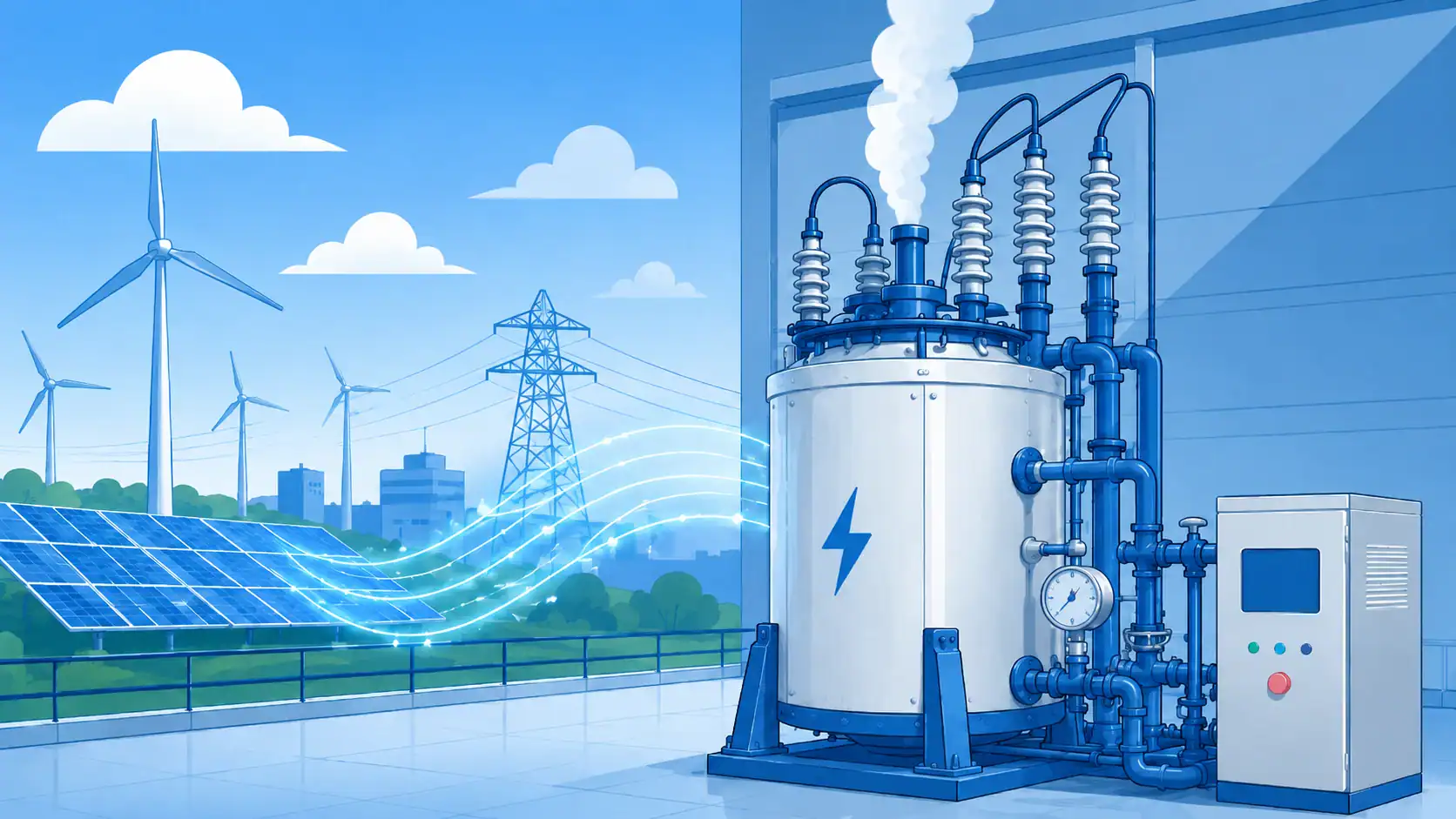
In a modern electrical system, not all relevant assets generate energy. Some consume it. And, in certain contexts, who consumes it can be just as important as who produces it. Electrode steam boilers belong precisely to that second group: their immediate function is to produce steam from electricity, but in a grid with high renewable penetration, their role goes far beyond the industrial process.
Their interest lies not only in how these systems generate heat, but also in how they can be integrated into a plant and the electrical grid as a large, fully controllable, fast, and predictable load. This post explains what they are, why they are important for grid stability, how they can generate revenue for operators, what equipment they replace, and in which sectors they make the most sense.
What is an electrode steam boiler—and why is it medium- or high-voltage?
An electric boiler converts electrical energy into thermal energy without combustion within the unit. This category includes two technologies:
- Resistance-heated boilers. Heat is generated by resistive elements submerged in water. They offer very fine and stable modulation, ideal for applications where precise load control is a priority. This is the standard technology for low-voltage systems and power ratings of up to a few megawatts. It is also the natural domain of Giconmes steam generators.
- Electrode boilers. Heat is generated by passing an electric current directly through the water, which acts as a resistive element. This allows for very high power outputs with extremely fast startup times.
The reason electrode boilers operate at medium or high voltage is purely physical. Power is the product of voltage and current; therefore, to deliver several megawatts at low voltage would require enormous currents, which are unfeasible due to conductor cross-sectional area limitations and associated losses.
Increasing the supply voltage (typically in the range of 6 to 24 kV) reduces the current for a given power level and makes the connection more manageable. Furthermore, by conducting the current directly through water—whose conductivity is controlled—the practical limitation on the number of resistive elements is eliminated, paving the way for high-power units with electrical efficiencies approaching 99%.
What matters is what both technologies have in common: they arelarge, fully controllableelectrical loads with a responsiveness that conventional thermal generation struggles to match. In practice, they can start up from a cold state to full load in a few minutes, go from minimum to maximum in a matter of seconds, and continuously modulate power within their range. From the perspective of the electric system, this behavior is more akin to that of a regulating asset than to that of a conventional consumer.
The Structural Challenge of the Electric Grid
The power system must maintain an almost instantaneous balance at all times between what is generated and what is consumed. Since electricity cannot be easily stored on a large scale within the grid itself, any imbalance is immediately reflected in the system frequency, which has a nominal value of 50 Hz in Europe: it rises when more electricity is generated than is demanded, and falls when consumption exceeds available generation.
With the rise of variable renewable energy generation, maintaining this balance has become more challenging. There is more intermittent energy and less synchronous inertia—the kind provided by large conventional rotating machines—so frequency and voltage deviations can occur within seconds. The blackout that affected the Iberian Peninsula in 2025 brought this challenge into sharp focus: maintaining stability in a grid with less inertia requires new sources of flexibility capable of reacting very quickly.
Traditionally, that flexibility was provided by power plants capable of adjusting their output. Today, the system operator is increasingly incorporating demand-side resources: consumers capable of adjusting their consumption in real time to help balance the grid. An electrode boiler, with its rapid modulation capability, is one of the most valuable demand-side resources an industrial plant can offer.
Flexibility mechanisms: implicit and explicit
There are two ways in which an industrial consumer can derive value from its flexibility:
- Implicit flexibility. This involves adjusting consumption based on the price of electricity: generating and, if necessary, storing steam when electricity is cheap, and reducing consumption when it is expensive. It does not require a contractual relationship with the system operator; it takes advantage of the wholesale market’s own price signal. Any consumer can implement it.
- Explicit flexibility. This involves making modulation capacity available to the system operator (in Spain, Red Eléctrica) through balancing services, which balance instantaneous supply and demand. The consumer—either directly or through an aggregator—adjusts their consumption in response to a signal and receives compensation for doing so.
In the Spanish system, the main markets in which a flexible resource can participate are:
- Secondary regulation (aFRR): automatic adjustment of generation or consumption on a scale of seconds to a few minutes to correct frequency deviations.
- Tertiary control (mFRR): manual activation by the operator to restore balance when secondary control is insufficient.
- Active Demand Response Service (SRAD): This service allows large consumers to reduce their consumption when requested by the utility to relieve strain on the grid.
The typical entry threshold is around 1 MW of manageable power. To participate, the boiler must have the appropriate control systems, telemetry, and communications with the operator or aggregator; sufficient modulation capacity; and compliance with the regulatory and authorization requirements of each market. Once these requirements are met, the equipment ceases to behave as a passive load and becomes a controllable load: it can increase consumption when the grid needs to absorb energy or reduce it when demand needs to be alleviated.
How it generates income for the person who operates it
Here is the most significant shift in logic. An electrode boiler is justified not only by the cost of the steam it produces during continuous operation, but also by the value it provides as a flexible asset within a broader energy architecture.
There are several ways to generate income and save money, and they can be combined (revenue stacking):
- Payments for availability and capacity. In many balancing markets, compensation is not limited to the energy actually consumed or reduced, but also includes the mere availability of power and the ability to respond. This is key: the boiler can generate value even during periods when it is not in the best interest to operate it as the primary heating source, simply by being network-ready.
- Price arbitrage (implicit flexibility). Concentrating steam production during off-peak electricity hours—using thermal storage—and avoiding peak hours reduces OPEX.
- Demand response and reserve capacity. Participate in demand response programs and provide reserve capacity to the system, typically coordinated by a market operator or an aggregator.
- Frequency regulation. Take advantage of rapid startup and modulation to participate in frequency balancing markets.
Orders of magnitude
The figures depend on the price of electricity, the value of availability in each market, the actual hours of operation, the ability to adjust output without affecting the process, and the thermal alternative available at the plant.
As a rough guide: in mature markets such as France, a 1 MW electric boiler can generate between 40,000 and 90,000 € per year by participating in flexibility and capacity programs; recent estimates for the Finnish market place revenue from balancing services (FCR-D + mFRR) at around 90,000–130,000 €/MW·year.
When the boiler replaces aging diesel or gas-fired equipment, the returns from increased flexibility can put the payback period in the range of 3 to 5 years. These are approximate figures, not guaranteed, and must be evaluated on a case-by-case basis.
The conclusion is that the analysis shifts from focusing solely on the cost of producing steam using electricity to incorporating the value that the boiler provides as a flexible resource.
What does it replace, and how does it coexist with cogeneration?
In its most straightforward application, the electrode boiler replaces or supplements natural gas or diesel-fired boilers. Since there is no combustion on-site, local emissions, stack requirements, and emissions permits are eliminated, as are the logistics of fuel storage. If the electricity comes from renewable sources, the process heat is decarbonized.
The most interesting scenario is not always pure replacement, but rather coexistence with an existing cogeneration system. The logic is simple: when it is cheaper to generate heat using electricity than gas, production is shifted to the electrode boiler, reducing overall OPEX; when the situation reverses and gas becomes more competitive again, cogeneration regains the lead, and the boiler remains available as a flexible load to participate in balancing markets.
Thus, the equipment pays for itself both during the hours it produces steam and during the hours it provides flexibility to the system, expanding the plant’s operational flexibility and adding a new revenue stream.
Typical Applications and Industries
Electrode boilers are particularly well-suited for situations where significant heat demand, high available electrical power, and a desire to decarbonize or monetize flexibility all come together:
- District heating networks, where thermal storage allows for balancing without any impact on the supply.
- Chemical and petrochemical industries, which consume large amounts of process steam.
- Food and beverages, paper and cardboard, textiles, pharmaceuticals and biotechnology, and, in general, any steam-intensive process.
- Cogeneration plants seeking to make their output more flexible in response to market signals.
- Backup and redundancy for existing facilities, while also providing control capabilities.
An important design consideration: for intermediate power levels, a modular configuration consisting of several electric generators can be an alternative—or a complement—to a single large boiler. Multi-unit operation provides redundancy, equipment rotation, continuity during maintenance, and scalability—advantages that should be considered when comparing electrification options.
Giconmes’ Approach
For this contribution to be meaningful, the boiler cannot be treated as an isolated piece of equipment: it requires electrical and control integration that is consistent with the plant’s architecture and network requirements. This involves correctly defining the connection and protective measures, aligning control strategies with the PLC or DCS, coordinating operation with the steam network and process constraints, and evaluating operational flexibility without compromising production.
At Giconmes, we design, manufacture, and supply electric steam generation systems and support the project from conception through commissioning, with Siemens PLC control, telemetry, and instrumentation ready for integration into demand management platforms. To facilitate access to flexibility markets, we collaborate with partners specializing in electricity demand management who are capable of installing the integration software and managing participation in the Spanish grid balancing mechanisms.
If you’re considering switching to electric steam generation, replacing a gas boiler, or figuring out how much revenue flexibility could generate in your specific case, write to us and we’ll analyze it together.