



Success stories
Two-level steam: a fixed installation to overcome mezzanine limitations
Project description
A leading European industrial bakery manufacturer needed to clean a new production line located in a mezzanine, with multiple hard-to-reach areas where steam is the most effective solution. However, access and space limitations prevented the existing steam generators from being moved to this area, making the cleaning operation difficult despite having the appropriate technology.

Original situation:
Challenges posed by the client:
Our customer, one of Europe’s leading industrial bakery manufacturers, was already successfully using several Giconmes RGV-0010 and RGV-0020 steam generators, together with their corresponding accessory kits, for cleaning and sanitizing their production lines.
To expand capacity, the plant added a new manufacturing line in a mezzanine built on top of the building. The new line featured numerous conveyor belts, nooks and crannies and hard-to-reach areas – precisely the type of environment where steam cleaning provides the best results. However, the very configuration of the mezzanine precluded the use of the steam equipment already in the plant.
On the one hand, the RGV-0010 and RGV-0020 generators, despite being mobile equipment on wheels, could not be hoisted up to the mezzanine due to access limitations.
On the other hand, even assuming they could climb, the aisles and workspaces on the upper floor were too narrow to allow for the usual movement of the machines along the production line.
The customer was thus faced with a paradoxical situation: he had the technology to steam clean his new bakery line, but could not physically bring it to the point where it was needed.
Proposed solution:
Customized steam solution developed by Giconmes.
Proposed solution:
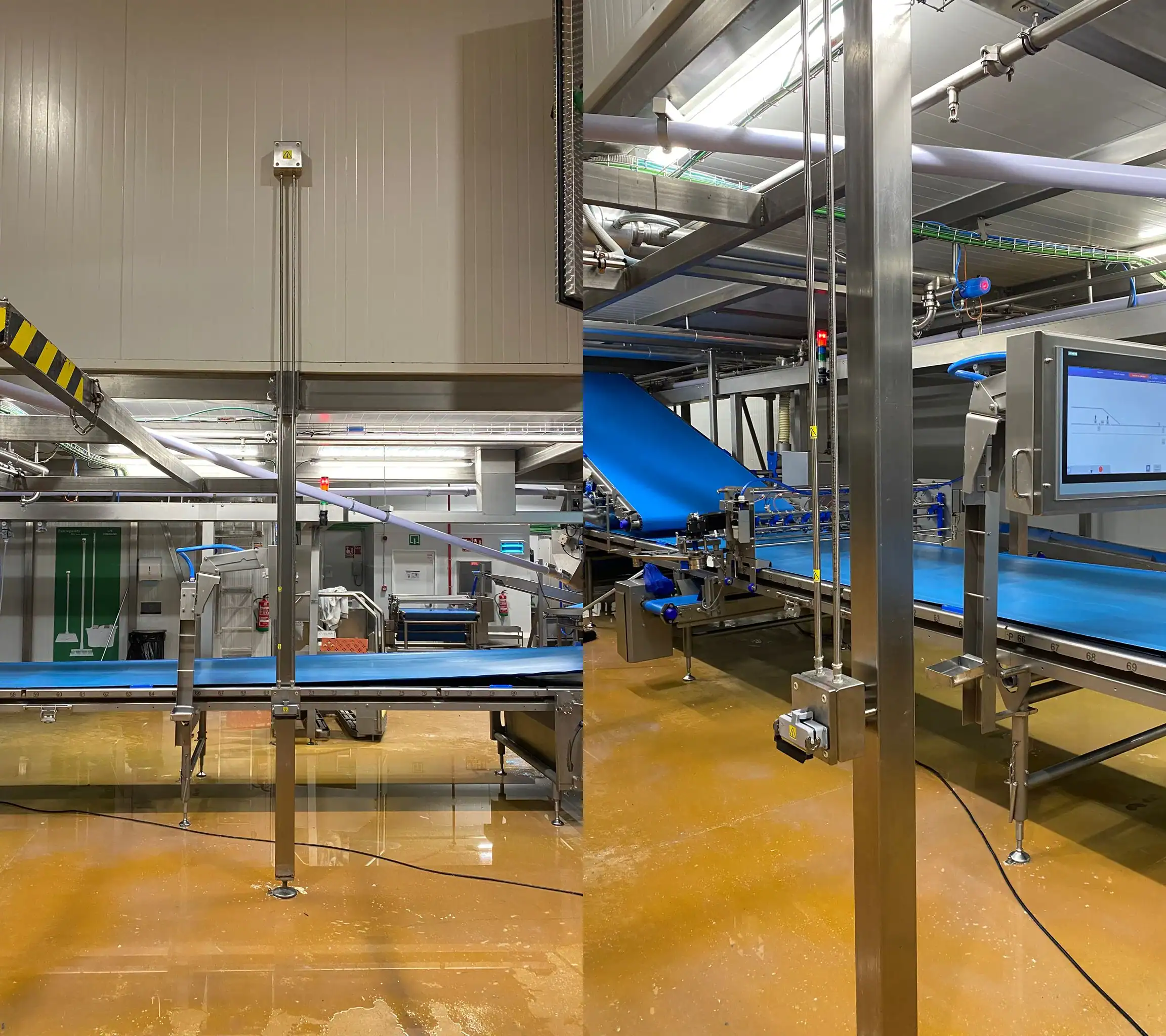
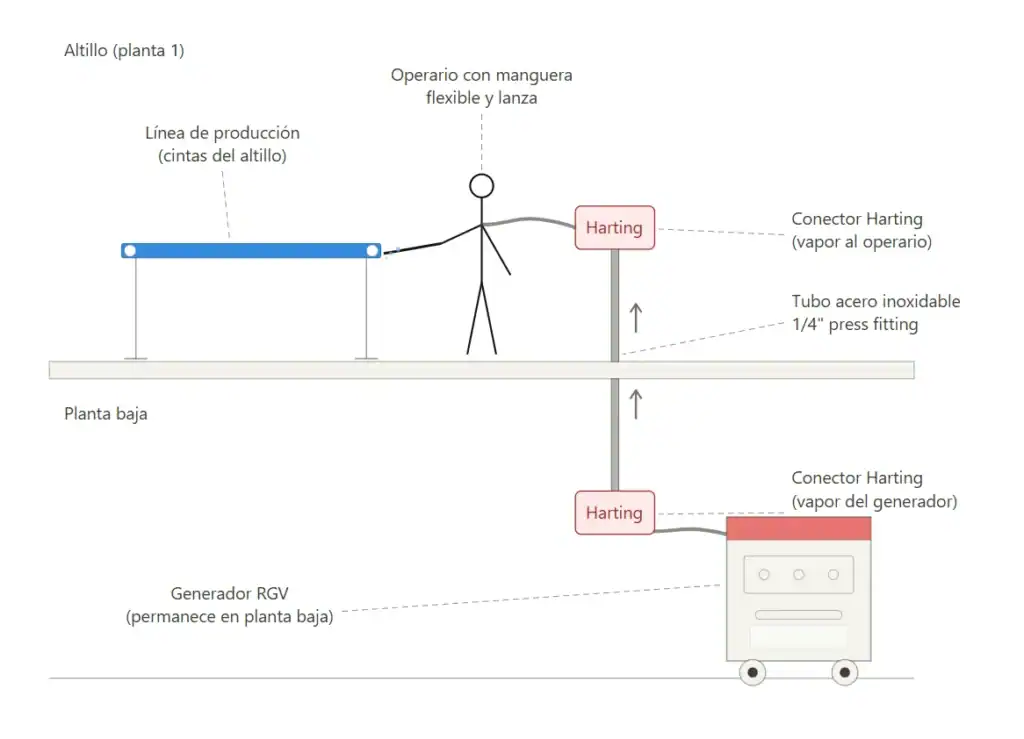
Giconmes came up with a practical solution adapted to the physical constraints of the plant: keep generators RGV-0010 and RGV-0020 on the ground floor and bring the steam to the mezzanine through a permanent fixed conduit.
In this way, heavy equipment would not have to be moved, and only hoses and fittings would have to be handled on the upper floor.
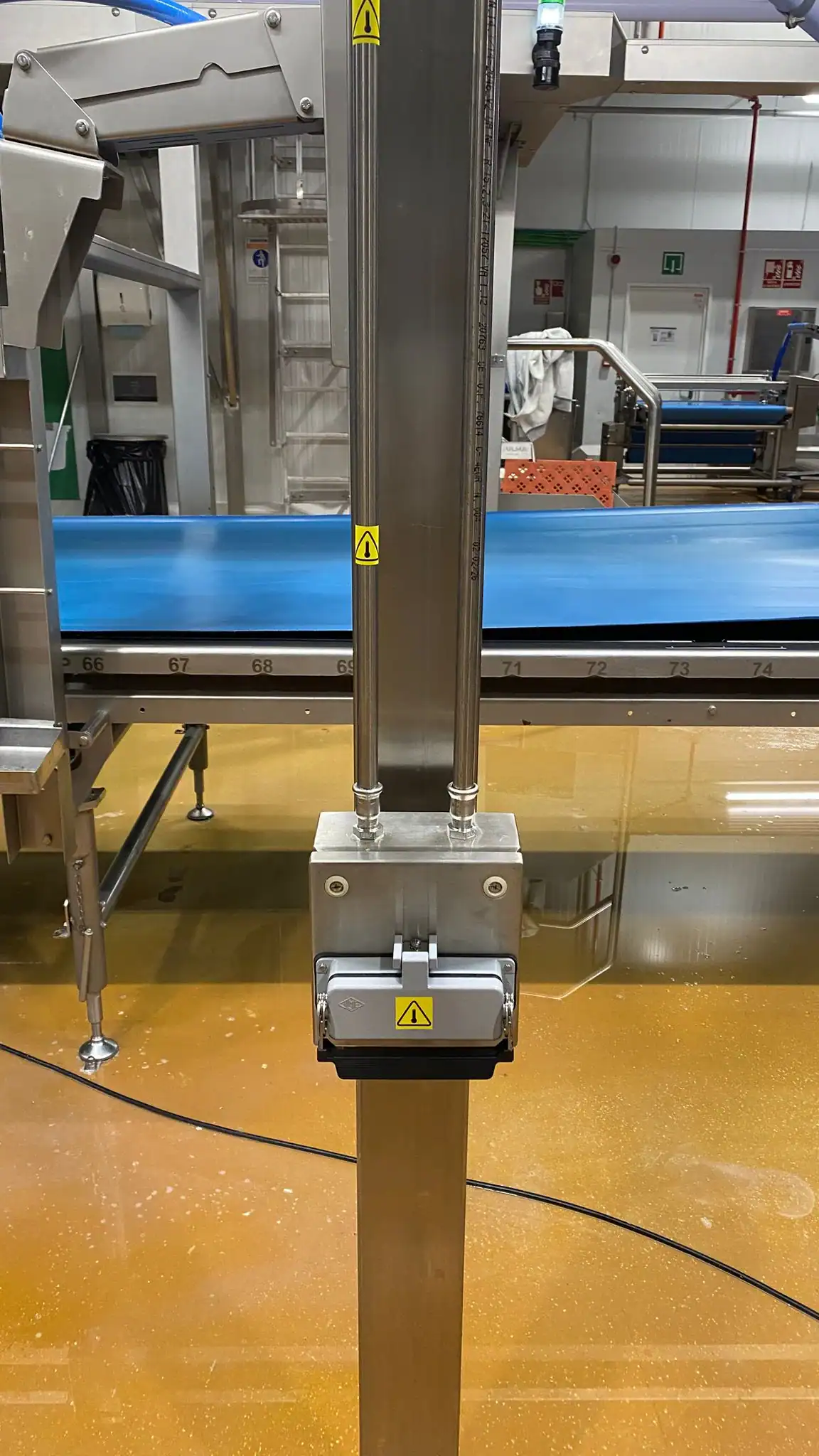
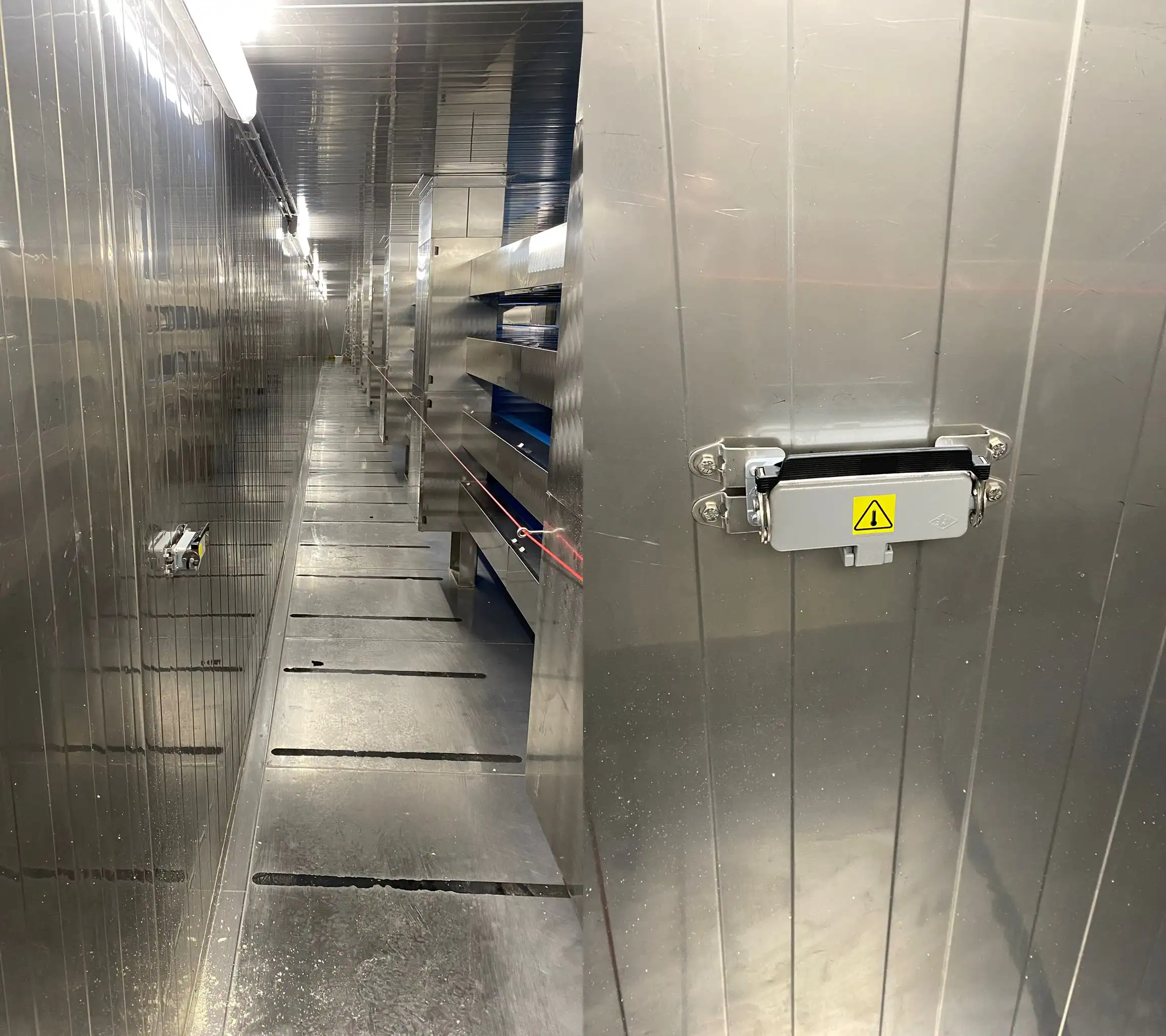
The solution is based on two key elements. First, the Harting fast connections, one of the differential components of Giconmes equipment.
These multi-pin connectors for industrial use are extremely robust, watertight and safe, and allow steam hoses to be coupled and uncoupled quickly and without risk to the operator.
Secondly, a 1/4″ stainless steel fixed pipe with press fittings, installed vertically from the first floor to the mezzanine, in charge of transporting the pressurized steam from one level to the other.
Stainless steel guarantees compatibility with steam and with the hygienic standards required in the food industry.
Day-to-day operation is simple. On the first floor, the RGV generator is connected to the lower end of the column via a Harting plug.
The pressurized steam rises through the stainless steel piping to the upper floor, where another Harting outlet allows the operator to directly connect his flexible hose with the corresponding lance or brush and clean the conveyor belts and other production equipment.
Thus, the cleaning operation on the mezzanine is identical to that in any other area of the plant, with the only difference being that the steam generator is located one level below. The only difference is that the steam generator is located one level below. The operator only has to climb up with the hose and accessories – light and easy to handle elements – without the need to move heavy equipment through narrow aisles, or to deal with the complexity of lifting machines up to the mezzanine.
Technology used:
- Electric steam generators (models RGV-0010 and RGV-0020)
- Harting multi-pin industrial quick connectors
- 1/4″ stainless steel fixed conduit
- Press fitting system
- Flexible steam hose
- Cleaning accessories (nozzles and steam brushes)
CHALLENGES
We meet customer requirements
Steam cleaning solution adapted to environments with access limitations, keeping the generators on the first floor and distributing the steam to the mezzanine through a fixed installation. We achieved the following results:

Operational without moving heavy equipment – The generators remain on the first floor, avoiding complex displacements and allowing working at height only with hoses and light accessories.

Fast and safe connection – Harting industrial connectors allow the system to be coupled and uncoupled in an agile, watertight and risk-free way for the operator.

Efficient steam distribution – The fixed stainless steel piping transports pressurized steam between levels, ensuring compatibility and hygienic standards.

Same operation at any level -Thesystem allows to replicate the cleaning in the mezzanine as in the rest of the floor, without space or accessibility limitations.
Do you need a customized solution?
We help you define what type of installation you need
There are no emissions beyond those produced during the electricity production process. Consequently, emissions can be neutral depending on the electricity mix. Electric steam boilers are the present and the future.
Absolutely. In fact, it is recommended to achieve maximum efficiency. There is no problem with remote control as long as it complies with current regulations.
A steam generator is a pressure vessel that, together with the piping network, is subject to regulatory control and complementary technical instructions, according to the regulations published in Royal Decree 809/2021, of September 21. Maintenance is divided into a part that can be easily fulfilled by the owner:
- Know and apply the manufacturer’s instructions regarding use, safety measures, and maintenance.
- Not to put the installation into service or prevent the operation of pressure equipment if the requirements of the Regulation are not met.
- Having at least the following documentation for the pressure equipment while they are installed: Declaration of conformity, manufacturer’s instructions (if applicable), and, if necessary, installation certificate, along with other supporting documentation (such as installation project, record of the last periodic inspection, certifications of equipment repairs or modifications, and any other documentation required by the relevant technical instruction complementary to this regulation). For detailed contents, refer to Annex IV of the regulation. Making this documentation available to the competent authority of the autonomous community and the companies responsible for maintenance, repair, or periodic inspections.
- Use the pressure equipment within its intended operating limits as specified by the manufacturer and take it out of service if it no longer meets the necessary safety requirements.
- Perform maintenance on the installations, pressure equipment, safety accessories, and control devices in accordance with the operating conditions and manufacturer’s instructions, and examine them at least once a year.
- Arranging for the necessary periodic inspections as required by Article 6 of the regulation.
- Having and maintaining an up-to-date record of pressure equipment categories I to IV, as defined in RD 709/2015, of July 24, or equipment similar to these categories according to Article 3.2 of the regulation, as well as their installations.
It is known that by applying heat to water, it transforms into steam at the boiling point and atmospheric pressure. From there, depending on the required saturation degree of steam for its proper application, we need to increase the pressure to obtain a higher temperature. To change the temperature and saturation degree of steam, we always need to modify the pressure.
It is a unit of pressure equivalent to 1 kg/cm2, 0.98 atmospheres, or 14.50 PSI.
Haven't found the answers to your questions?
Please send us a question or download all the information
USES OF STEAM IN INDUSTRY AND OTHER BUSINESSES
Other similar success stories using steam

The use of steam is gaining popularity in several industries due to its efficiency and environmental benefits..
In our "Success Stories" section, you can discover more about companies that have adopted this technology and have achieved successful results in terms of efficiency and sustainability. Click on the success stories to learn more details.
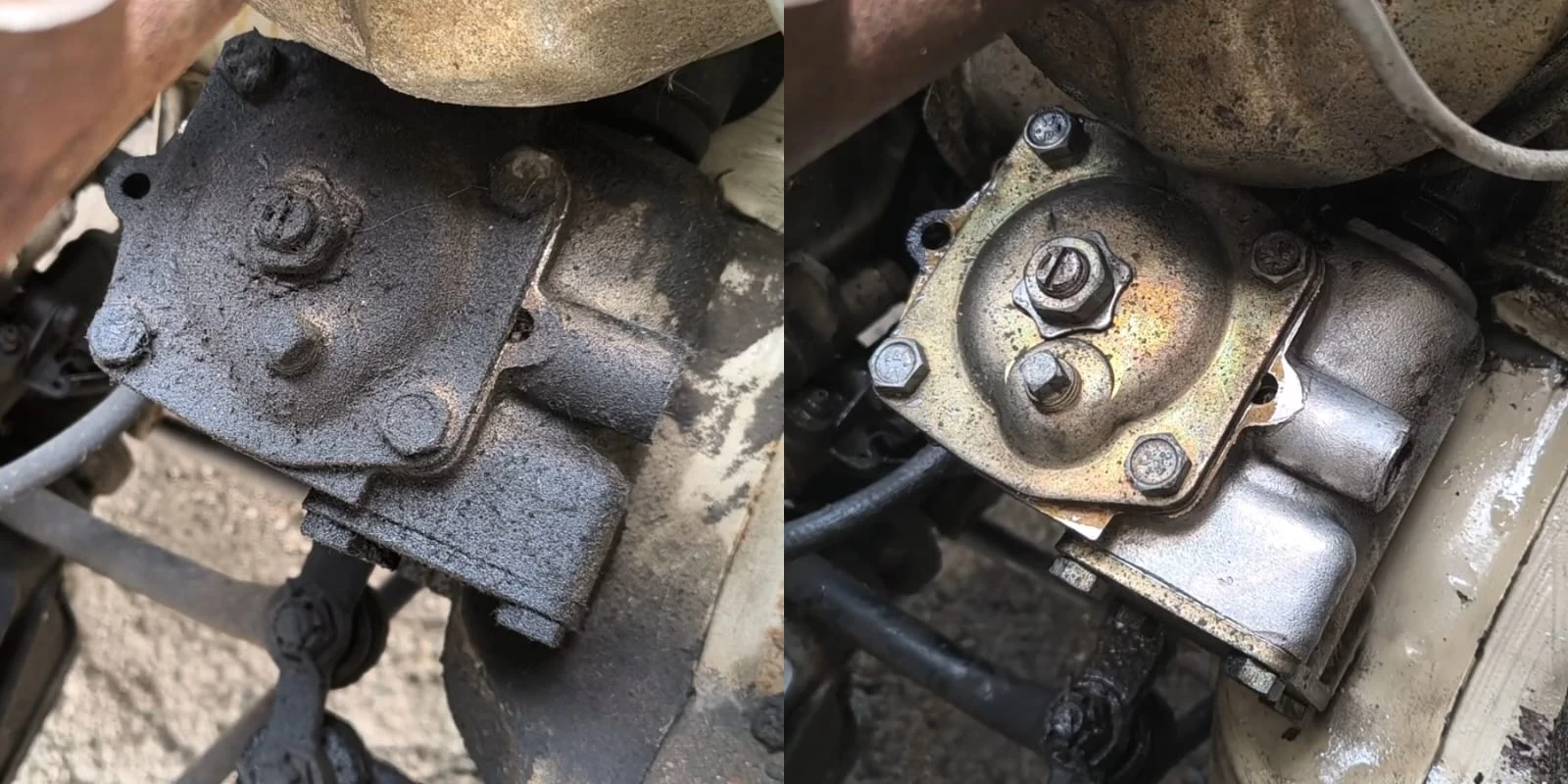
Situación original ¿Qué retos nos planteó el cliente? Nuestro cliente necesitaba una solución eficaz para la limpieza de motores de vehículos, un entorno con numerosos recovecos, componentes eléctricos y piezas sensibles que no admiten el uso de agua ni de productos químicos convencionales. Los métodos de limpieza tradicionales resultaban insuficientes: el agua podía dañar elementos […]

Situación original ¿Qué retos nos planteó el cliente? Un fabricante de ingredientes naturales estaba construyendo una nueva planta de producción y necesitaba incorporar un sistema de generación de vapor limpio capaz de alimentar simultáneamente 4 reactores. Cada reactor requería un caudal de 80 kg/h de vapor, lo que suponía una demanda total de 320 kg/h. […]