



Success stories
Clean steam for 4 reactors: a boiler house that travels in containers
Project description
A natural ingredients manufacturer needed to generate clean, food-grade steam to simultaneously feed 4 reactors in its new plant, ensuring purity, safety and continuous operation in a compact facility located outside the building.

Original situation:
Challenges posed by the client:
A natural ingredients manufacturer was building a new production plant and needed to incorporate a clean steam generation system capable of simultaneously powering 4 reactors.
Each reactor required a flow rate of 80 kg/h of steam, which meant a total demand of 320 kg/h. In addition, as this was a plant dedicated to food ingredients, it was essential that the steam generated be of culinary quality, complying with the most demanding standards of purity and safety for contact with the product.
In addition to this technical requirement, there was a major space constraint: the internal layout of the new plant did not allow the steam generation equipment to be housed inside the factory, so the entire installation had to be solved outside the building, exposed to the ambient conditions. This posed an additional challenge in terms of design, equipment protection and system efficiency.
In summary, the customer needed a solution that combined high production capacity of clean food-grade steam, operational reliability for a continuous process with 4 reactors in parallel, and a compact and robust configuration adapted to an outdoor installation.
Proposed solution:
Customized steam solution developed by Giconmes.
Proposed solution:
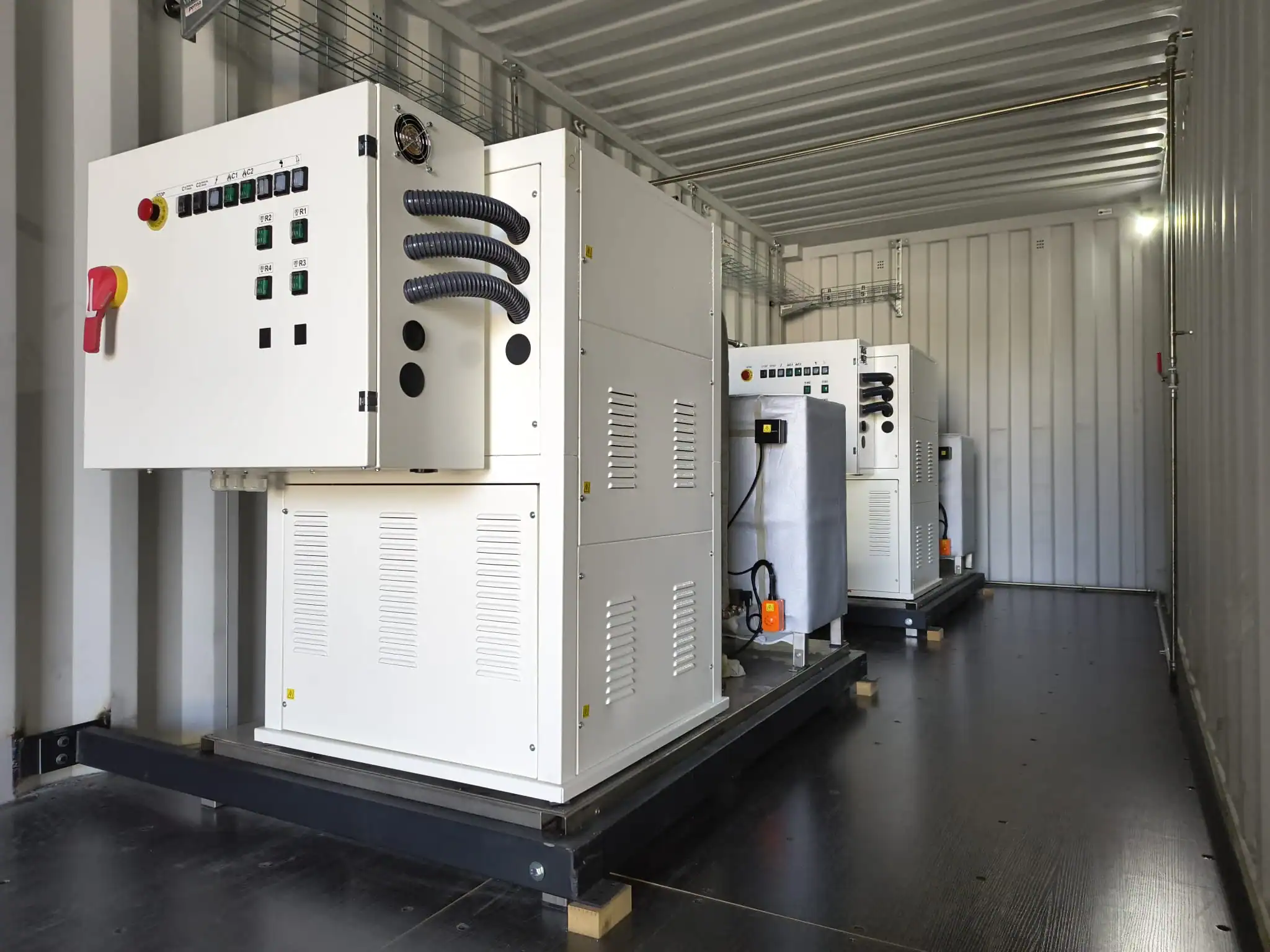
To meet the customer’s needs, Giconmes designed a turnkey solution based on two electric steam generators model NGV-60120, each with a power of 120 kW and a production capacity of up to 165 kg/h of steam.
Working in parallel, both units provide the 320 kg/h needed to simultaneously feed the plant’s 4 reactors.
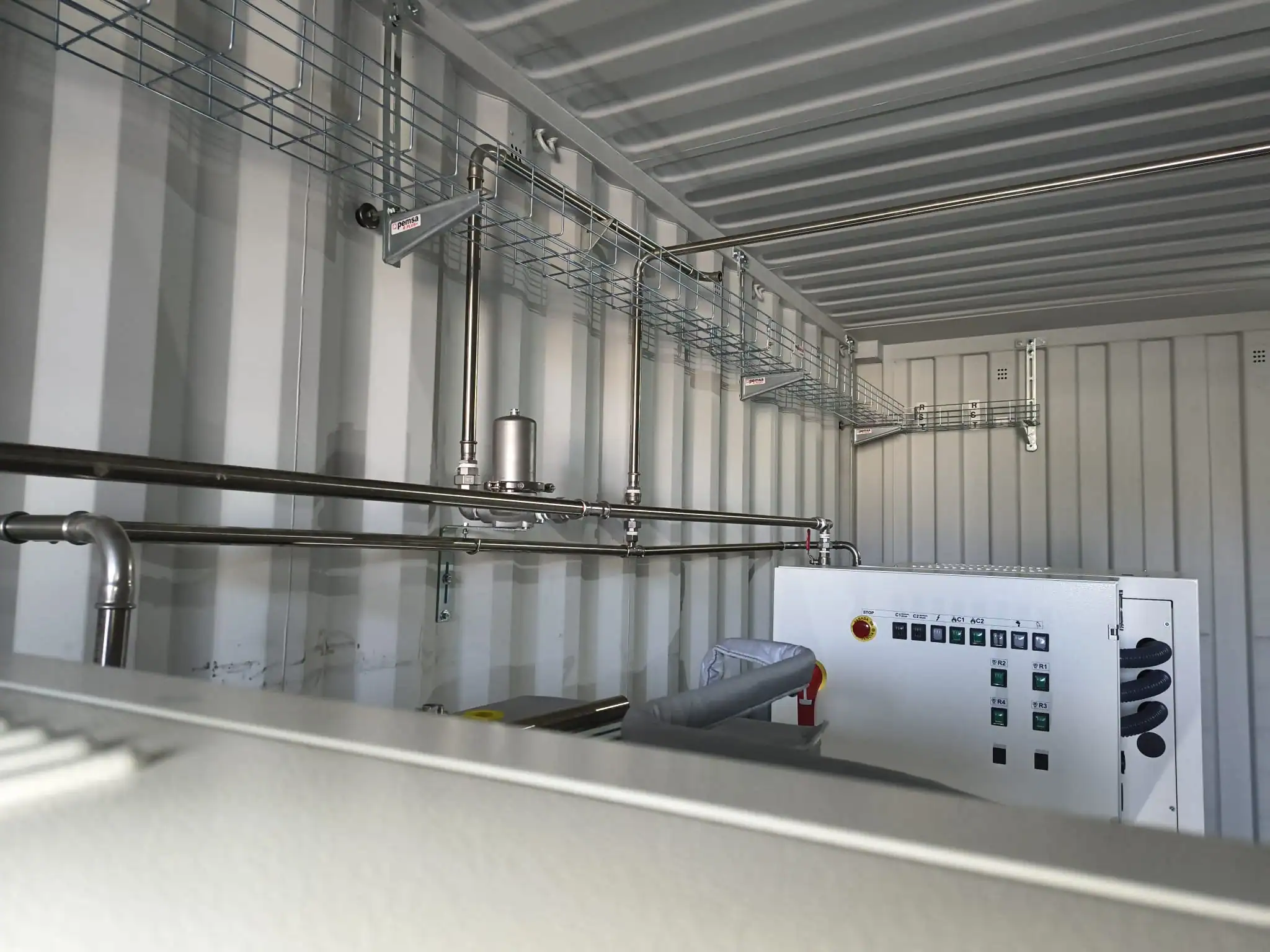
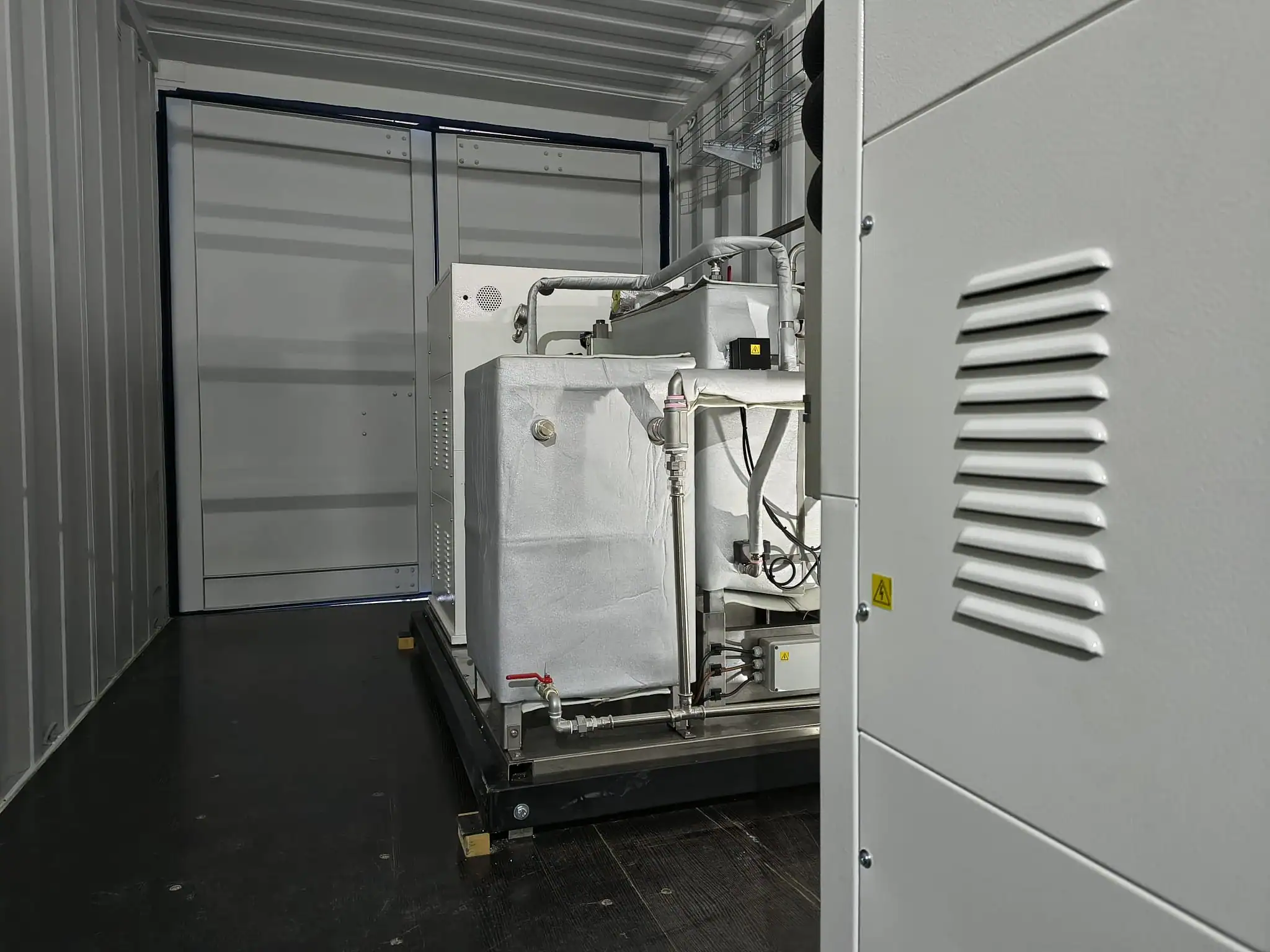
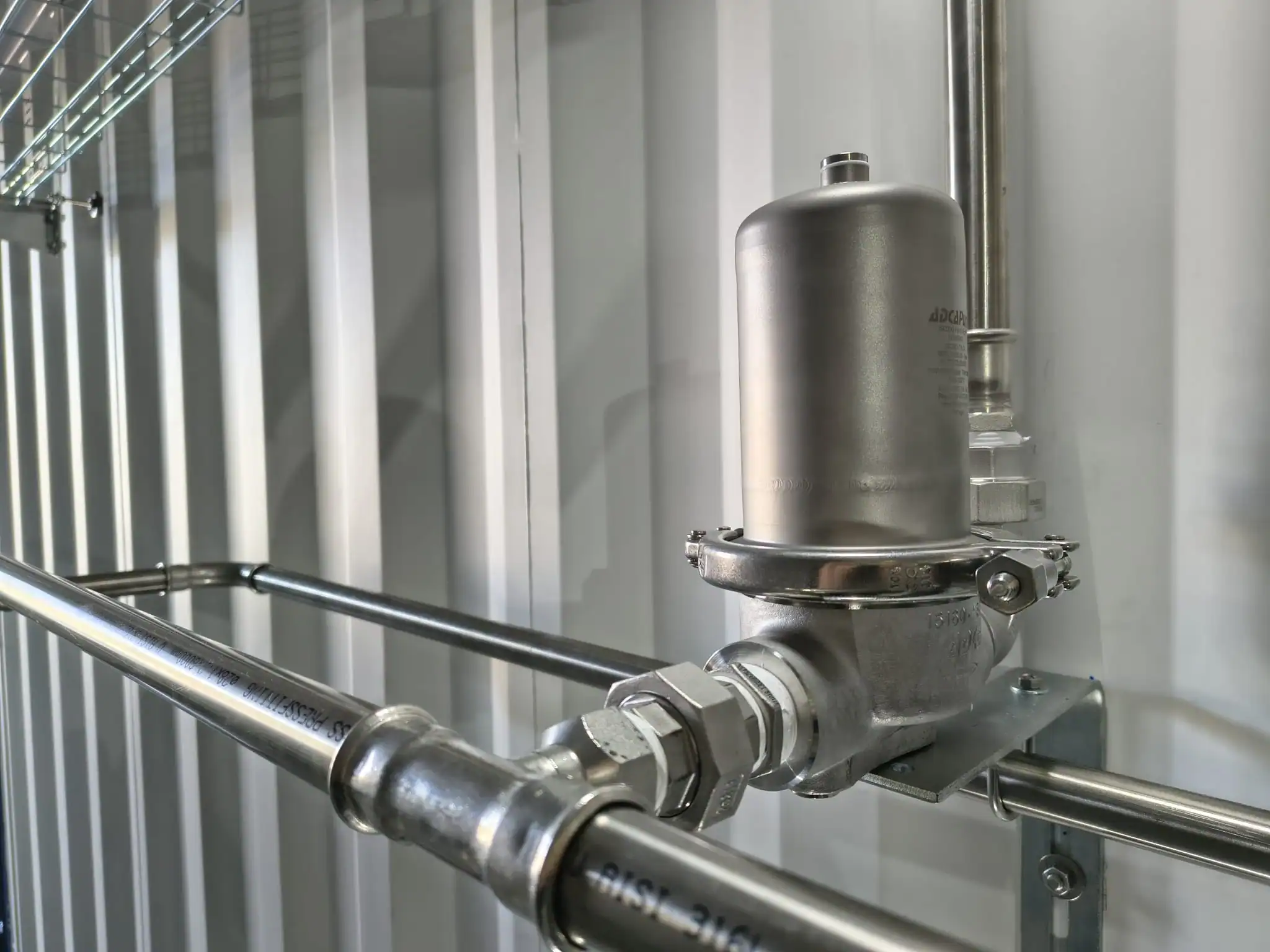
The entire installation was conceived as a compact, self-contained system. The two generators were mounted on a stainless steel SKID platform along with the rest of the components: two 160-liter condensate recovery tanks made entirely of AISI A-304 stainless steel, two 90-liter automatic blowdown systems that discharge at fixed intervals to prevent the accumulation of residues and ensure the internal cleanliness of the boilers, and a 5-micron particulate filter that ensures that the steam supplied meets the culinary quality standards required by the client.
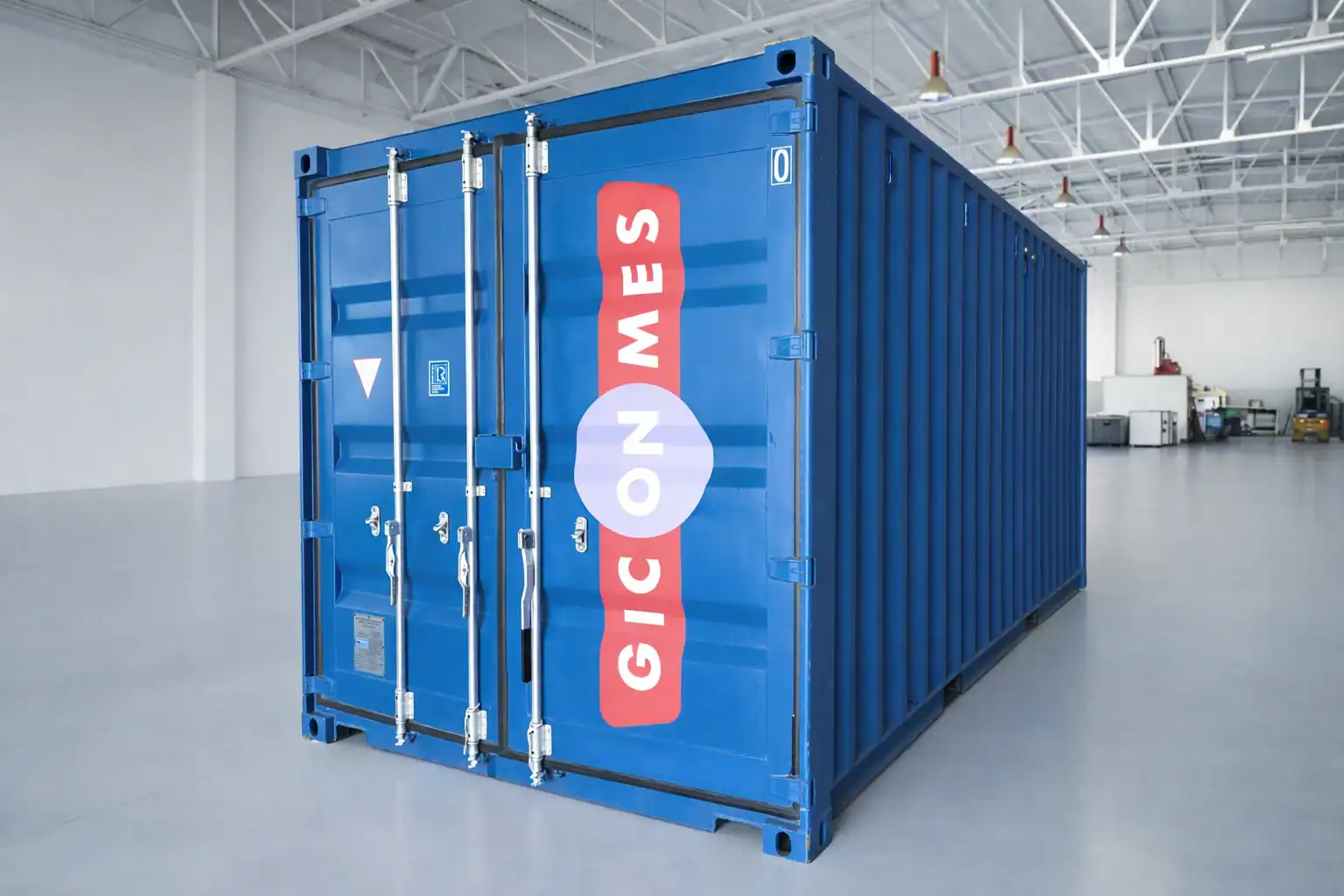
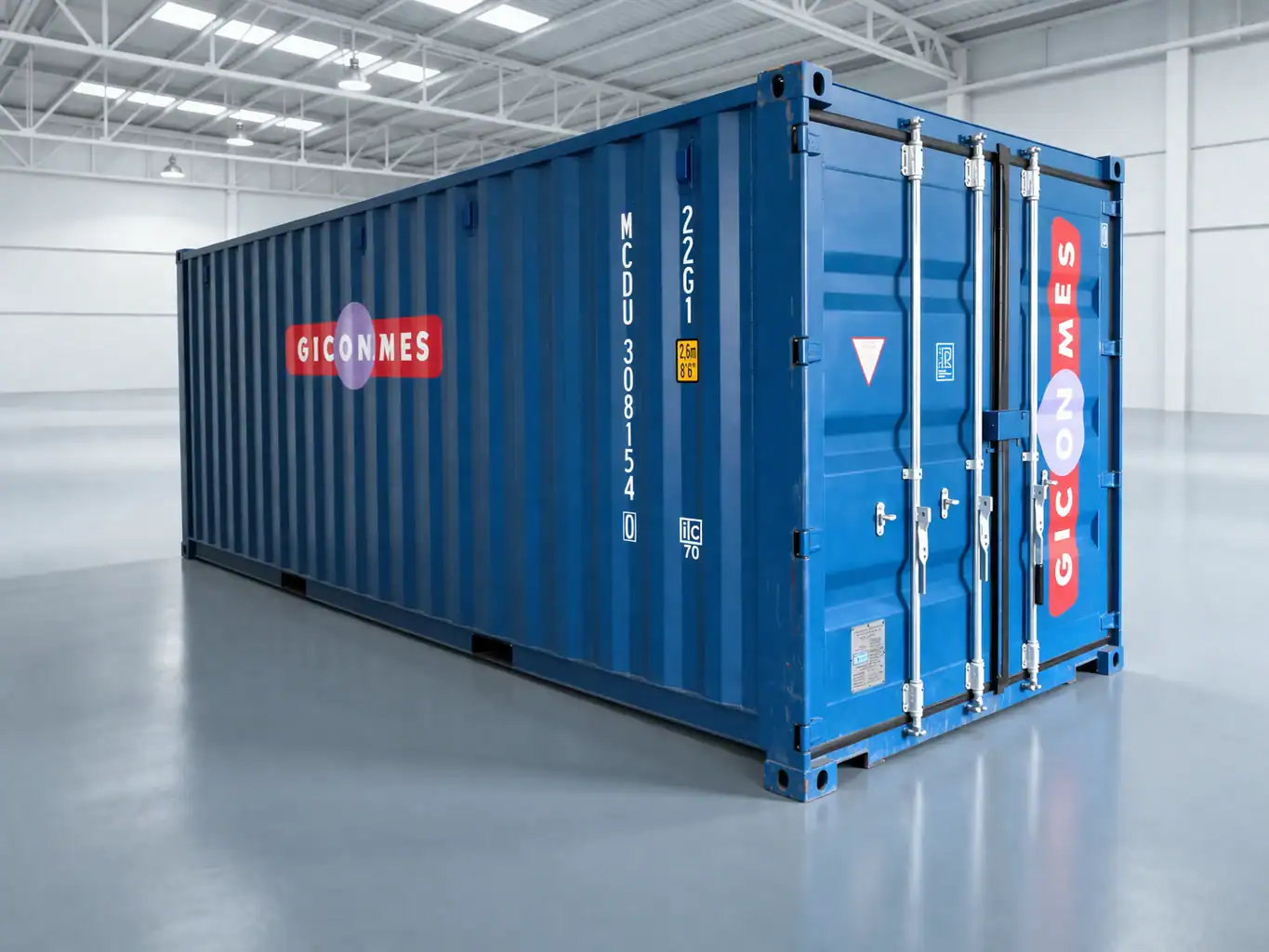
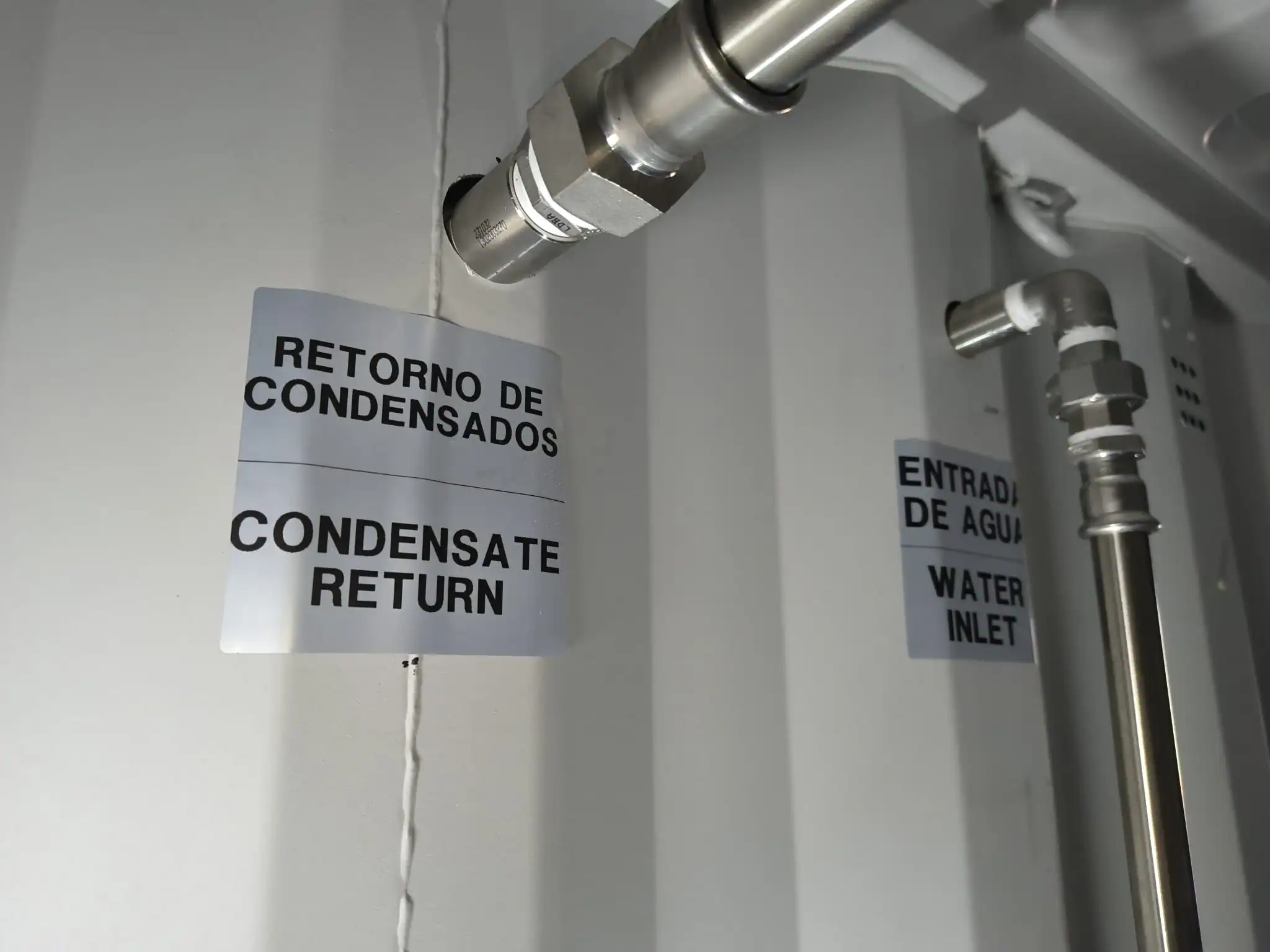
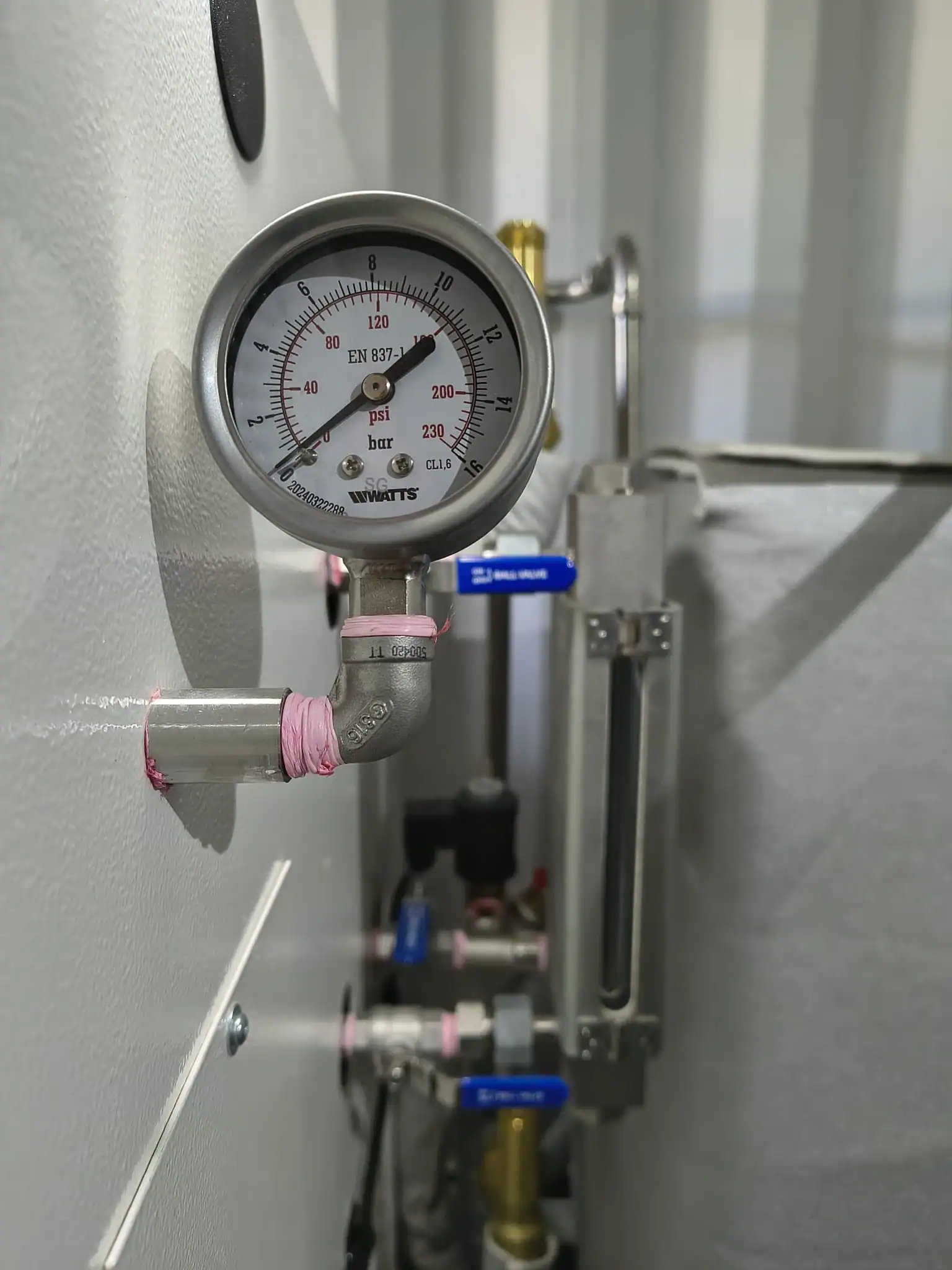
The key to the project was the delivery format: the entire set was pre-assembled and assembled in a 20-foot sea container within Giconmes’ facilities in Zaragoza, including the stainless steel distribution piping, the electrical control panel with independent control for each reactor and all labeled connections.
The container, with the system fully tested, was moved to the customer’s factory and placed outside the building, thus solving the interior space limitation.
Start-up required only three connections: the power supply, the water inlet and the connection of the steam outlets to the four reactors.
A true plug and play system that minimized plant installation times and allowed the customer to start production without interruptions or complex civil works.
Technology used:
- NGV-60120 electric steam generators (2 x 120 kW, 165 kg/h per unit) working in parallel
- Stainless steel SKID platform with compact, self-contained system
- Condensate recovery tanks of 160 L in stainless steel AISI 304
- 90 L automatic flushing systems for continuous internal cleaning
- 5-micron particulate filter to ensure food-quality steam
- 20-foot sea container with complete pre-assembled installation
- Electric control panel with independent control for each reactor
- Plug & play system with quick connections (electricity, water and steam)
CHALLENGES
We meet customer requirements
Solution for a natural ingredients manufacturer that needed to generate clean, food-grade steam. We achieved the following results:

Ultra-fast in-plant installation – With everything arriving pre-assembled and tested from the factory, start-up was reduced to three connections (electricity, water and steam to reactors), saving days or weeks of construction time compared to a conventional installation.

Zero impact on interior factory space – The container was located outside, freeing up valuable square footage inside the plant for production, storage or future expansion.

Guaranteed culinary quality steam – The combination of AISI A-304 stainless steel boilers, automatic purge and 5 micron filtration ensures clean steam suitable for contact with food ingredients, meeting industry standards.

Protected and relocatable equipment – The container acts as a self-contained boiler room that protects the generators from outside environmental conditions, and also offers the possibility of relocating to another location if the customer’s needs change in the future.
Do you need a customized solution?
We help you define what type of installation you need
There are no emissions beyond those produced during the electricity production process. Consequently, emissions can be neutral depending on the electricity mix. Electric steam boilers are the present and the future.
Absolutely. In fact, it is recommended to achieve maximum efficiency. There is no problem with remote control as long as it complies with current regulations.
A steam generator is a pressure vessel that, together with the piping network, is subject to regulatory control and complementary technical instructions, according to the regulations published in Royal Decree 809/2021, of September 21. Maintenance is divided into a part that can be easily fulfilled by the owner:
- Know and apply the manufacturer’s instructions regarding use, safety measures, and maintenance.
- Not to put the installation into service or prevent the operation of pressure equipment if the requirements of the Regulation are not met.
- Having at least the following documentation for the pressure equipment while they are installed: Declaration of conformity, manufacturer’s instructions (if applicable), and, if necessary, installation certificate, along with other supporting documentation (such as installation project, record of the last periodic inspection, certifications of equipment repairs or modifications, and any other documentation required by the relevant technical instruction complementary to this regulation). For detailed contents, refer to Annex IV of the regulation. Making this documentation available to the competent authority of the autonomous community and the companies responsible for maintenance, repair, or periodic inspections.
- Use the pressure equipment within its intended operating limits as specified by the manufacturer and take it out of service if it no longer meets the necessary safety requirements.
- Perform maintenance on the installations, pressure equipment, safety accessories, and control devices in accordance with the operating conditions and manufacturer’s instructions, and examine them at least once a year.
- Arranging for the necessary periodic inspections as required by Article 6 of the regulation.
- Having and maintaining an up-to-date record of pressure equipment categories I to IV, as defined in RD 709/2015, of July 24, or equipment similar to these categories according to Article 3.2 of the regulation, as well as their installations.
It is known that by applying heat to water, it transforms into steam at the boiling point and atmospheric pressure. From there, depending on the required saturation degree of steam for its proper application, we need to increase the pressure to obtain a higher temperature. To change the temperature and saturation degree of steam, we always need to modify the pressure.
It is a unit of pressure equivalent to 1 kg/cm2, 0.98 atmospheres, or 14.50 PSI.
Haven't found the answers to your questions?
Please send us a question or download all the information
USES OF STEAM IN INDUSTRY AND OTHER BUSINESSES
Other similar success stories using steam

The use of steam is gaining popularity in several industries due to its efficiency and environmental benefits..
In our "Success Stories" section, you can discover more about companies that have adopted this technology and have achieved successful results in terms of efficiency and sustainability. Click on the success stories to learn more details.
Situación original ¿Qué retos nos planteó el cliente? El cliente es una empresa farmacéutica española con una planta de producción y extracción vegetal ubicada en el sureste peninsular. Desde esta planta desarrolla, investiga y fabrica productos farmacológicos y extractos de plantas medicinales con aplicación en los sectores farmacéutico, cosmético, alimentario y nutracéutico. La planta cuenta […]


Situación original ¿Qué retos nos planteó el cliente? En esta panificadora industrial con producción continua se daba la situación de que la limpieza de sus transportadores modulares se había convertido en un problema recurrente. Las bandas, tipo modular plástico utilizadas en distintas fases del proceso, acumulaban restos de masa, harina y grasas que exigían limpiezas […]