


Success stories
How to Clean a Modular Belt Without Removing It: 90% Less Water and a Payback Period of 8 Months
Project Description
A cookie manufacturer needed to clean and disinfect an Intralox modular conveyor belt on-site—which had residue stuck in its joints and hinges—without disassembling it, without using chemicals, and without damaging the modular material.

Original Situation
What challenges did the client present us with?
Our client manufactures cookies and uses an Intralox modular belt on its production line. During the process, a mixture of fat, protein, sucrose, flour, egg, sugar, and oil sticks to the belt. This mixture adheres to the surface and gets trapped in the joints and hinges of the modules.
As the conveyor belt runs, the waste becomes compacted and increasingly difficult to remove, posing a hygiene risk. Manual cleaning required disassembling the conveyor belt, which was not feasible due to its great length: it would have entailed long downtimes, significant labor, and the risk of damaging the belt during disassembly and reassembly.
The customer needed to clean and disinfect the belt in place, without dismantling it, without using chemicals, and without damaging the modular material.
Solution Provided
Steam solution developed ad hoc by Giconmes
Proposed Solution
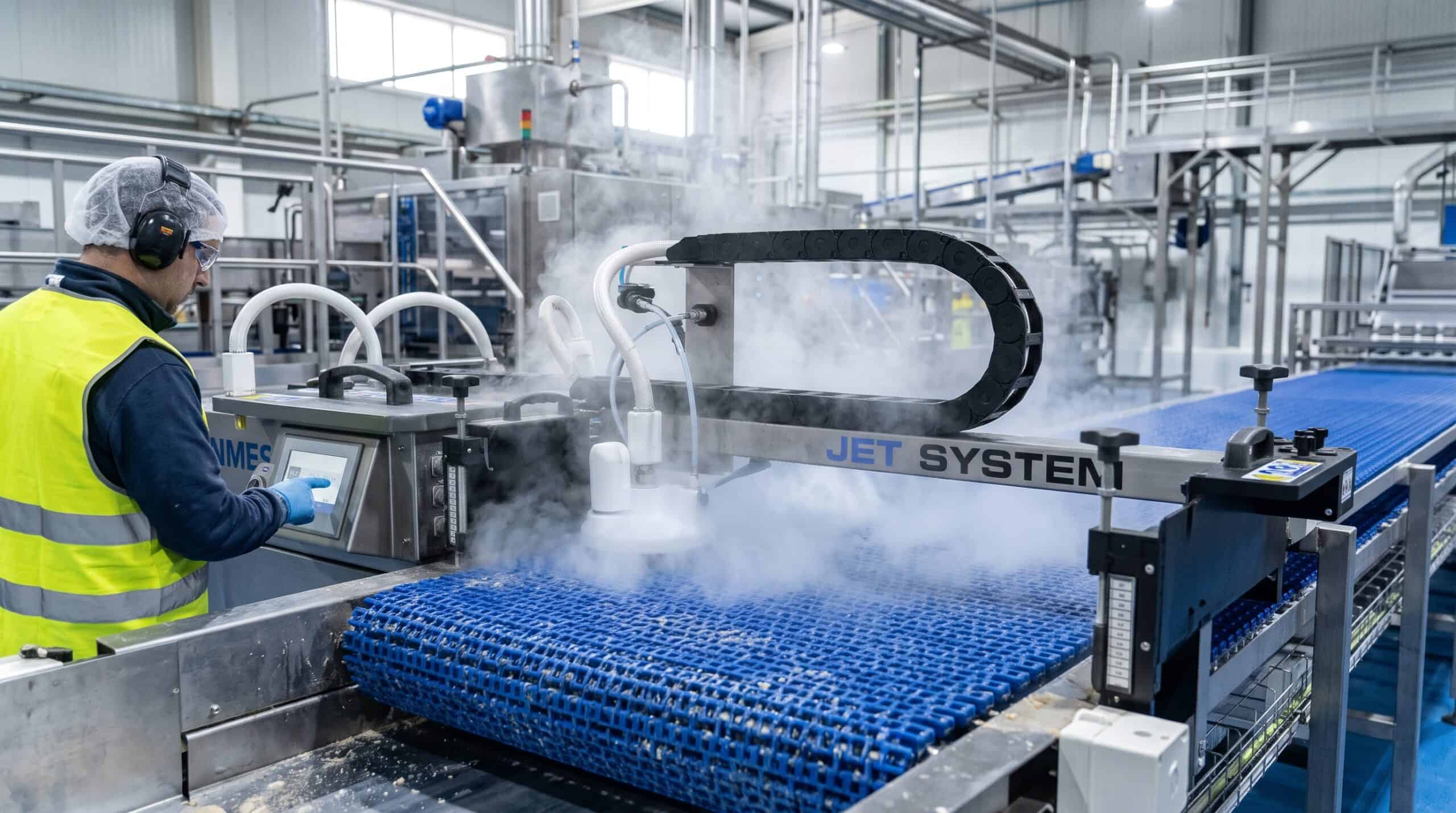
Giconmes installed its Jet System, an automatic saturated steam cleaning system designed for conveyors.
The equipment is plug-and-play: it connects to the line without any construction work or changes to the conveyor and adapts to different belt widths. During startup, an initial calibration is performed and saved in memory, so subsequent cleaning cycles begin without the need for reconfiguration.
The system offers two operating modes:
- Continuous sweeping of the entire conveyor belt for thorough sanitization.
- Sector-by-sector cleaning, focusing on areas where the most debris accumulates, to optimize time and resource use.
The steam combines three actions: thermal, which melts and softens the adhered residue; mechanical, through the impact of the steam jet, which loosens and carries away the residue; and penetration through condensation, which allows the steam to reach the joints and hinges of the modular belt. All of this sanitizes the surface using nothing but water.
Technology used
- Jet System, an automatic saturated steam cleaning system for conveyors
- Continuous cleaning of the entire belt
- Sectional cleaning
- Saturated steam with triple action: thermal, mechanical, and penetration via condensation
CHALLENGES
We meet our clients’ requirements
No need to remove the belt. Cleaning is done with the belt in place, even if it’s very long. This eliminates long downtime caused by removal and the risk of damaging the belt during installation and removal.

70% fewer cleaning staff. The Jet System operates automatically, either in continuous sweeping mode or by section, freeing up operators to perform higher-value tasks.

90% less water. Saturated steam cleans using a fraction of the water required by conventional methods, and without generating polluting effluents.

Sanitation without biocides or chemicals and without damaging the material. Heat and steam action remove grease, sugar, and flour without abrasives or detergent residue from surfaces that come into contact with food.

Payback period of 8 months. With savings on labor, water, and downtime, the investment pays for itself in less than a year.
Do you need a customized solution?
We help you define what type of installation you need
There are no emissions beyond those produced during the electricity production process. Consequently, emissions can be neutral depending on the electricity mix. Electric steam boilers are the present and the future.
Absolutely. In fact, it is recommended to achieve maximum efficiency. There is no problem with remote control as long as it complies with current regulations.
A steam generator is a pressure vessel that, together with the piping network, is subject to regulatory control and complementary technical instructions, according to the regulations published in Royal Decree 809/2021, of September 21. Maintenance is divided into a part that can be easily fulfilled by the owner:
- Understand and follow the manufacturer’s instructions regarding use, safety measures, and maintenance.
- Do not put the installation into service or allow pressure equipment to operate if the requirements of the Regulation are not met.
- Having at least the following documentation for the pressure equipment while they are installed: Declaration of conformity, manufacturer’s instructions (if applicable), and, if necessary, installation certificate, along with other supporting documentation (such as installation project, record of the last periodic inspection, certifications of equipment repairs or modifications, and any other documentation required by the relevant technical instruction complementary to this regulation). For detailed contents, refer to Annex IV of the regulation. Making this documentation available to the competent authority of the autonomous community and the companies responsible for maintenance, repair, or periodic inspections.
- Use pressure equipment within the operating limits specified by the manufacturer and take it out of service if it no longer meets the necessary safety requirements.
- Maintain facilities, pressure equipment, safety accessories, and control devices in accordance with operating conditions and the manufacturer’s instructions, and inspect them at least once a year.
- Arrange for the corresponding periodic inspections to be carried out in accordance with the provisions of Article 6 of the regulation.
- Having and maintaining an up-to-date record of pressure equipment categories I to IV, as defined in RD 709/2015, of July 24, or equipment similar to these categories according to Article 3.2 of the regulation, as well as their installations.
It is known that by applying heat to water, it transforms into steam at the boiling point and atmospheric pressure. From there, depending on the required saturation degree of steam for its proper application, we need to increase the pressure to obtain a higher temperature. To change the temperature and saturation degree of steam, we always need to modify the pressure.
It is a unit of pressure equivalent to 1 kg/cm2, 0.98 atmospheres, or 14.50 PSI.
Haven't found the answers to your questions?
Send us a question or download all the information
USES OF STEAM IN INDUSTRY AND OTHER BUSINESSES
Other similar success stories involving the use of steam

The use of steam is gaining popularity in various industries due to its effectiveness and environmental benefits.
In our “Success Stories” section, you can learn more about companies that have adopted this technology and achieved successful results in terms of efficiency and sustainability. Click on the success stories to learn more.
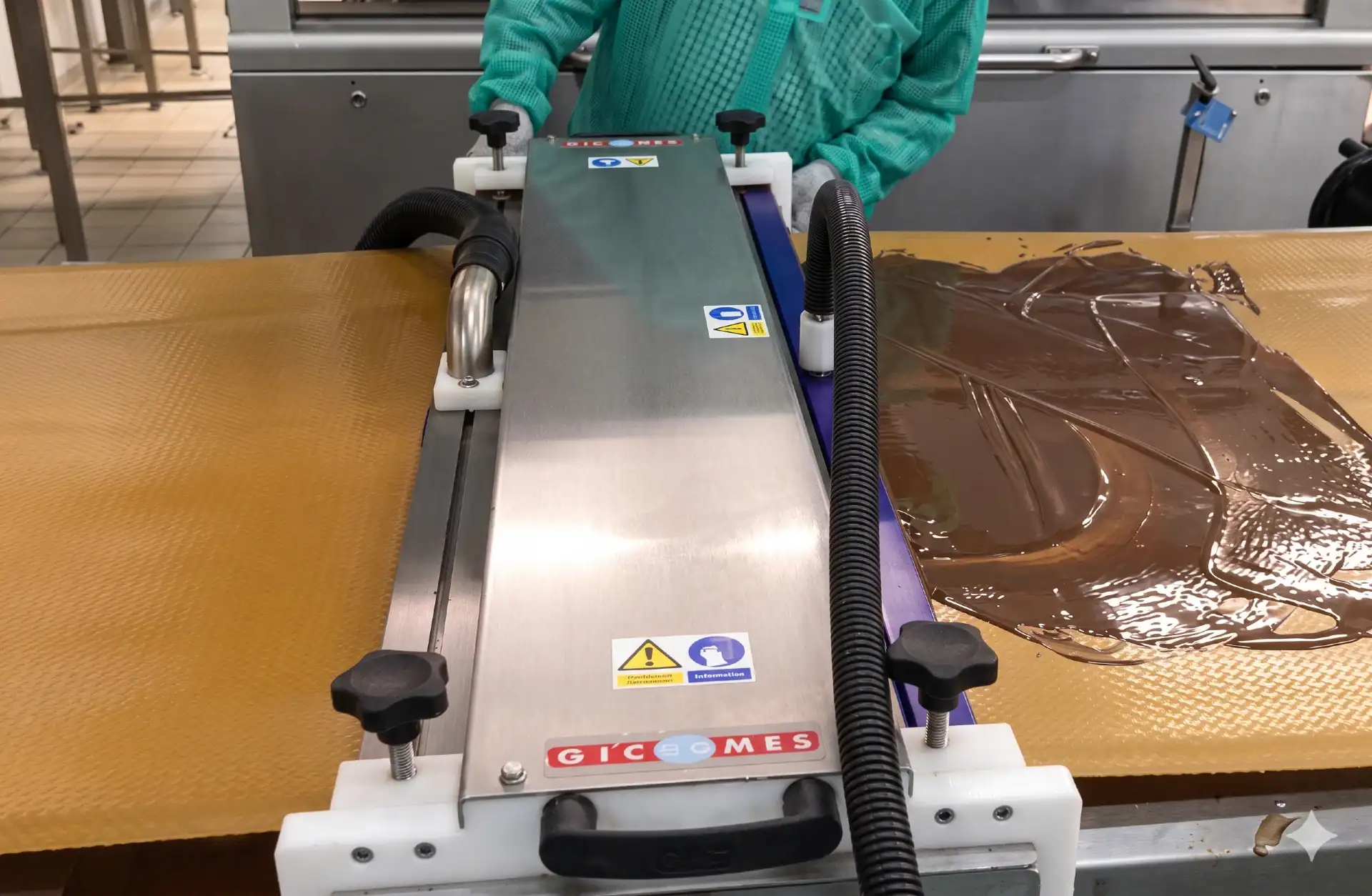
Situación original ¿Qué retos nos planteó el cliente? Un fabricante de chocolate y derivados del cacao contaba en su planta con un transportador de lona de gran longitud (cerca de 50 metros) cuya limpieza era una de las operaciones más exigentes del proceso. Los residuos de chocolate, cacao y grasas se adhieren con fuerza a […]


Situación original ¿Qué retos nos planteó el cliente? Una reconocida empresa del sector alimentario contaba con un transportador de lona de 30 metros de longitud, pieza clave dentro de su línea de producción. La limpieza de este elemento era crítica para garantizar la seguridad alimentaria, ya que cualquier resto de producto acumulado podía convertirse en […]