



Success stories
Eliminate a bottleneck in bottle recertification: 780 hours freed up per year and payback in less than three months
Project description
How one of Spain’s leading industrial gas operators reduced cylinder drying times after hydrostatic testing using industrial steam, optimizing nitrogen consumption and plant operating capacity together with Giconmes.

Original situation:
Challenges posed by the client:
The customer, a leading operator of industrial and medical gases in Spain, manages a fleet of more than one million carbon steel cylinders distributed among five plants, each of which handles the logistics, filling and maintenance of hundreds of thousands of units.
As required by European pressure equipment regulations, all these cylinders must undergo a periodic hydrostatic test every ten to fifteen years: they are filled with water, pressurized to 300 bar to verify their structural integrity and, once the test is passed, they must be perfectly dry and free of any particles before being returned to service. Any trace of residual moisture contaminates the gas and, worse, initiates internal corrosion processes that compromise the life of the vessel.
The company’s previous drying process consisted of injecting nitrogen at 170°C for thirty minutes in batches of six bottles. It was a reliable method, but cumbersome: it consumed a significant amount of nitrogen, required continuous attention from operators and, above all, conditioned the operating capacity of each plant.
With more than fifteen thousand bottles passing through review each year in a typical plant, drying became one of the structural bottlenecks in the recertification process.
The customer had begun to explore the possibility of speeding up drying by introducing a pre-steaming stage: an initial minute of steam followed by a brief injection of nitrogen, reducing the entire cycle to a fraction of the original time.
On paper, the savings were considerable. But before committing an investment and modifying a critical process replicated in five plants, the production manager wanted to see the system working in his own facilities, with his own bottles and his own quality criteria.
That’s where Giconmes comes in. The proposal was straightforward: organize a test morningat the Zaragoza plant, set up an NGV industrial steam generator in real production conditions, and let the data speak for itself.
Proposed solution:
Customized steam solution developed by Giconmes.
Proposed solution:
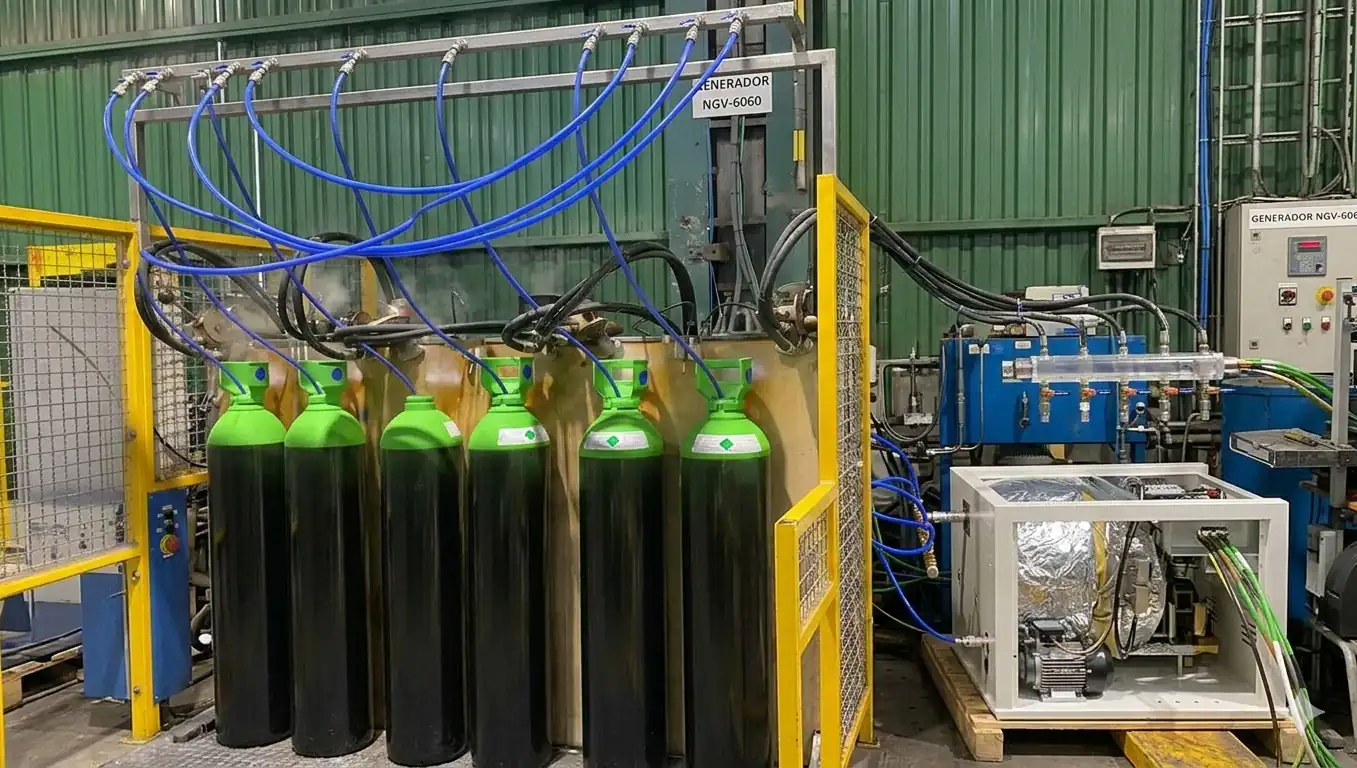
Giconmes proposed a NGV-6060 unit in full stainless steel version: a 60 kW industrial steam generator with all components in contact with water made of AISI 304 stainless steel.
The choice of stainless steel was not a free choice. In a process where the objective is precisely to guarantee the cleanliness of the inside of the bottle, it would not make sense to introduce equipment that could drag rust particles or metal residues into the circuit. The steam that enters the cylinder leaves the generator with the same purity with which the feed water entered.
The equipment was mounted on a wheeled base so that it could be moved around the plant according to operational needs, and was configured with two independent manifolds of six outlets each.
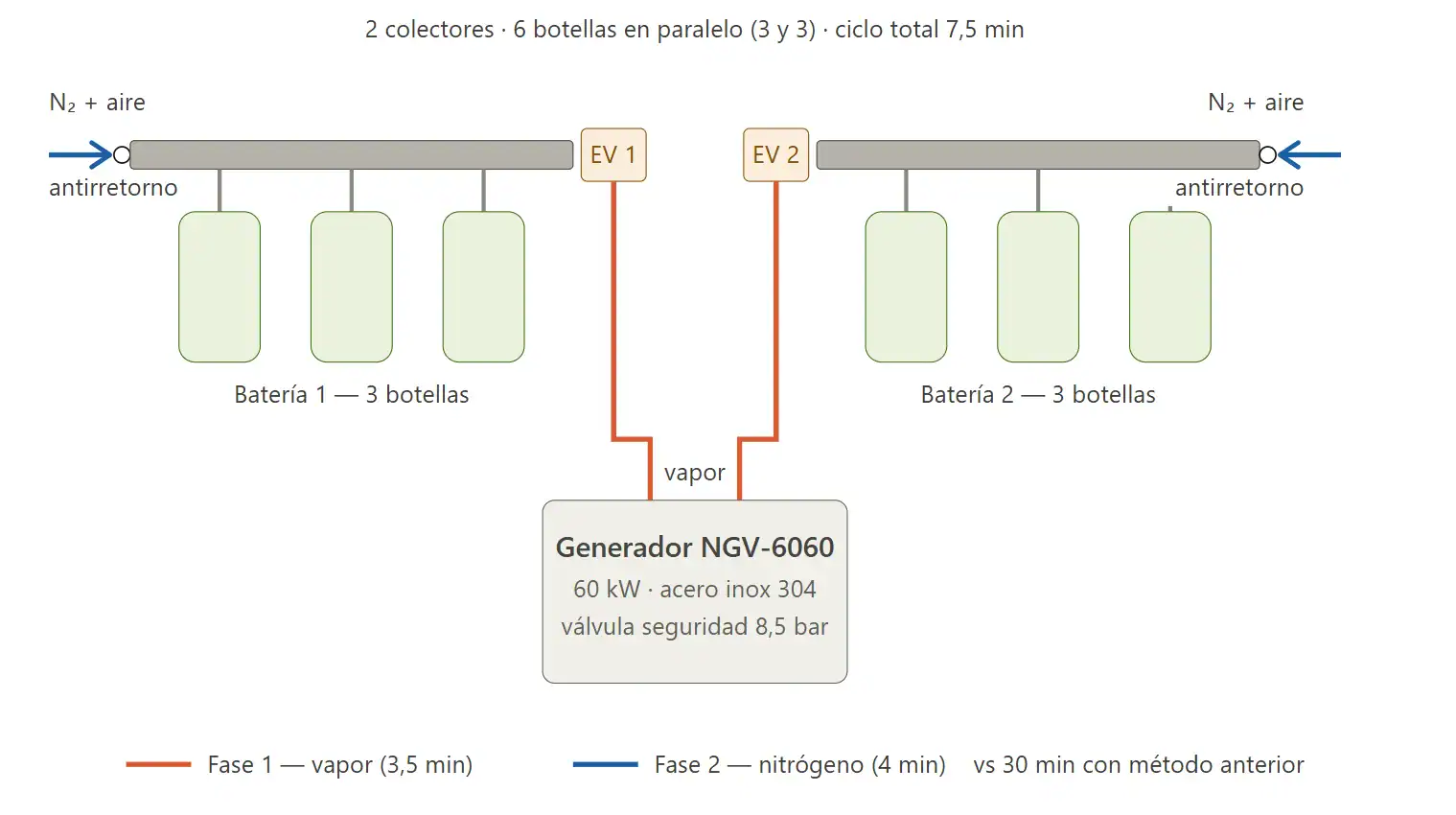
This architecture makes it possible to feed two drying stations in parallel – twelve bottles working simultaneously, six in each station – which takes full advantage of the thermal capacity of the generator. Each collector incorporates air and steam backflow preventers and a pneumatically operated solenoid valve that the customer controls from his own installation, integrating frictionlessly with the rest of the process.
The test at the Zaragoza plant was run in a single morning. With the previous method, drying a batch of six bottles required thirty minutes of nitrogen injection at 170 °C. With the new procedure, the times were as follows: 3.5 minutes of steam followed by 4 minutes of nitrogen, total 7.5 minutes for six bottles.
A 75% reduction in cycle time, while fully meeting the quality and interior cleanliness criteria required by the customer.
Technology used:
- Industrial steam generator NGV-6060 Full Inox 60 kW (AISI 304)
- Mobile configuration on a wheeled base for floor displacement
- Two independent manifolds with six outlets each
- Integrated backflow preventer system for air and steam
- Pneumatic solenoid valves integrated with the customer’s system
CHALLENGES
We meet customer requirements
The new steam drying system drastically reduced the recertification times of industrial gas cylinders, maintaining the internal cleanliness standards required by the customer and optimizing the plant’s operating capacity. We achieved the following results:

The time savings are the most visible. With a much larger fleet but a mandatory overhaul cycle every ten to fifteen years, each plant pressure tests and dries about fifteen thousand bottles per year. With the previous method, this consumed approximately 1,040 hours of operation per year, equivalent to 130 working days. With the new solution, that time is reduced to 260 hours. Each plant frees up more than 780 operating hours per year, which can be used for other tasks in the recertification process or simply to absorb peaks in demand without the need for overtime.

Direct economic savings combine labor, nitrogen consumption and energy. With two operators attending to the drying process and a company cost of €30/hour, the hours freed up represent around €62,500 per year per plant. This is in addition to an approximate 70% reduction in nitrogen consumption (cycles are reduced from 30 to just 4 minutes of injection) and the energy savings associated with heating, which together add up to around €2,000 per year per plant. The total per plant is therefore around €65,000 per year. This means that the return on investment is less than three months.
Do you need a customized solution?
We help you define what type of installation you need
There are no emissions beyond those produced during the electricity production process. Consequently, emissions can be neutral depending on the electricity mix. Electric steam boilers are the present and the future.
Absolutely. In fact, it is recommended to achieve maximum efficiency. There is no problem with remote control as long as it complies with current regulations.
A steam generator is a pressure vessel that, together with the piping network, is subject to regulatory control and complementary technical instructions, according to the regulations published in Royal Decree 809/2021, of September 21. Maintenance is divided into a part that can be easily fulfilled by the owner:
- Know and apply the manufacturer’s instructions regarding use, safety measures, and maintenance.
- Not to put the installation into service or prevent the operation of pressure equipment if the requirements of the Regulation are not met.
- Having at least the following documentation for the pressure equipment while they are installed: Declaration of conformity, manufacturer’s instructions (if applicable), and, if necessary, installation certificate, along with other supporting documentation (such as installation project, record of the last periodic inspection, certifications of equipment repairs or modifications, and any other documentation required by the relevant technical instruction complementary to this regulation). For detailed contents, refer to Annex IV of the regulation. Making this documentation available to the competent authority of the autonomous community and the companies responsible for maintenance, repair, or periodic inspections.
- Use the pressure equipment within its intended operating limits as specified by the manufacturer and take it out of service if it no longer meets the necessary safety requirements.
- Perform maintenance on the installations, pressure equipment, safety accessories, and control devices in accordance with the operating conditions and manufacturer’s instructions, and examine them at least once a year.
- Arranging for the necessary periodic inspections as required by Article 6 of the regulation.
- Having and maintaining an up-to-date record of pressure equipment categories I to IV, as defined in RD 709/2015, of July 24, or equipment similar to these categories according to Article 3.2 of the regulation, as well as their installations.
It is known that by applying heat to water, it transforms into steam at the boiling point and atmospheric pressure. From there, depending on the required saturation degree of steam for its proper application, we need to increase the pressure to obtain a higher temperature. To change the temperature and saturation degree of steam, we always need to modify the pressure.
It is a unit of pressure equivalent to 1 kg/cm2, 0.98 atmospheres, or 14.50 PSI.
Haven't found the answers to your questions?
Please send us a question or download all the information
USES OF STEAM IN INDUSTRY AND OTHER BUSINESSES
Other similar success stories using steam

The use of steam is gaining popularity in several industries due to its efficiency and environmental benefits..
In our "Success Stories" section, you can discover more about companies that have adopted this technology and have achieved successful results in terms of efficiency and sustainability. Click on the success stories to learn more details.
Situación original ¿Qué retos nos planteó el cliente? Nuestro cliente, uno de los principales fabricantes de bollería industrial de Europa, ya venía utilizando con éxito varios generadores de vapor Giconmes RGV-0010 y RGV-0020, junto con sus correspondientes kits de accesorios, para las tareas de limpieza y sanitización de sus líneas de producción. Con el objetivo […]

Situación original ¿Qué retos nos planteó el cliente? Nuestro cliente necesitaba una solución eficaz para la limpieza de motores de vehículos, un entorno con numerosos recovecos, componentes eléctricos y piezas sensibles que no admiten el uso de agua ni de productos químicos convencionales. Los métodos de limpieza tradicionales resultaban insuficientes: el agua podía dañar elementos […]