



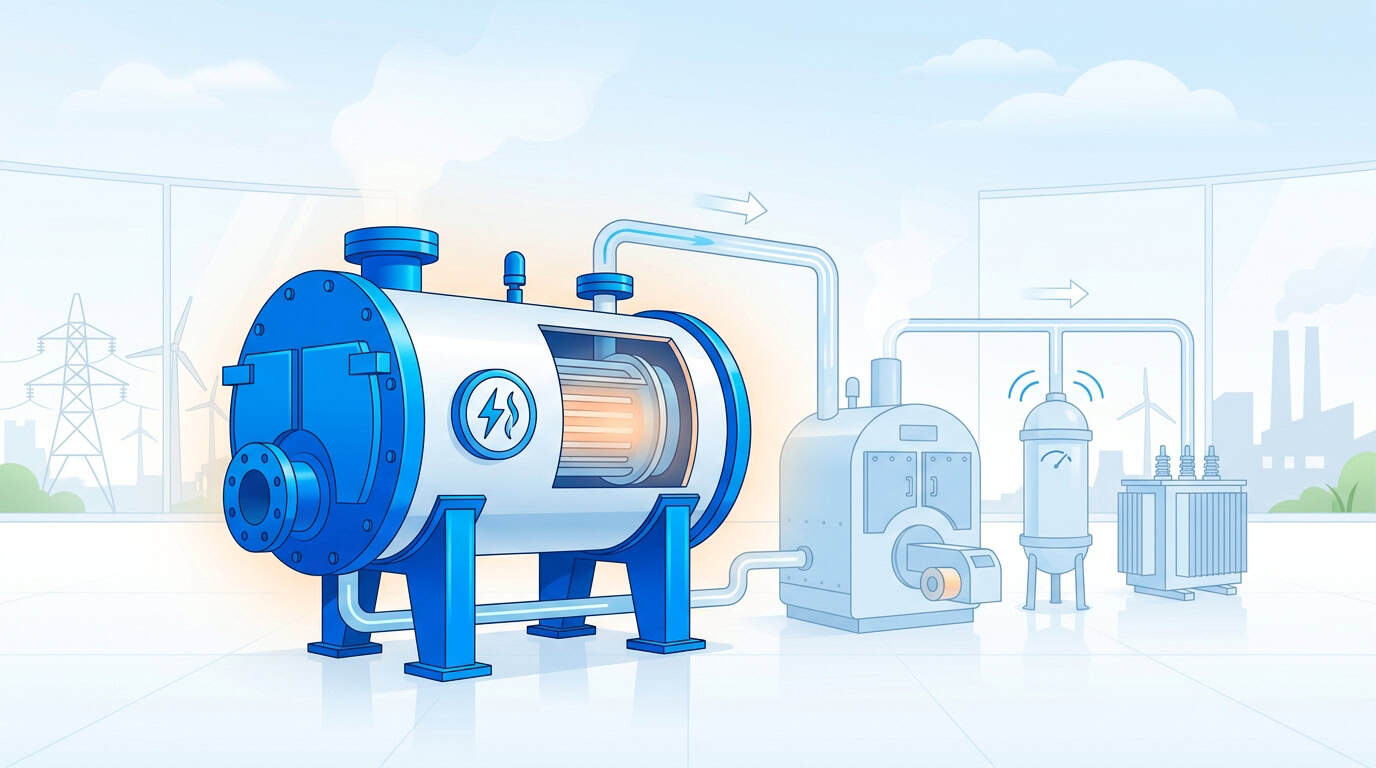
Summary (TL;DR): The section of 0.5 to 3 metric tons of steam per hour This is where boiler replacement in Spanish industry is currently concentrated: bakeries, dairy plants, meat processing plants, cosmetics manufacturers, pharmaceutical companies, and fine chemical manufacturers. In this sector, there are two main approaches: the low-pressure electric steam generator (380 V) —heating elements or electrodes— which produces steam without combustion and is typically connected to the transformer already installed at the plant, and the ultra-low-NOx gas boiler, which uses the same fuel but with emissions well below the limits that will take effect on 2030 for existing installations. Giconmes Ibérica, a manufacturer of electric steam generators since 1957 In Zaragoza, it covers both routes up to 3 t/h and prepares a comparative study of each plant.
Why the 0.5–3 t/h range is the one currently being upgraded
A 1-, 2-, or 3-metric-ton-per-hour steam boiler is typical in boiler rooms across the Spanish food and pharmaceutical industries: it was installed 15 or 20 years ago, runs on natural gas, and serves several processes at once (cooking, sterilization, cleaning, and tank heating). And it is precisely this type of boiler that now requires a decision on what to do with it, for three reasons:
- Emissions regulations. Directive (EU) 2015/2193 and Royal Decree 1042/2017 establish requirements for natural gas boilers that 1 to 50 MW thermal a NOx limit of 100 mg/Nm³ in new facilities and in 250 mg/Nm³ in existing ones, which must comply with it starting from 2025 if they exceed 5 MW and before the January 1, 2030 if they are between 1 and 5 MW. A boiler that 2 t/h are around 1.5 MW thermal: It falls within the scope of the regulation, and companies have three years to comply. Many cannot meet those standards without replacing the burner—and often the entire boiler.
- Cheaper electricity for more hours per year. Thanks to solar power, the number of hours with low or zero market prices has increased significantly in Spain. An electricity consumer with a capacity of 1–2 MW who can adjust their output can take advantage of these hours and also earn Energy Savings Certificates (CAE) for replacing gas.
- The electrical power is already available at the plant. A 2 t/h generator consumes about 1.5 MW. Many medium-sized industrial plants have that capacity available in their substation or can achieve it through a low-voltage expansion, without needing a medium-voltage connection. That is the major difference compared to 10 kV electrode boilers: at this voltage level, electrification does not require major electrical work.
The question is no longer “When will it be time to replace the boiler?” but rather “Should I replace it with an electric generator or an ultra-low-NOx gas boiler?”
Option A: Low-voltage (380 V) electric steam generator
Two technologies, one connection
- Resistance Heater (Giconmes NGV and HGV series): submersible sheathed heating elements, with either step-wise or modulating control. Up to 2.8 t/h, typical pressures up to 10 bar, and available in stainless steel and clean steam versions.
- Low-voltage electrode generator: three electrodes at 380 V submerged in water with controlled conductivity; the current heats the water directly and vaporizes it. No heating elements to replace, purely resistive load without a capacitor bank, continuously adjustable from 5% to 100%. From 0.25 to 2 t/h at 10 bar.
In both cases, the equipment is powered by 380 V three-phase power and is connected to the plant’s internal power grid.
Specifications for the electric model range up to 3 t/h
| Parameter | 380 V Electrode Generator | HGV resistance generator |
|---|---|---|
| Steam production | 0.25 – 2 metric tons per hour | up to 2.8 metric tons per hour |
| Steam pressure | 10 bar | up to 10 bar (other pressures available upon request) |
| Electrical power | 189 – 1,512 kW | depending on model, up to ≈ 2 MW |
| Power supply | 380 V / 50 Hz, three-phase | 380 V / 50 Hz, three-phase |
| Load control | 5–100% continuous | in stages or modulating |
| Thermal efficiency | ≈ 99% | ≈ 98–99% |
| Footprint of a 2 t/h unit | 3.3 × 2.7 m, 3.8 m high | similar, without a chimney |
| Feed water | Dechlorinated | Dechlorinated |
Advantages Over a Gas Boiler
- No combustion: zero NOx, zero CO, no chimney, no flue gas analysis, not subject to Royal Decree 1042/2017.
- Efficiency: 99% of the electricity is converted into steam; there are no losses due to exhaust gases or burner air purge.
- Space and civil engineering: a 2 t/h unit fits within approximately 9 m² of floor space. There is no burner room, no fuel tank, and no flue.
- Response and Modulation: Start-up in minutes and fine-tuned power regulation, allowing the system to match actual process demand and participate in electricity flexibility mechanisms.
- Minimal maintenance: no burner, no combustion inspection, no chimney cleaning.
- Expandable with storage: A steam accumulator or a stratified hot water tank allows for production during off-peak hours and consumption during peak hours.
When It’s Not the Best Option
- When the process operates 24/7 at full capacity and the average price of electricity at the plant clearly exceeds the thermal equivalent of natural gas, with no margin for shifting consumption.
- When the plant does not have—and cannot obtain—an additional 1–2 MW of low-voltage power within a reasonable timeframe.
- When steam pressure above 10–12 bar is required continuously.
Option B: Ultra-low NOx gas-fired steam boiler
What does “ultra-low NOx” mean?
The legal limit for a new natural gas boiler rated at more than 1 MW is 100 mg/Nm³ of NOx. An ultra-low NOx boiler is designed, from the combustion chamber to the burner with flue gas recirculation, to operate at around 30 mg/Nm³ or less (referenced to 3% O₂), providing a margin of safety against current regulations and against the stricter local and regional standards already under discussion.
Advantages
- No change in energy source: the plant retains its gas supply, boiler room, and a large part of the facility.
- Compliance with a margin to spare: it resolves the mandatory 2030 retrofit requirement for existing boilers ranging from 1 to 5 MW all at once.
- Lower investment than the electric path when capacity needs to be expanded.
- Compatible with biomethane and hydrogen blends, which leaves the door open for gradual decarbonization.
Limitations
- It’s still combustion: there’s CO₂, a chimney, periodic inspections, and burner maintenance.
- It does not qualify for revenue from electricity flexibility or CAEs for fuel substitution.
The hybrid configuration: the one being installed most often
In most of the 1- to 3-metric-ton-per-hour projects we’re analyzing, the answer isn’t “electric or gas,” but rather electric and gas in parallel:
- The electric generator covers the base load when electricity is cheap (daytime hours, weekends, flexibility services), with storage if the process allows it.
- The ultra-low NOx boiler covers periods when electricity is expensive and acts as a backup.
- A single control system determines which equipment to use for production each hour, based on energy prices and process constraints.
This approach reduces the investment required compared to 100% electrification, maintains security of supply, and captures most of the economic and emissions savings. It is also the approach that best aligns with industrial decarbonization incentives, which reward actual reductions in gas consumption without requiring its total elimination.
Decision-making criteria: the checklist we use at Giconmes
Before proposing a technology, we ask the plant for seven pieces of information:
- Steam demand profile (average, peak, and minimum t/h; hours/year).
- Required steam pressure and quality (industrial, clean, food-grade).
- Electrical power available at the substation and cost/timeline for low-voltage expansion.
- Gas and electricity prices at the plant, including an hourly price curve.
- Status of the current boiler in relation to Royal Decree 1042/2017 and compliance deadline.
- Available space and whether production must be maintained during the replacement.
- Committed decarbonization targets (Scope 1, CSRD reporting, customer requirements).
Using these seven data points, we conducted a comparative study of the 10-year total cost of ownership for the three alternatives: 100% electric, 100% ultra-low NOx, and hybrid.
The Giconmes line up to 3 t/h
Giconmes Ibérica has been in business for more than 65 years manufacturing electric steam generators in Zaragoza. The NGV line (from 3 kW more than 180 kW) and HGV (up to 2.8 metric tons per hour) of resistors is now complemented by electrode generators from 380 V from 0.25 to 2 metric tons per hour and with ultra-low-NOx gas boilers up to 3 t/h, manufactured under the Giconmes brand with a design certified for the European market. The same engineering team that has supplied generators for a combined-cycle power plant, for hydrogen electrolysers, and for cleaning bread-making lines is the one studying the replacement of a boiler 2 t/h.
What we offer for a project of this scope:
- Comparative study of electric, ultra-low NOx gas, and hybrid systems based on total cost of ownership.
- Integration engineering: low-voltage connection, water treatment, storage, control system.
- Management of grants and Energy Savings Certificates.
- Commissioning, training, and maintenance throughout the Iberian Peninsula.
Frequently Asked Questions
How much electrical power does a 2 t/h steam generator require?
About 1.5 MW at 380 V three-phase. In an electrode generator, the load is purely resistive and does not require reactive power compensation.
Can I connect a 1–2 t/h electric generator without a medium-voltage connection?
In most medium-sized industrial plants, yes: it can be connected to the existing transformer or to a low-voltage extension. Medium-voltage (10 kV) electrode boilers are only practical for capacities of several metric tons per hour or more.
How much space does a 2 t/h electric generator take up?
About 9 m² in floor area and less than 4 m in height, with no burner, chimney, or fuel tank.
What NOx limit must a new gas boiler meet in Spain?
100 mg/Nm³ for natural gas at or above 1 MW thermal, in accordance with Royal Decree 1042/2017 (EU Directive 2015/2193). Ultra-low NOx boilers operate at around 30 mg/Nm³.
When must existing gas boilers be retrofitted?
Those with a capacity of more than 5 MW starting in 2025; those with a capacity between 1 and 5 MW (approximately 1.5 to 7 t/h) by January 1, 2030.
Can an electric generator generate revenue?
Yes. Because of its ability to modulate quickly, it can participate in electricity flexibility services, and by replacing gas, it generates Energy Savings Certificates.In this post, we explain both mechanisms.
What is the difference between a resistance-type water heater and an electrode-type water heater?
The resistance-type heater heats the water using sheathed heating elements and is controlled in stages; the electrode-type heater passes current through the water itself, has no heating elements that need replacing, and is continuously adjustable from 5% to 100%. Both are powered by 380 V.
Do you need to replace a boiler with a capacity between 0.5 and 3 t/h?
Send us your steam consumption profile and the electrical power available at your substation, and we’ll provide you with a no-obligation comparative analysis. Contact us at giconmes.es or give us a call: in less than a week, you’ll know whether your plant is a good fit for an electric generator, an ultra-low NOx boiler, or a hybrid solution.
Main keywords: 2 t/h electric steam generator, 1 t/h electric steam boiler, 380 V electrode steam generator, ultra-low NOx gas boiler, low-NOx boiler (100 mg/Nm³), 2030 gas boiler replacement, RD 1042/2017 boilers, industrial steam electrification