



Many industrial processes don’t require steam. They need hot water that’s stable and available immediately. At Giconmes, we’ve been working with steam for decades, so we know how to tell when steam is the right solution—and when it isn’t.
We just designed a pressurized hot water tank heated by electric heating elements for an industrial client. Here’s a look at the design decisions behind it.
Why pressurize the water?
At atmospheric pressure, water boils at 100 °C. If we pressurize it, we can operate above that temperature without it evaporating. This has several advantages:
- More energy in less space. Every extra degree represents stored heat without increasing the size of the tank.
- No condensate or blowdowns. There are no losses due to re-evaporation, and no condensate return system to maintain.
- Very stable temperature. The water releases heat uniformly, making it ideal for heat exchangers, reactor jackets, or temperature-controlled washing.
How We Designed It
The tank has an outer diameter of 1,000 mm and a capacity of approximately 1,000 liters. These are the key design decisions:
Domed bottoms. A flat bottom does not withstand pressure well. Domed bottoms distribute the stress and allow for reasonable wall thicknesses.
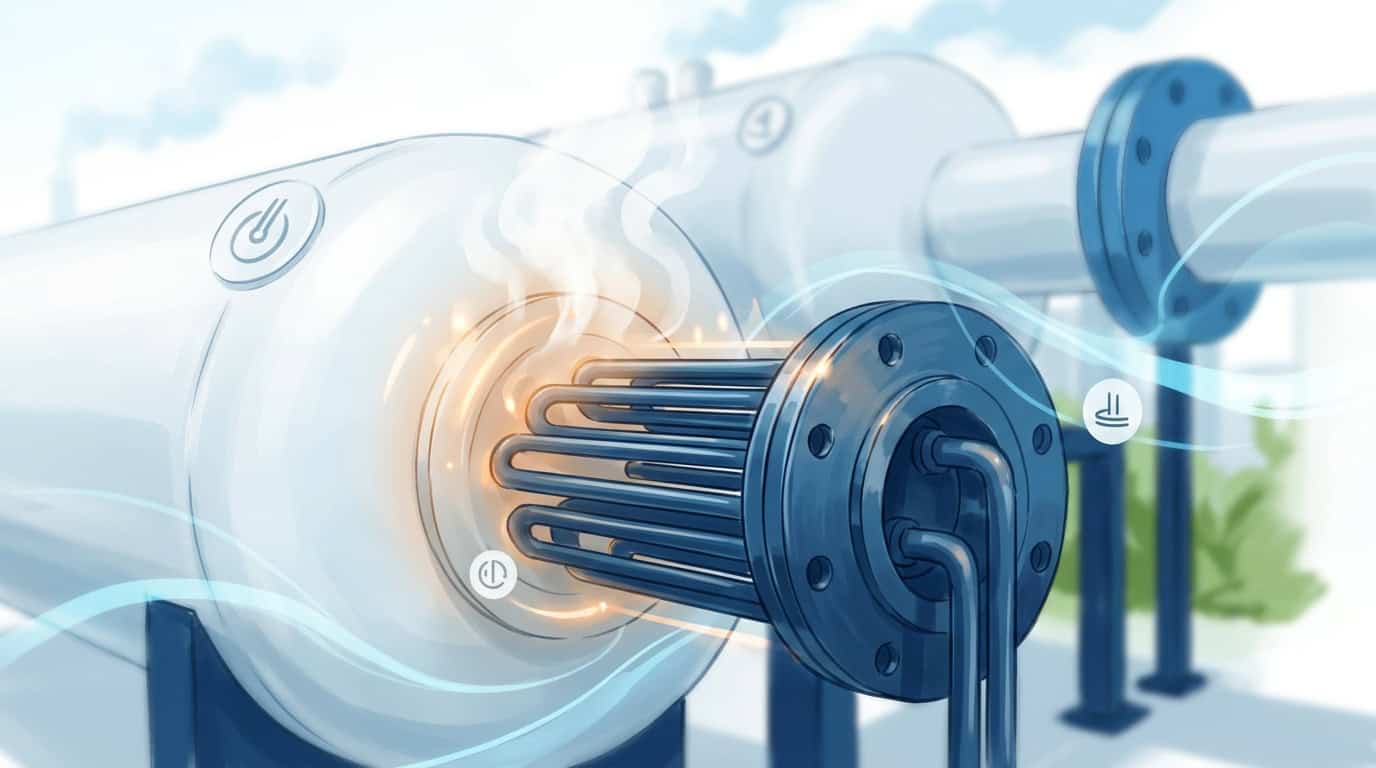
Heating elements on a removable flange. The heating element assembly is mounted on a large-diameter flanged cover. It can be removed entirely for inspection or replacement without disturbing the rest of the tank. In an electric unit, this is the most important maintenance point.
All connections are planned during the design phase: water inlet and outlet, temperature and pressure gauges, safety valve, drain, and vent. It’s better to plan for them from the start than to weld them on later.
Designed for transport and installation. Support legs, lifting lugs, and a retaining lug. A tank of this size must be moved and securely anchored, and that is also part of the design.
How to Determine the Required Power
The basic calculation is simple. The energy required depends on the mass of water, its specific heat, and the temperature difference:
P = m · cp · ΔT / t
An example: heating 1,000 liters from 15 °C to 85 °C in one hour.
1,000 kg × 4.186 kJ/kg·°C × 70 °C / 3,600 s ≈ 81 kW
Added to this are heat losses and a design margin. In practice, we would be looking at about 90 kW of installed power. If the process allows for a longer heating time, the power requirement decreases, and with it, the contracted power rating.
Safety: This is not a household water heater
A pressurized water tank stores a great deal of energy. Therefore:
- Depending on the pressure and volume, the equipment may fall under the Pressure Equipment Directive (PED, 2014/68/EU), with all that this entails in terms of design, manufacturing, and documentation.
- The safety valve is sized for the maximum power of the heating elements.
- The heating elements are equipped with a safety thermostat that is independent of the process control system.
- The insulation reduces heat loss and protects operators from hot surfaces.
Hot water or steam?
There’s no single answer. As a general rule:
| Need | Best option |
|---|---|
| Direct injection, sterilization, steam cleaning | Steam |
| Heat Transfer at a Constant Temperature | Pressurized hot water |
| Humidification or Air Conditioning | Steam |
| Storage for Peak Demand | Pressurized hot water |
Many plants need both. The important thing is not to use steam out of habit when hot water would do the job with fewer losses.
Electrifying Process Heat
Heating with electric resistance elements means zero on-site emissions—no smokestack, no fuel. If the electricity comes from renewable sources, the process is truly decarbonized. In addition, a storage tank allows for heating during off-peak hours when electricity is cheapest and using that heat when the process requires it. This opens the door to flexibility markets and Energy Savings Certificates (CAE).
Frequently Asked Questions
At what temperature can a pressurized water tank operate?
It depends on the design pressure. It can operate above 100 °C as long as the tank pressure exceeds the saturation pressure of water at that temperature.
Can the heating elements be replaced without disassembling the tank?
It must be drained, but not disassembled. With the removable flange, replacement is a simple maintenance task.
Is it more expensive than a gas boiler?
The initial investment is usually lower, and maintenance is simpler. Operating costs depend on the price of electricity and whether off-peak hours are utilized.
Secondary keywords: industrial superheated water, electric resistance heating, industrial hot water storage tank, electrification of process heat, hot water vs. steam, PED pressure vessel