



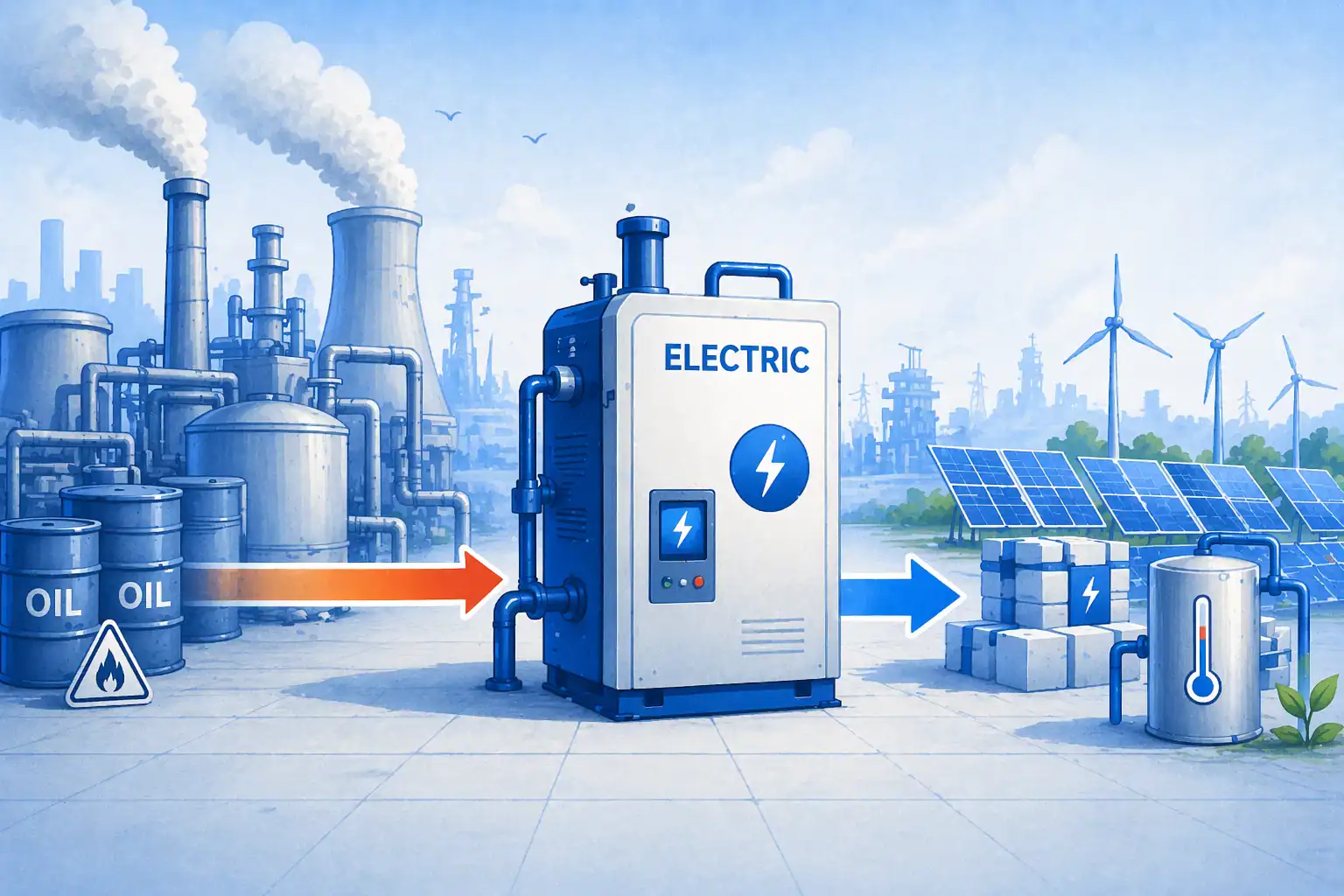
Whenever a debate on industrial decarbonization is opened, the script is repeated: industrial heat pumps, thermal energy storage (TES), green hydrogen.
Academic reports, press articles and industry conferences revolve almost exclusively around these technologies. And yet there is a solution that has been in operation for decades in food, pharmaceutical, textile and chemical plants around the world – with zero direct emissions, near 99% efficiency and an operational simplicity that none of the above can match.
We’re talking about electric resistive steam boilers. And it’s time they got the attention they deserve.
The problem: 2.2 billion tons of CO₂ per year.
Industrial steam production is one of the biggest contributors to climate change that hardly anyone mentions outside of specialized circles. According to an article published in the scientific journal Joule by researchers at MIT, converting water to steam by burning gas, oil or coal generates more than 2.2 gigatons of CO₂ annually – accounting for more than 5% of global emissions associated with energy use.
Steam is ubiquitous. It is used in food sterilization, chemical reactor heating, textile forming, composite curing, industrial cleaning and hundreds of other processes. As the researchers themselves point out, much of the industrial processes designed over the past 160 years have been built around the availability of steam. Eliminating it is not an option. Decarbonizing it is.
The blind spot: all the focus on heat pumps
One need only look up“industrial decarbonization” in any academic database to see the imbalance. Studies on industrial heat pumps and TES number in the hundreds. Those specifically addressing resistive electric boilers as a decarbonization solution are comparatively few.
Why? Probably because electric boilers are not “disruptive” in the sense that investors and incumbents like. There is no novel thermodynamic cycle to explain. There is no COP (coefficient of performance) greater than 1 to present on a slide. They are, quite simply, equipment that convert electricity into heat at close to 99% efficiency, with no combustion, no moving compression parts, no refrigerants and no need for waste heat.
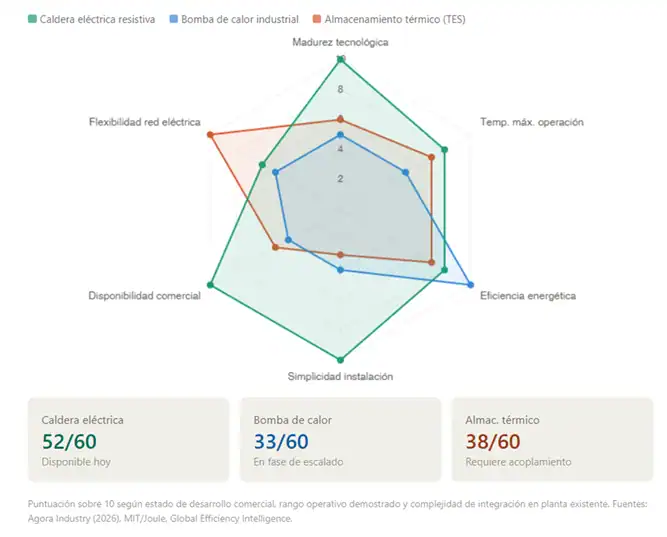
Industrial heat pumps are promising technologies, no doubt. But it is important to be rigorous about their current status:
- Most commercial high-temperature systems are limited to about 150 °C, with expectations of reaching 300 °C by 2035.
- They require specific operating conditions (low temperature heat sources, integration with existing processes) that are not always available.
- Many models are still in the commercial scale-up phase, with pilot installations and first production units.
Thermal storage (TES), meanwhile, is a valuable piece of the energy puzzle – especially for harnessing surplus renewable energy – but it is not itself a steam generator. It needs to be coupled with other generation technology.
Meanwhile, resistive electric boilers are already operating today in factories around the world at pressures of up to 10 bar or more, with steam temperatures above 180 °C, PED/CE certification in accordance with Directive 2014/68/EU, and proven reliability for decades.
Market reality: accelerated growth
While academia has been slow to pay attention to electric boilers, the market has not waited. The global electric boiler sector reached an estimated value of $10.55 billion in 2025, with a projected annual growth rate of 9.4% through 2035 – which would put the market above $25 billion by the close of that period.
Europe, in particular, is accelerating. An Agora Industry report published in February 2026 estimates that around 60% of current fuel consumption for process heat in European industry could already be electrified with mature technologies, rising to 90% with technologies expected by 2035. The food, paper, textile and part of the chemical sectors are the most immediate candidates – precisely the sectors where steam electric boilers have been operating for years.
The European Union is actively supporting this transition. The Electrification Action Plan, framed within the European Green Deal, sets clear targets for industrial decarbonization. Countries such as Finland are already earmarking hundreds of millions of euros from the Recovery and Resilience Facility (RRF) specifically for the installation of high-efficiency electric boilers. And in Spain, the industrial boiler market is being driven by the growing demand for efficient systems in the food sector, the integration of renewable fuels and the modernization of aging industrial infrastructures.
Leading companies such as Heineken, Arla Foods and Diageo have already installed large-scale electric boilers in their European plants, demonstrating that the technology is not only technically but also economically viable on an industrial scale.
The advantages that no one is counting
Resistive electric boilers have a number of competitive advantages that, although obvious, are often overlooked in comparative analyses:
- Conversion efficiency close to 99%. Virtually all electrical energy is converted into useful heat. No flue gas losses, no chimney, no significant radiation losses at the burner – because there is no burner.
- Zero direct emissions. As there is no combustion, no CO₂, NOx, SOx or particles are generated at the point of use. The total environmental impact depends only on the electricity mix that powers the equipment. In a country like Spain, with a growing penetration of renewables in the grid, this means automatic progressive decarbonization without the need to change the equipment.
- Operational and maintenance simplicity. No burner, no coolant circuit, no compressor: electric boilers have far fewer parts susceptible to failure. Maintenance is more predictable, inspections are simpler and the risk of unplanned shutdowns is drastically reduced.
- Installation as direct replacement (drop-in). An electric boiler can replace a gas boiler in the same space, connecting to the same existing steam distribution network. No plant redesign is required, no fuel storage or gas line is needed, and start-up is fast.
- Precise modulation and control. Electric power allows finer pressure and temperature control with shorter response times than combustion. This is especially valuable in processes that require precisely regulated steam, such as sterilization or controlled reactor heating.
- Safety. No flame, no storage of fossil fuels, no risk of explosion due to gas leakage. The risk profile of an electric boiler is significantly lower than that of a combustion boiler.
- Unlimited autonomy. Connected to the mains and to a water supply (with appropriate treatment), electric boilers can operate continuously without refueling interruptions.
What about the cost of electricity?
It is the inevitable question, and it deserves an honest answer. Yes, the cost of electric kWh is, in many regions, higher than that of natural gas thermal kWh. This operating cost differential is real and is the main barrier that studies point to for mass adoption of electric boilers.
However, there are several factors that are changing this equation:
- The price of CO₂ is rising. The European Emissions Trading System (EU ETS) is making the use of fossil fuels progressively more expensive. As the price per ton of CO₂ increases, the cost gap between gas and electricity narrows.
- Renewable electricity is getting cheaper. The cost of solar and wind power has fallen dramatically over the past decade and continues to fall. Companies that enter into renewable energy PPAs (Power Purchase Agreements) can lock in competitive electricity prices over the long term.
- The hidden costs of gas. Burner maintenance, emissions inspections, gas infrastructure, insurance associated with fossil fuels – all of these costs are often underestimated in simplistic €/kWh comparisons.
- Total cost of ownership (TCO). When the costs of installation, maintenance, regulatory compliance, operational risk and equipment lifetime are integrated, electric boilers are becoming increasingly competitive, especially at low and medium outputs.
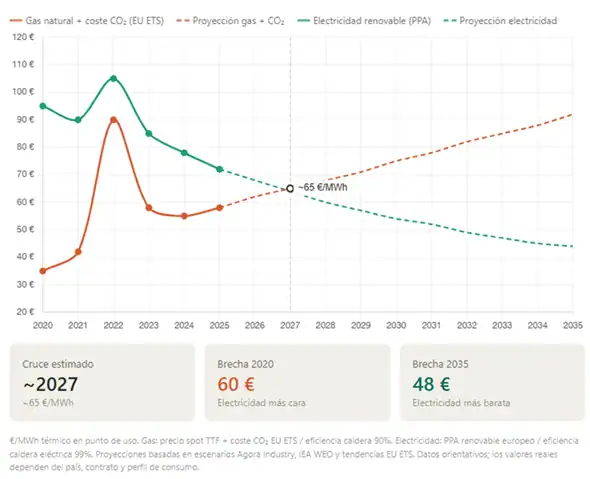
Agora Industry’s own report notes that industrial heat electrification is already cheaper than natural gas in certain applications in Europe, and that with the right political support – credible carbon pricing, electricity tax reform, investment support – competitiveness will spread rapidly.
About Giconmes Ibérica
Giconmes Ibérica, S.L. has been manufacturing industrial steam generators since 1957 in Zaragoza (Spain). Our equipment is designed and manufactured according to the European Pressure Equipment Directive 2014/68/EU (PED CE) and the UNE-EN 13445 standard. We work with customers in the food, biotechnology, pharmaceutical, textile and advanced industry sectors in Europe and internationally.