



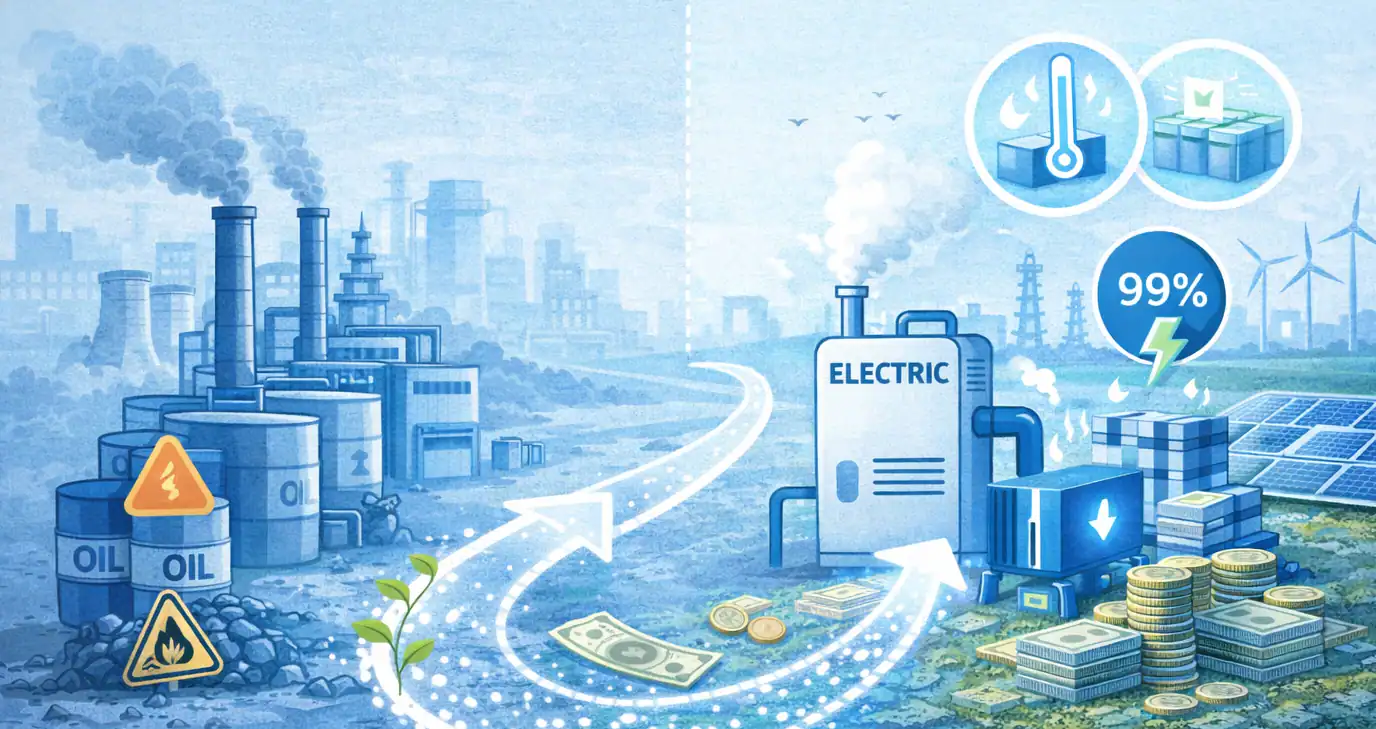
For decades, industrial heat has been the neglected sector of the energy transition. While electrification was advancing rapidly in areas such as mobility and power generation, thermal processes – pasteurization, drying, sterilization and steam generation –continued to rely almost exclusively on fossil fuels.
Today, that paradigm is changing.
Industrial heat accounts for about two-thirds of global industrial energy consumption and more than 20% of world energy consumption. Of this total, approximately 80% is still generated by fossil fuels.
In this context, electric steam boilers are positioned as one of the key technologies to transform this reality. But what is truly relevant is that they not only allow decarbonization, but can also generate direct economic value for the companies that adopt them.
Electrification of industrial heat is now a reality
For years it has been assumed that industrial heat was difficult to electrify. However, this idea is rapidly becoming less valid. Most industrial processes operate in temperature ranges below 400-600°C, especially in sectors such as food, pharmaceuticals, chemicals and manufacturing. In these ranges, electrification is not only feasible, it is already fully developed.
Available technologies – such as electric resistance boilers, electrode boilers or industrial heat pumps –are mature, commercially available and ready to be integrated into existing installations. Today it is possible to work with solutions that offer efficiencies of more than 99%, production capacities of up to 8 to 10 tons per hour of steam and high design pressures, with virtually instantaneous modulation capability.
This makes it possible to handle demanding processes without the need for fossil fuels. Even applications such as milk powder production, which require high temperatures, can be solved by electric steam or superheated air systems.
The conclusion is clear: the limitation is no longer technological, but strategic.
The new economics of heat: when electricity competes with gas
Traditionally, the main argument against electrification was economic. Electricity was more expensive than natural gas for generating heat. However, this relationship is changing structurally in Europe.
In several electricity markets, electricity in the day-ahead market is already cheaper than gas for a significant portion of the time, even considering grid costs. This phenomenon intensifies as the penetration of renewable energies increases, introducing greater volatility in electricity prices and generating periods of very low or even negative prices.
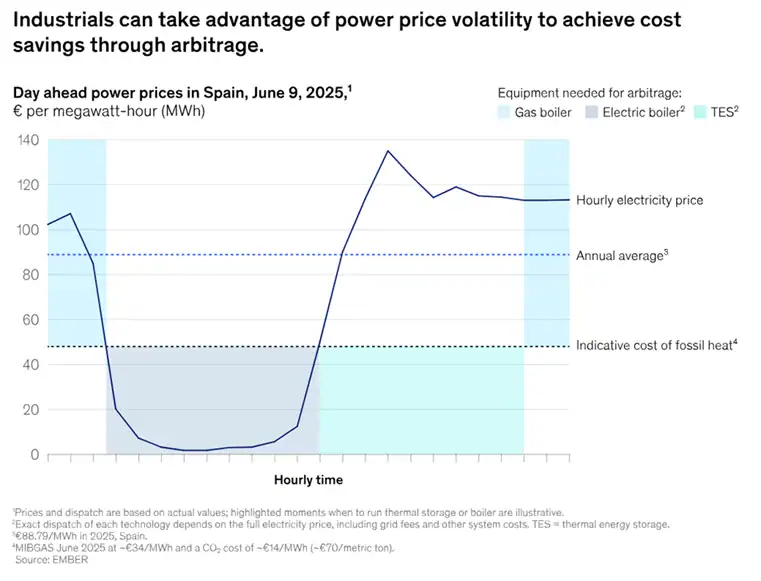
At the same time, the cost of gas is under increasing pressure from the European Emissions Trading Scheme (ETS), which increases the structural cost of fossil fuels.
Electrification introduces a fundamental change: it decouples the cost of heat from the price of gas and other fossil fuels. This opens the door to much more active energy management, where consumption can be dynamically adapted to market conditions.
From a piece of equipment to an asset: the electric boiler as a value driver
This is where the real paradigm shift occurs. The electric steam boiler ceases to be a simple piece of production equipment and becomes an energy asset capable of generating revenue.
This value is mainly articulated through two mechanisms: energy flexibility and Energy Saving Certificates (ESC).
Energy flexibility allows industry to adapt its electricity consumption according to the needs of the system. In an environment with high renewable penetration, where generation is intermittent, the ability to adjust demand becomes increasingly valuable. Europe will need a significant increase in this flexibility in the coming years, and industry has a key role to play.
In this context, an electric boiler can operate as a kind of “thermal battery“. When electricity prices are low, steam production is increased; when prices rise, consumption is reduced. When combined with thermal storage systems, it is possible to completely decouple steam production from the time of electricity consumption, optimizing costs very significantly.
Beyond this internal optimization, facilities of a certain capacity can participate directly in electricity markets, providing adjustment, regulation or demand response services. In some European countries, this type of participation can generate significant revenues, turning the thermal facility into an asset with additional return.
In addition to this layer of value, in the case of Spain, there is the Energy Savings Certificates system. This mechanism makes it possible to directly monetize the energy savings derived from the replacement of fossil fuel-based technologies with electric solutions. Each kilowatt hour of savings can be converted into a certificate that is sold on the market, generating additional income that significantly reduces the payback period.
The result is a profound transformation of the business case: flexibility and efficiency gains are added to operational savings, creating a much stronger value proposition.
New business models: eliminating the CAPEX barrier
One of the main historical barriers to electrification of heat has been the initial investment. However, new models are emerging that make it possible to overcome this barrier.
The most relevant is the model known as Heat-as-a-Service. Under this approach, an external supplier assumes the investment, technical integration and operation of the system, including participation in the energy markets. The industry, on the other hand, pays only for the heat consumed, usually under a long-term contract.
This model reduces the need for upfront investment, eliminates technical complexity and shifts operational and market risk to the supplier. For many industrial companies, especially those with high reliability requirements, this approach may be the most efficient way to approach electrification.
A market in accelerated expansion
Market signals point to very significant growth in the coming years. Industrial thermal storage, which is a key element in maximizing the value of electrification, could multiply its capacity in Europe exponentially over the next decade.
Recent projects in large industrial groups demonstrate that this transformation is already underway. These are not experimental pilots, but large-scale investments aimed at optimizing energy costs and structurally reducing emissions.
This growth not only responds to environmental criteria, but also to an increasingly clear economic logic.
Spain: a clear opportunity to lead
Spain is in a particularly favorable position to lead this change. The high penetration of renewable energies frequently generates periods of low electricity prices, which favors flexible electrification.
In addition, the Energy Saving Certificates system is already in operation and allows direct monetization of investments in efficiency. In addition to this, there is a relevant industrial fabric, with intensive thermal consumption sectors that can benefit from these solutions.
This is reinforced by an evolving regulatory environment that increasingly values demand flexibility and penalizes the use of fossil fuels.
Conclusion: acting now is a competitive advantage
The electrification of industrial heat by means of electric steam boilers is no longer a bet on the future, but a strategic decision for the present.
The convergence of competitive renewable electricity, flexibility markets and mechanisms such as PPAs creates a unique opportunity: decarbonizing industrial activity while generating additional revenues.
Companies that position themselves now will not only reduce their carbon footprint, but will also be able to capture new sources of value and build a sustainable competitive advantage. In a rapidly evolving environment, waiting for the market to fully mature can mean being late.
For those who want to delve deeper into the trends, business models and figures that are driving this transformation, we recommend reading several recent McKinsey analyses that address in detail the electrification of industrial heat and the growing value of energy flexibility in Europe:
- Industrial heat electrification in Europe: New business models emerge
- Tackling heat electrification to decarbonize industry
- Unlocking Europe’s €8 billion energy flexibility opportunity
These contents allow a deeper understanding of both the macro context and the strategic implications for the industry, and anticipate how this market will evolve in the coming years.
Contact us and we will help you design the optimal solution for your installation.