



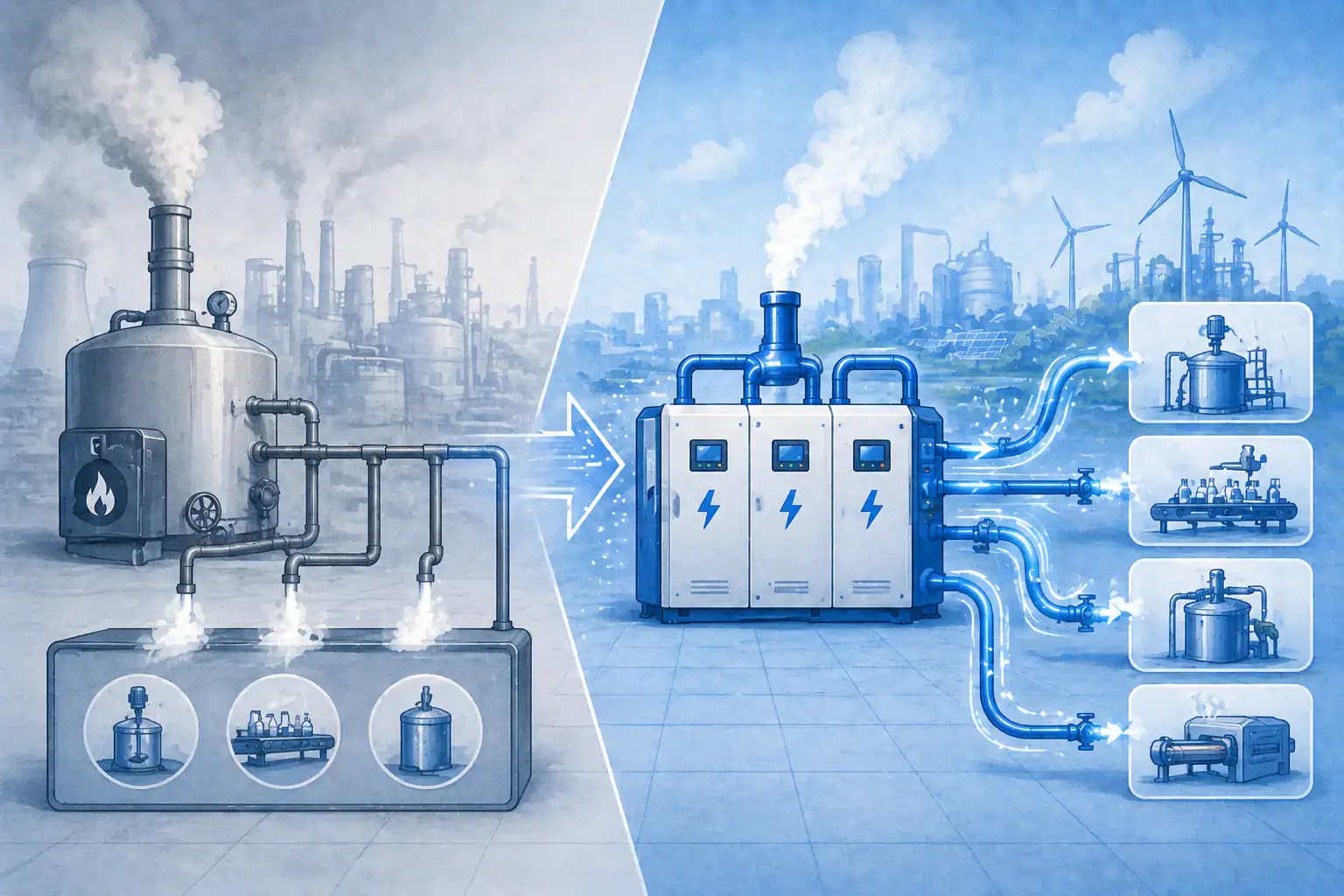
Steam electrification is no longer the future, it is the present.
Electrification of industrial heat is moving from being a trend to a tangible in-plant reality. Regulatory pressure, the rising cost of emissions and, above all, the improved competitiveness of electricity – especially when combined with on-site renewable generation – are pushing many industries to rethink how they generate steam.
In this context, electric steam has gone from being a marginal solution to consolidating itself as a viable alternative in very demanding sectors, from food to chemical or even emerging applications such as hydrogen. However, despite this progress, there is a pattern that is all too often repeated in electrification projects.
And it has nothing to do with the technology, but with how the change is approached.
The mistake: replicating a system designed for gas
The most common mistake is to approach electrification as a simple equipment replacement. That is, taking the existing gas boiler as a reference and looking for its direct electrical equivalent, maintaining the same installed power or the same nominal steam flow.
This approach, although intuitive, is based on a faulty premise: the assumption that both systems behave the same. In practice, this leads to sizing decisions that do not reflect the real needs of the process, but only a static snapshot of the current installation.
The result is that a design conceived for a technology with certain limitations – such as thermal inertia or combustion losses – is transferred to another that operates under a completely different logic.
What changes when steam is electric
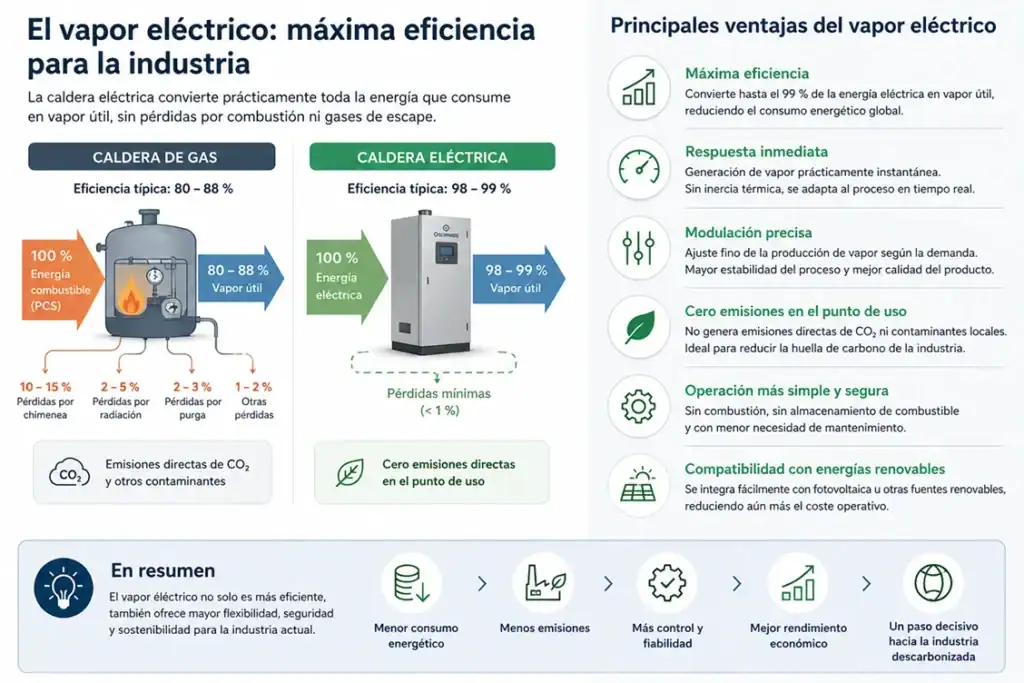
Switching to electric steam is not just about changing the energy source; it is about changing the way the system responds to the process. Unlike combustion boilers, electric generators allow a virtually immediate response, adjusting steam production according to the actual demand at any given moment.
This fine modulation capability, combined with very high efficiency and the elimination of typical losses such as stack losses, makes it possible to work much more dynamically. The system is no longer conditioned by inertia and adapts to the process, not the other way around.
Therefore, maintaining the same sizing criteria is not only unnecessary, but can be counterproductive.
When design fails, it’s not the technology that’s the problem
The consequences of this initial mistake often appear quickly, both in the investment and operation phase. In some cases, the system is oversized as a precaution, resulting in higher CAPEX, more demanding electrical infrastructure and unnecessary fixed costs. In others, the opposite happens: the system is not able to cover demand peaks, generating instability in the process or yield losses.
But beyond these extremes, the most common problem is the lack of flexibility. Systems designed without taking into account the real variability of the process end up being rigid, inefficient and difficult to adapt to changes in production.
On many occasions, when an electric steam project fails to meet expectations, it is not because the technology fails, but because it has been designed with the wrong logic.
Rethink the system from the process
Approaching steam electrification correctly requires changing the starting point. Instead of asking what equipment replaces the existing one, the question should be how the process actually behaves and what it needs at any given time.
This involves analyzing the demand profile with a certain level of detail, understanding not only average consumption, but also peaks, duty cycles and possible simultaneities. From there, the system can be resized more accurately, avoiding unnecessary inertia and adjusting the power to the operating reality.
In this context, modular design makes particular sense. Combining several generators instead of a single unit makes it possible to better adapt to varying loads, improve efficiency in partial operation and add a degree of redundancy that is key in many processes.
When validation or pre-testing phases are also incorporated, the system ceases to be an estimate and becomes a solution adjusted to real conditions.
To electrify is not to replace, it is to redesign.
The electrification of industrial steam should not be seen as an isolated technology change, but as an opportunity to rethink how heat is generated and used in the process.
Replicating the existing system may seem like the quickest option, but it is rarely the most efficient. On the other hand, when you start from the process analysis and take advantage of the real capabilities of electric steam, the result is not only an alternative to gas, but a more flexible, more efficient system that is better adapted to the plant’s needs.
Because, ultimately, electrifying well is not about changing a piece of equipment. It’s about designing better.
Contact us and we will help you design the optimal solution for your installation.