



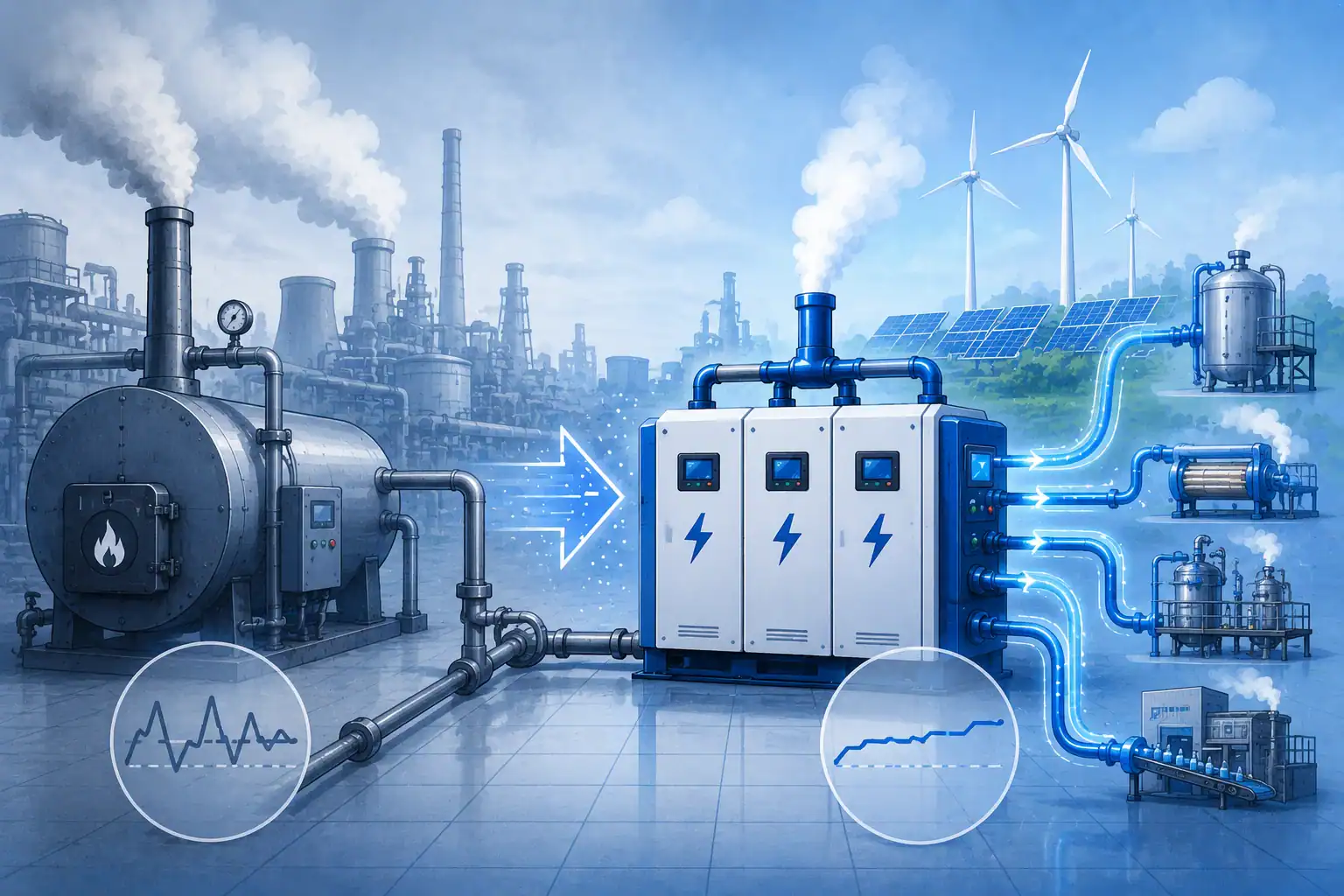
The efficiency of a boiler is not a decorative data on the data sheet. It defines what percentage of the energy you pay for ends up as useful steam for your process, and what percentage escapes through the chimney, blowdown or radiation losses. Most Spanish industrial facilities still have combustion boilers operating at 75-85%.
Modern electric generators, such as those of Giconmes, achieve 99%. The difference, translated into kWh and euros, is significant, and from 2023 can also be monetized through the Energy Saving Certificate System (CAE).
How to calculate the efficiency of a boiler
Let’s start by understanding how the efficiency of a boiler is calculated. Efficiency (η) is the ratio of the heat absorbed by the water – that which is actually incorporated into the steam – to the total heat supplied to the system:
η = (Heat absorbed by the water / Heat supplied to the system) × 100
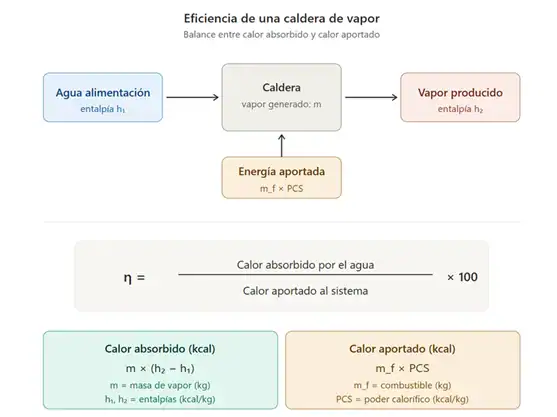
The heat absorbed depends on how much water evaporates and the enthalpy difference between the feed water and the steam produced:
Q_absorbed = m × (h₂ – h₁)
where m is the mass of steam generated (kg), h₁ the enthalpy of the feedwater (kcal/kg) and h₂ that of the steam (kcal/kg).
The heat input depends on the fuel consumed and its calorific value, in the case of a combustion boiler:
Q_carried = m_f × PCS
where m_f is the mass of fuel and PCS its gross calorific value (kcal/kg). In an electric boiler, the heat input is simply the electrical energy consumed.
Numerical example: 1,000 kg/h of steam at 10 bar
Let’s take a typical industrial process that demands 1,000 kg/h of saturated steam at 10 bar, starting with feed water at 20 °C:
m = 1,000 kg/h
h₂ ≈ 663 kcal/kg (saturated steam at 10 bar)
h₁ ≈ 20 kcal/kg (water at 20 °C)
Q_absorbed = 1.000 × (663 – 20) = 643.000 kcal/h ≈ 748 kWh/h
That is the net energy that has to be incorporated into the steam. The energy that the equipment needs to consume will always be higher; how much more depends solely on the efficiency of the equipment.
Gas vs. electric: where is the difference
Combustion boilers (natural gas, diesel, LPG) operate, at best, with efficiencies of 80-85 %. Losses are divided between:
- Smoke losses in the chimney (gases exit at high temperature).
- Radiation and convection losses in the boiler body.
- Bottom and surface blowdown losses.
- Losses associated with incomplete combustion or excess air.
Electric boilers achieve efficiencies of 99%. No combustion, no fumes, no chimney. Practically all the electrical energy introduced is directly transformed into heat transferred to the water. The only relevant losses are the radiative losses of the equipment body (~1 %).
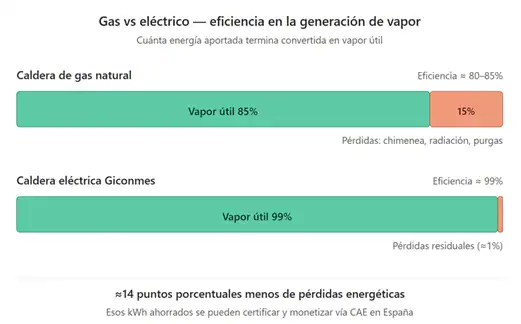
Applying both yields to the previous example:
| Equipment | Efficiency | Energy input for 1.000 kg/h of steam |
|---|---|---|
| Natural gas boiler | 85 % | 643,000 / 0.85 = 756,500 kcal/h ≈ 880 kWh/h |
| Giconmes electric generator | 99 % | 643,000 / 0.99 = 649,500 kcal/h ≈ 755 kWh/h |
To produce exactly the same steam, the electric boiler needs ≈125 kWh less per hour of operation. In an industrial facility working 8,000 hours per year, that’s 1,000 MWh of final energy saved annually.
How to monetize savings: the CAE system
Since Royal Decree 36/2023, updated by Order TED/133/2026, Spain has had the Energy Saving Certificate System (CAE). It is the mechanism with which the State transfers to the market the national energy efficiency obligations derived from Directive (EU) 2018/2002.
Operation is straightforward:
1 CAE = 1 kWh of final energy saved, certified and verified as additional.
The obligated parties – electricity, gas and fuel retailers – must prove an annual volume of energy savings, either by contributing to the National Energy Efficiency Fund (FNEE) or by purchasing CAE generated by third parties.
Any company carrying out an energy efficiency action can generate CAE and sell them to an obligated entity or to a delegated entity acting as an intermediary.
The replacement of a combustion boiler with an electric generator fits within the actions contemplated by the system. In the case of specific industrial equipment, it is usually processed as a singular action, which implies a measurement and verification plan (M&V) according to the IPMVP protocol and the intervention of a verifier accredited by ENAC.
As a guideline, with the CAE prices observed during 2025-2026 (approximate range of 50-80 €/MWh, depending on the sales channel), the 1,000 MWh per year of the example could become 50,000-80,000 € in revenue from the sale of certificates. And that income is added to the direct savings in energy bills and the reduction of CO₂ emissions associated with the electrification of the process.
Conclusions
The efficiency jump from 85% to 99% is not a technical detail, but a quantifiable competitive advantage that pays for the equipment several times over during its lifetime:
- Less energy consumed to produce the same steam.
- Direct savings in energy bills, especially relevant in a context of increasingly renewable electricity and gas with volatile prices.
- Additional revenues from the sale of CAE in the Spanish regulated market.
- Emissions reduction and better fit with the company’s decarbonization plans.
At Giconmes, we design and manufacture electric steam and superheated water generators for industrial processes, from compact units to large modular equipment. If you are evaluating the replacement of a combustion boiler or the sizing of new equipment, we can help you calculate the expected savings and structure the project to be eligible under the CAE system.