



Success stories
Steam flow control at low load (0.2–2 kg/h) for a pilot-scale syngas and hydrogen cell
Project description
A technology center dedicated to the production of hydrogen and methane from syngas needed a steam system capable of operating at very low flow rates and constant pressure to ensure the stability of its experiments. Conventional equipment did not offer the required precision, jeopardizing the reproducibility of experimental results and the proper conduct of research processes.

Original situation:
Challenges posed by the client:
A leading technology center, focused on developing advanced processes for the utilization of syngas (synthesis gas) to produce hydrogen and methane, needed to integrate a steam supply system capable of ensuring extremely stable operating conditions within a pilot research cell.
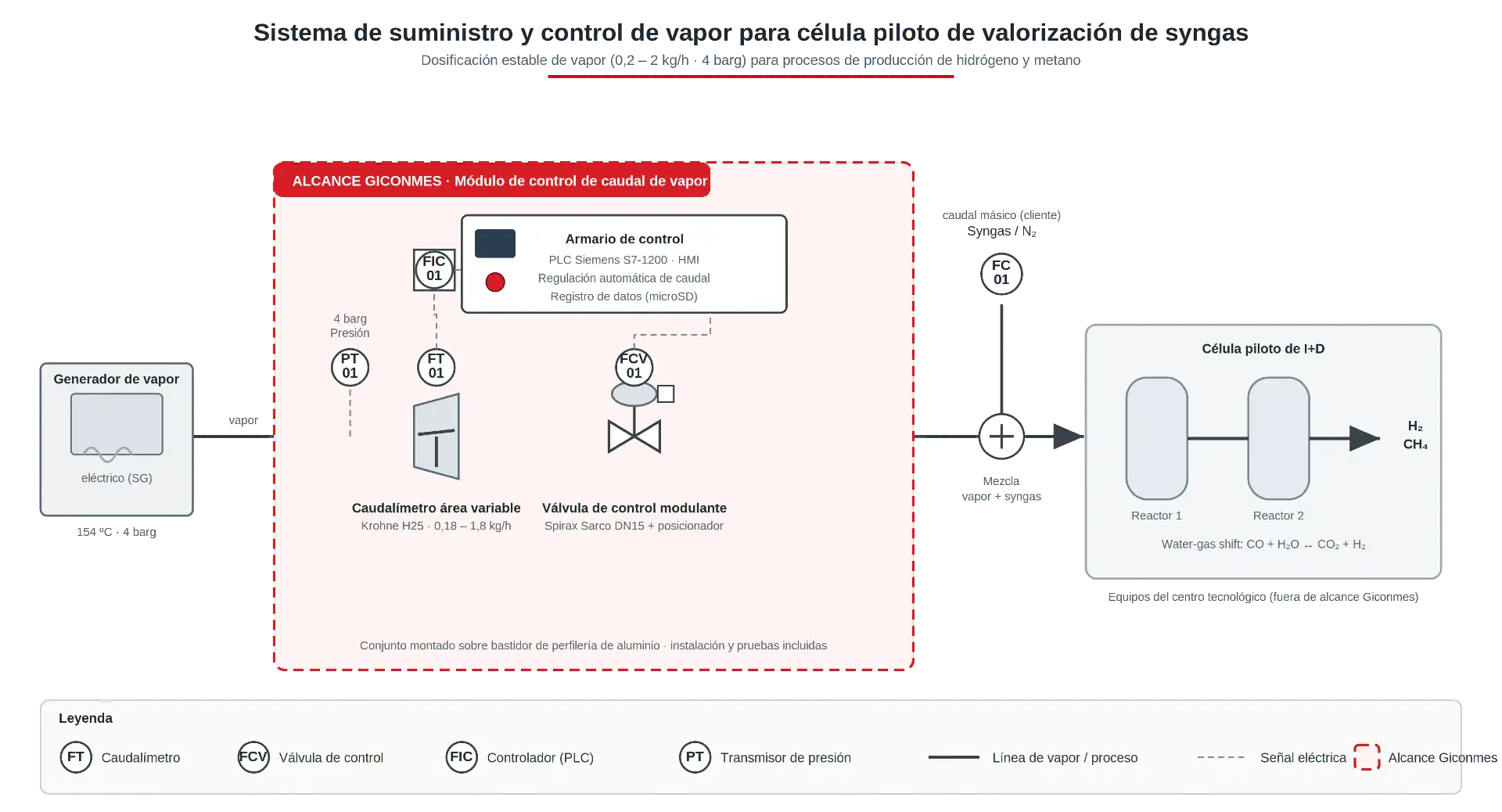
The real challenge was not in generating steam, but in controlling it. The process required working with very low steam flow rates, ranging from 0.2 to 2 kg/h, while maintaining a constant operating pressure of 4 barg. This is a minimum load condition, under which most conventional generators lose stability: they cycle, overheat, or deliver an irregular flow rate.
And therein lay the risk. In the water-gas shift reaction (CO + H₂O ⇌ CO₂ + H₂), water vapor is not an auxiliary component: it is a reactant that converts carbon monoxide in the syngas into additional hydrogen. Any fluctuation in the steam flow rate directly alters the H₂/CO ratio, shifts the reaction equilibrium, and compromises the most valuable aspect of a pilot plant: the reproducibility of experimental results.
That is why the technology center was not simply looking for an equipment supplier, but rather a partner specializing in steam generation, regulation, and management under low-load conditions—one capable of providing specific expertise that a standard catalog cannot offer.
Proposed solution:
Customized steam solution developed by Giconmes.
Proposed solution:
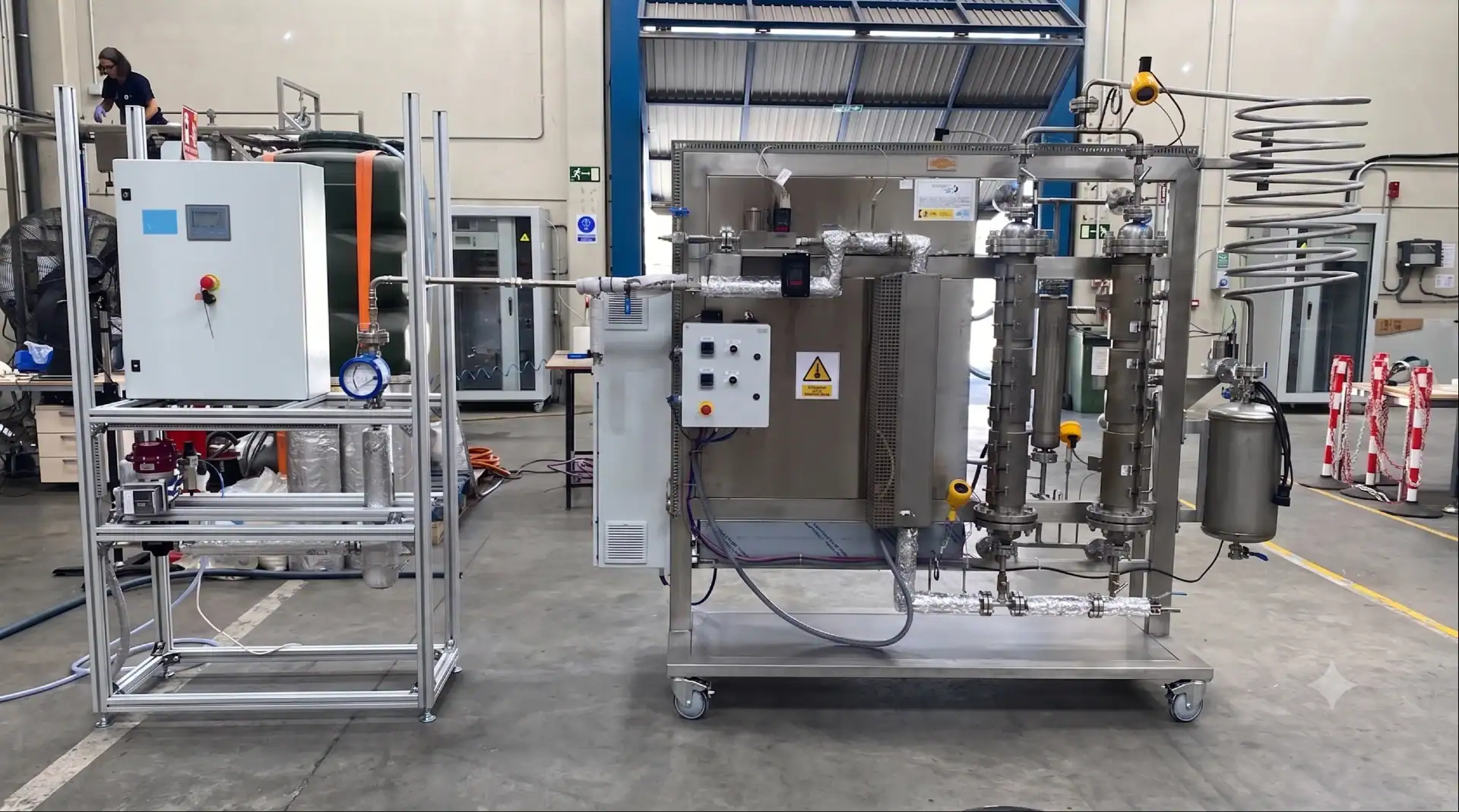
We draw on our expertise in steam technology to develop a solution tailored to the pilot cell’s requirements: not off-the-shelf equipment, but a steam flow control skid designed to operate with precision precisely where other systems lose stability—in the low-load range.
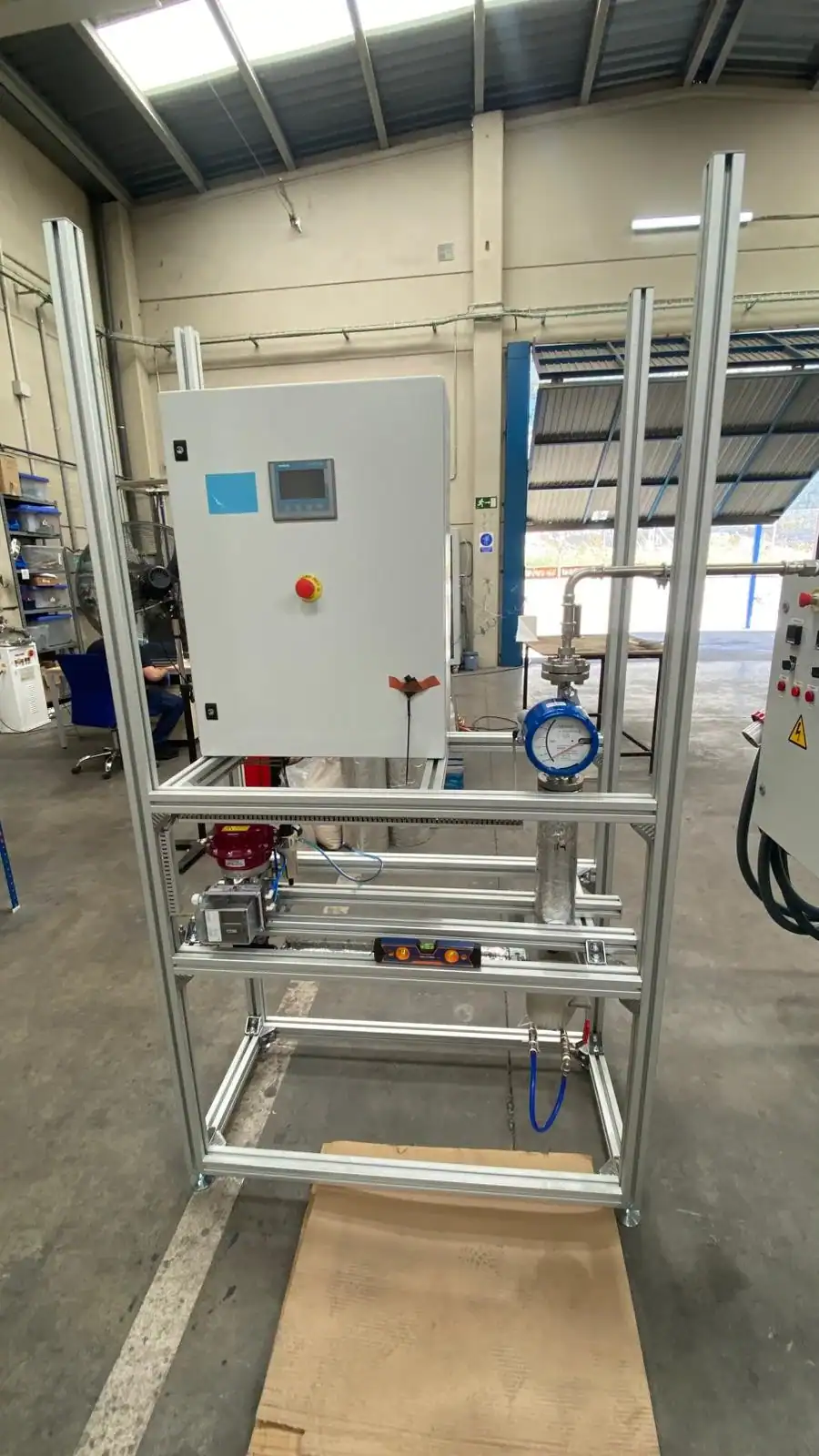
The scope included the design, supply, and integration of a compact assembly mounted on an aluminum extrusion frame, containing all the components necessary for stable and repeatable steam metering:
- High-precision variable-area flowmeter, specifically selected to reliably measure minimum steam flow rates within the required range.
- Pneumatically operated modulating steam control valve with a positioner, designed to regulate flow continuously and smoothly.
- Control cabinet with a Siemens S7 PLC, power supply, and 24 V DC control circuit, fully wired, for automatic process control.
- Data logging via microSD card, which is key to the traceability and reproducibility of R&D tests.
- Instrumentation and auxiliary components necessary to ensure operational stability, including installation and testing.
The solution was fully integrated into the technology center’s pilot cell, enabling the controlled injection of water vapor into the reaction process with syngas.
The supplied system consistently provided the steam needed to facilitate the syngas ( synthesis gas) conversion reactions , which were designed to increase the production of hydrogen and methane. In this type of process, water vapor acts as a reactant: it converts carbon monoxide in the synthesis gas into additional hydrogen through the water-gas shift reaction.
That is why precise steam control was crucial: only a stable, controlled flow rate can ensure reproducible test conditions and maximize process efficiency in research.
Technology used:
- Steam flow control skid designed for stable operation under low-load conditions
- High-precision variable-area flowmeter for measuring minimum steam flow rates
- Pneumatic modulating steam control valve with a positioner for continuous flow control
- Siemens S7 PLC with a 24 V DC power supply and control unit for automatic process control
- MicroSD-Based Data Acquisition and Recording System for Test Traceability
- Process instrumentation and auxiliary components to ensure operational stability and repeatability
CHALLENGES
We meet customer requirements
The installation fully met the objectives set by the client. Among the key results are:

Stable control of the steam flow rate within the required operating range (0.2–2 kg/h).

Maintaining a constant operating pressure of 4 barg.

Successful integration with the rest of the pilot cell, achieving the process conditions necessary to obtain the expected experimental results.

Automated operation via PLC, with data logging for traceability.
Thanks to a combination of specialized technology and expertise in low-load steam management, we were able to provide a robust and reliable solution for a highly demanding R&D application, contributing to the development of hydrogen production technologies and the energy transition.
Do you need a customized solution?
We help you define what type of installation you need
There are no emissions beyond those produced during the electricity production process. Consequently, emissions can be neutral depending on the electricity mix. Electric steam boilers are the present and the future.
Absolutely. In fact, it is recommended to achieve maximum efficiency. There is no problem with remote control as long as it complies with current regulations.
A steam generator is a pressure vessel that, together with the piping network, is subject to regulatory control and complementary technical instructions, according to the regulations published in Royal Decree 809/2021, of September 21. Maintenance is divided into a part that can be easily fulfilled by the owner:
- Know and apply the manufacturer’s instructions regarding use, safety measures, and maintenance.
- Not to put the installation into service or prevent the operation of pressure equipment if the requirements of the Regulation are not met.
- Having at least the following documentation for the pressure equipment while they are installed: Declaration of conformity, manufacturer’s instructions (if applicable), and, if necessary, installation certificate, along with other supporting documentation (such as installation project, record of the last periodic inspection, certifications of equipment repairs or modifications, and any other documentation required by the relevant technical instruction complementary to this regulation). For detailed contents, refer to Annex IV of the regulation. Making this documentation available to the competent authority of the autonomous community and the companies responsible for maintenance, repair, or periodic inspections.
- Use the pressure equipment within its intended operating limits as specified by the manufacturer and take it out of service if it no longer meets the necessary safety requirements.
- Perform maintenance on the installations, pressure equipment, safety accessories, and control devices in accordance with the operating conditions and manufacturer’s instructions, and examine them at least once a year.
- Arranging for the necessary periodic inspections as required by Article 6 of the regulation.
- Having and maintaining an up-to-date record of pressure equipment categories I to IV, as defined in RD 709/2015, of July 24, or equipment similar to these categories according to Article 3.2 of the regulation, as well as their installations.
It is known that by applying heat to water, it transforms into steam at the boiling point and atmospheric pressure. From there, depending on the required saturation degree of steam for its proper application, we need to increase the pressure to obtain a higher temperature. To change the temperature and saturation degree of steam, we always need to modify the pressure.
It is a unit of pressure equivalent to 1 kg/cm2, 0.98 atmospheres, or 14.50 PSI.
Haven't found the answers to your questions?
Please send us a question or download all the information
USES OF STEAM IN INDUSTRY AND OTHER BUSINESSES
Other similar success stories using steam

The use of steam is gaining popularity in several industries due to its efficiency and environmental benefits..
In our "Success Stories" section, you can discover more about companies that have adopted this technology and have achieved successful results in terms of efficiency and sustainability. Click on the success stories to learn more details.
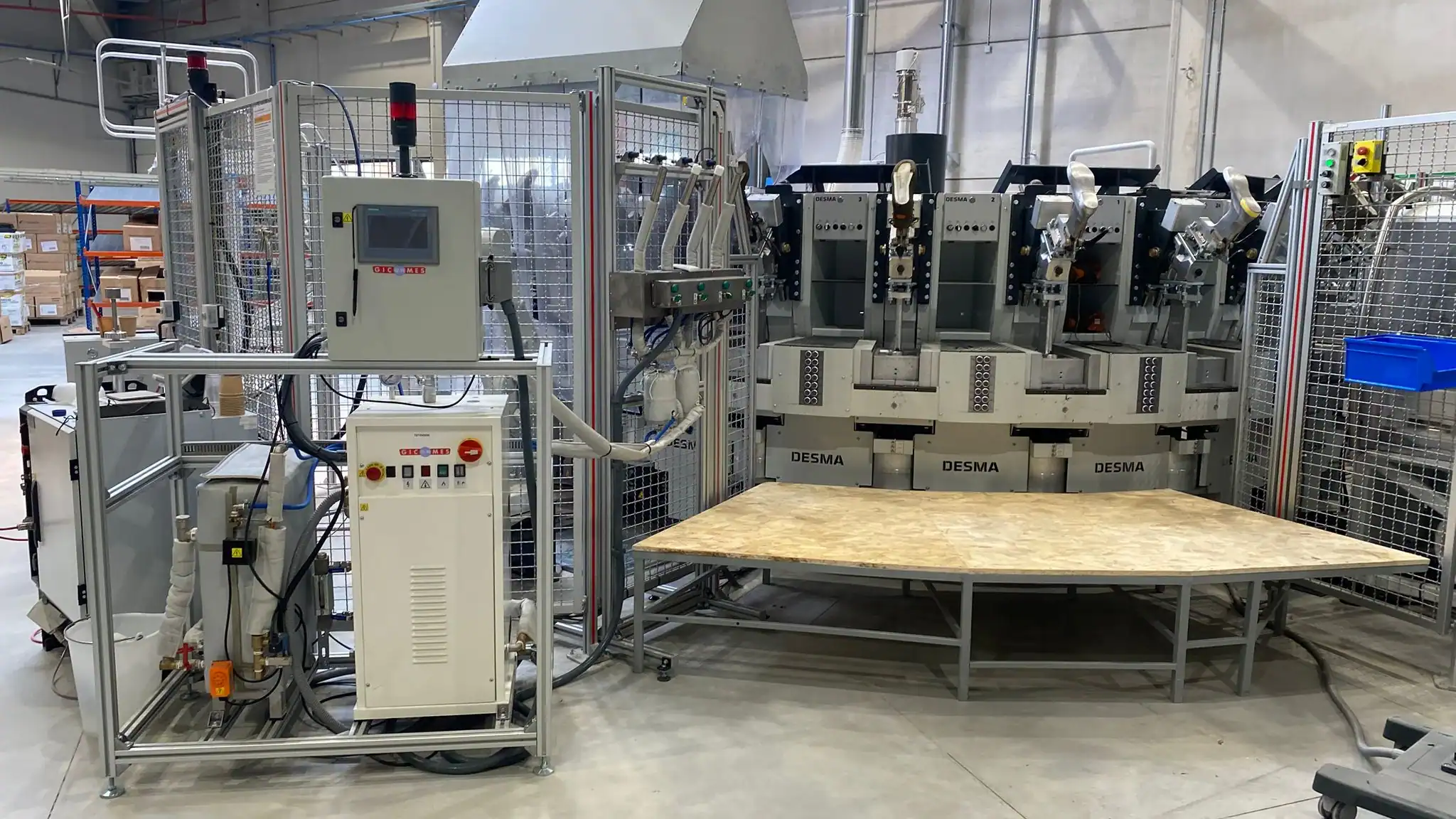
Situación original ¿Qué retos nos planteó el cliente? En una nueva planta de fabricación de botas de seguridad, el cliente incorpora una estación giratoria de pegado en la que los operarios deben aplicar vapor a los botines para reblandecer el material justo antes del montaje. Cada operario trabaja sobre 4 botines en paralelo, lo que […]

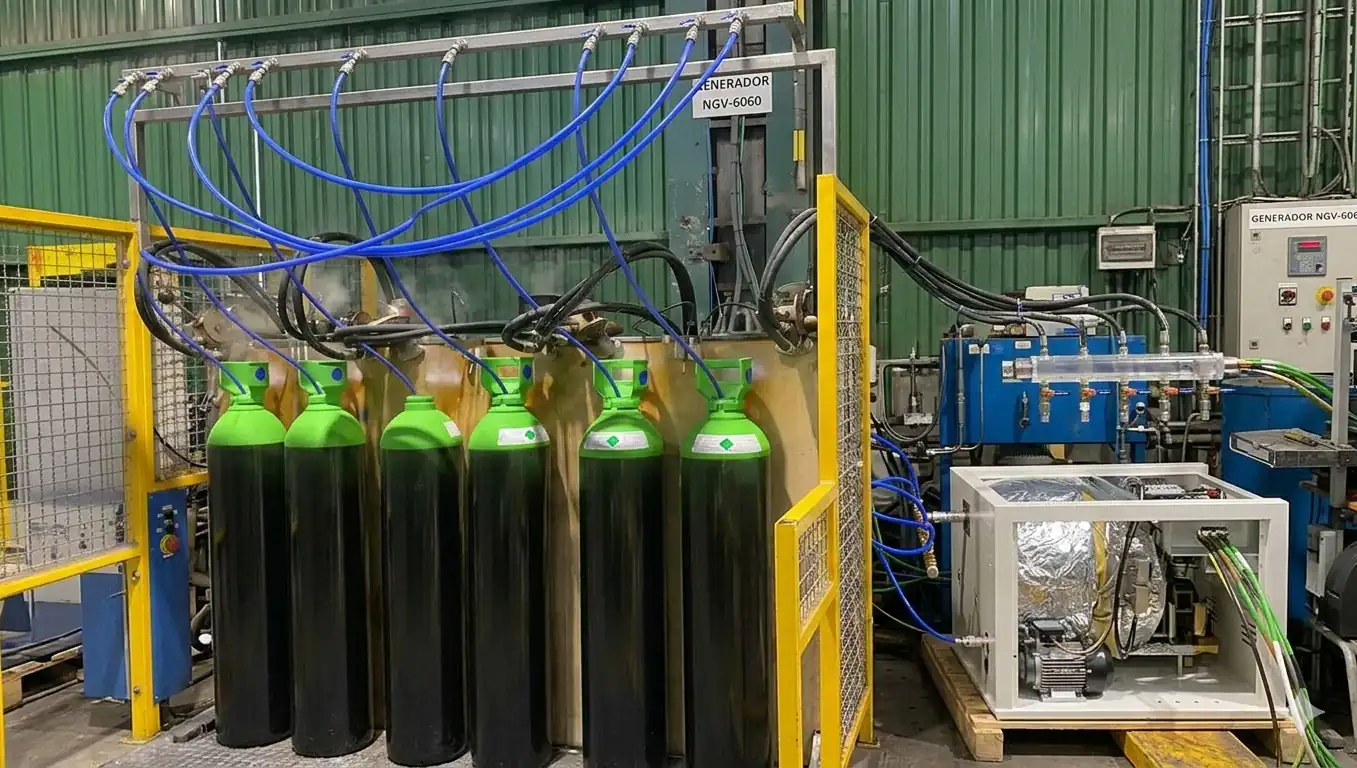
Situación original ¿Qué retos nos planteó el cliente? El cliente, una de las principales operadoras de gases industriales y medicinales en España, gestiona una flota de más de un millón de botellas de acero al carbono distribuidas entre cinco plantas, cada una de las cuales se ocupa de la logística, el llenado y el mantenimiento […]