



Success stories
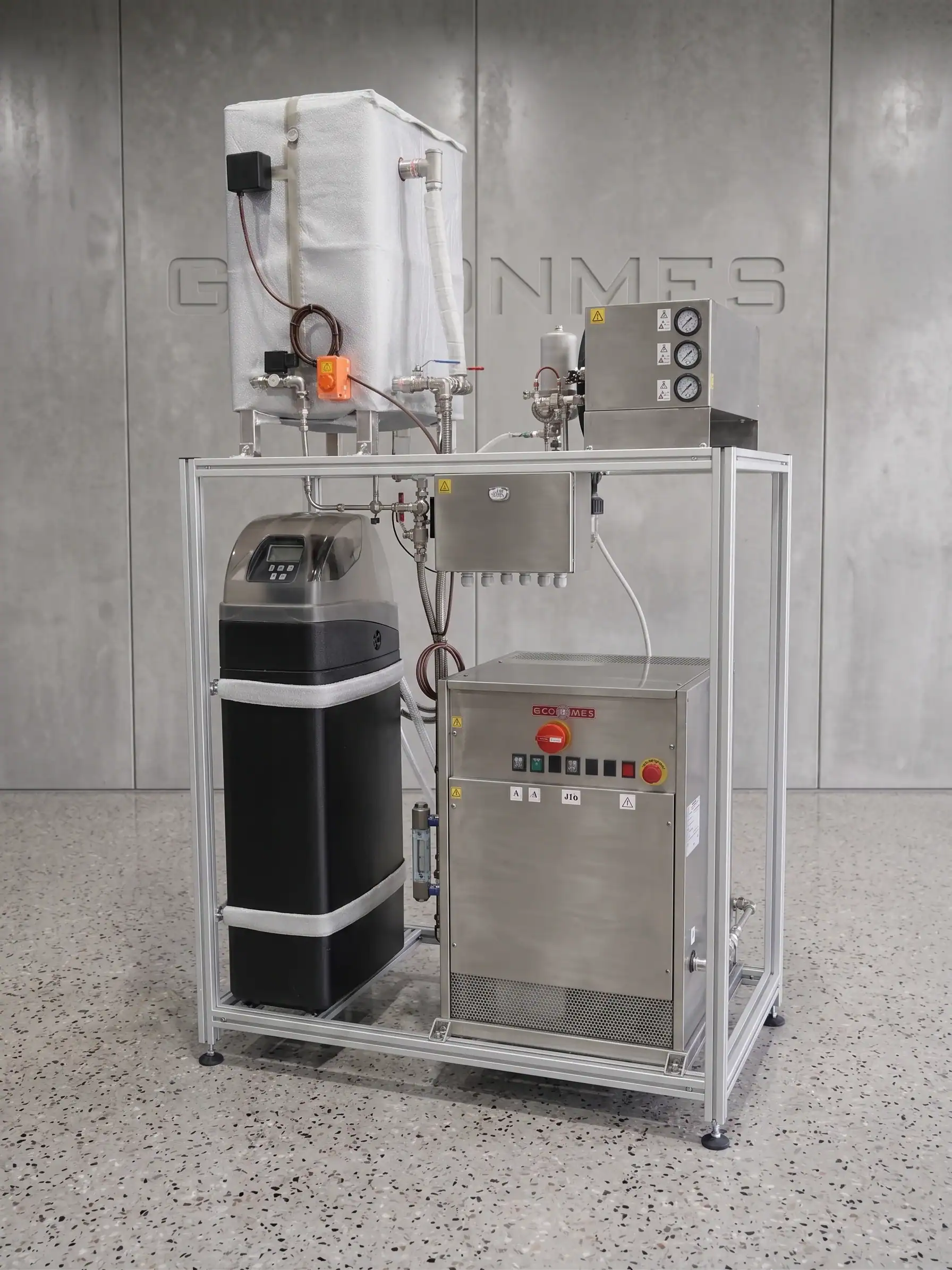
Stainless steel superheated steam skid for a packaging machine
Project description
A packaging machinery manufacturer needed 12 kg/h of clean, superheated steam for a new, higher-capacity production line, with capacity to handle peak demand and a complete skid-mounted solution.

Original Situation
What challenges did the client present us with?
A leading European manufacturer of industrial packaging machinery—with whom Giconmes had previously developed a superheated clean steam skid for a thermoforming line used to package processed cheese—contacted us again regarding a new project.
In this case, the machine to be equipped had a higher production capacity and, consequently, a greater steam demand than that of the previously supplied system. The customer had estimated a steam requirement of 12 kg/h and specifically requested that the system be sized with a safety margin to ensure a stable supply even during peak cycles of the packaging machine.
The requirements set forth were as follows:
- A steam flow rate of at least 12 kg/h, with sufficient power reserve to handle demand peaks without pressure fluctuations.
- Since the steam comes into direct contact with the packaged product, it was necessary to ensure that the steam was of food-grade quality, free of particles and carryover.
- Superheated steam to prevent condensation inside the packaging and maintain hygienic and sanitary conditions throughout the process.
- Stainless steel construction for both the steam generator and the superheater—a requirement the customer identified as a priority due to the humid environment and intensive cleaning routines.
- An independent water treatment system that ensures consistent feedwater quality and protects the equipment’s service life.
- Condensate recovery tank and return valve, integrating the return from the machine to optimize the system’s energy efficiency.
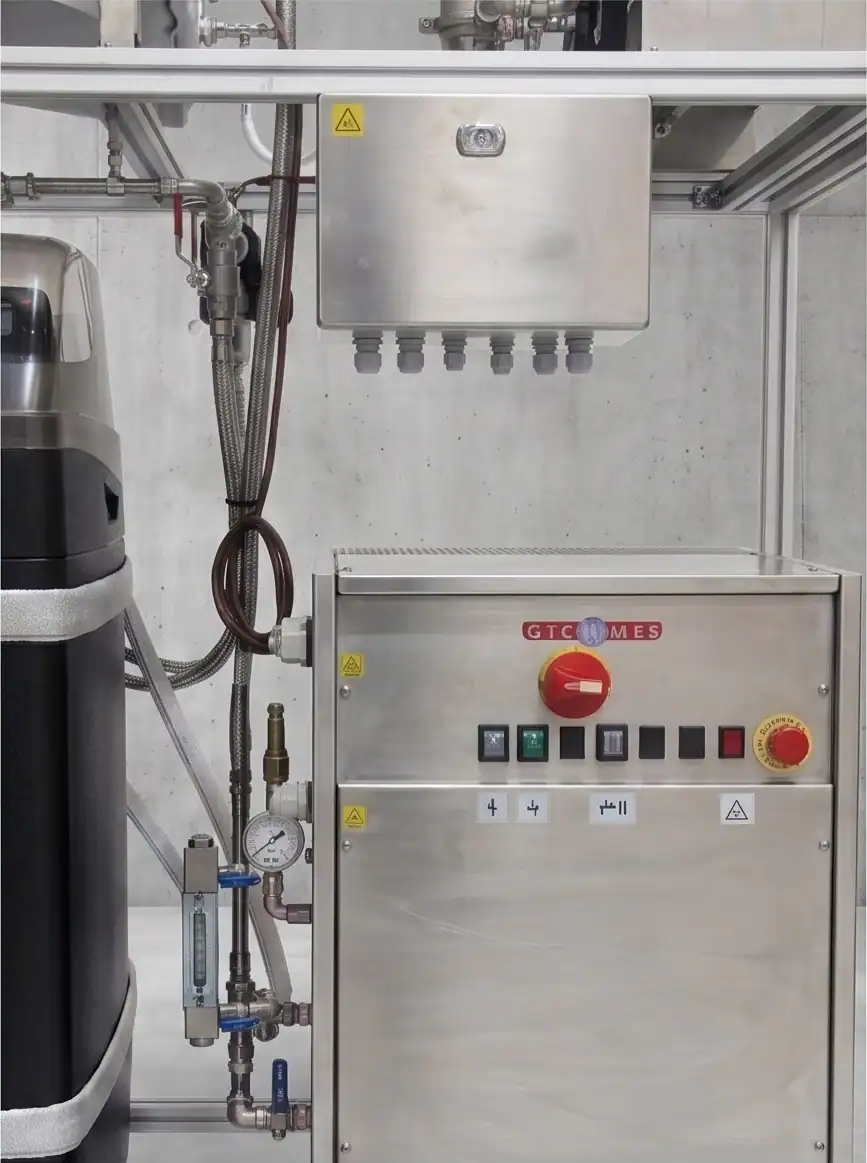
- Dedicated electrical panel to centralize system protection and control and simplify connection to the factory’s electrical system.
- Mounted on a skid, with all components interconnected and factory-assembled, replicating the architecture of the previous project to facilitate the manufacturer’s internal standardization.
Solution Provided
Steam solution developed ad hoc by Giconmes
Proposed solution:
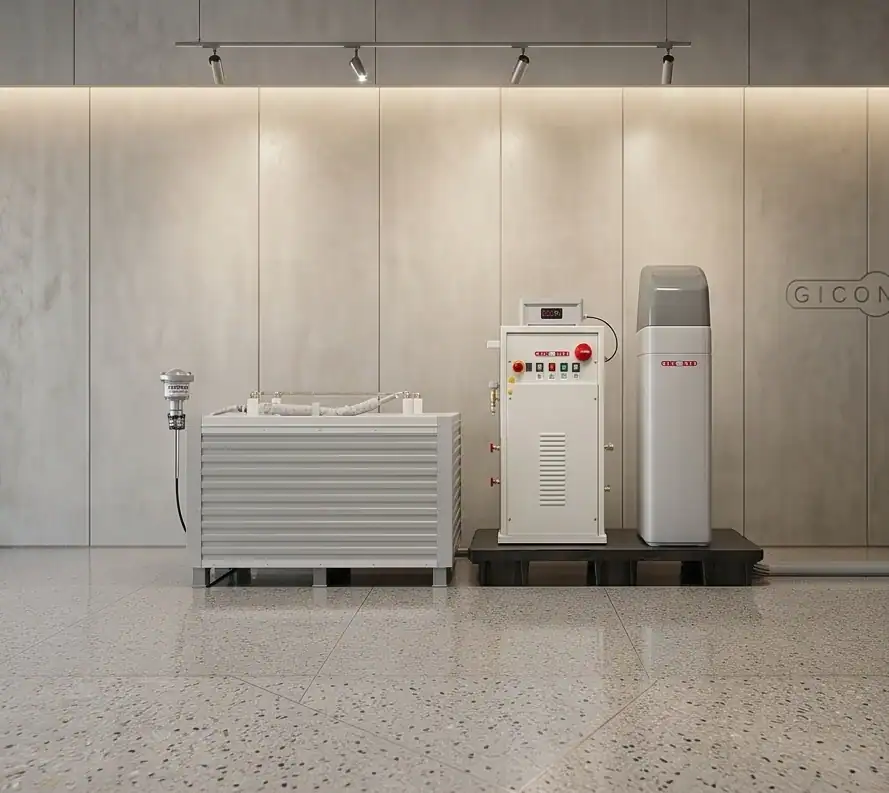
Building on the architecture already validated in the previous project, Giconmes’ technical team scaled up the system to meet the new process requirements using a 22 kW NGV-3022 electric steam generator, with a production capacity of up to 30 kg/h and an operating range between 0.3 and 7 bar.
This sizing places the system’s operating point at approximately 40% of its installed capacity, compared to the required 12 kg/h. Far from being an unnecessary oversize, this is a deliberate decision: the power reserve allows the system to absorb demand peaks during each packaging cycle without pressure fluctuations and ensures a wide and stable control margin. Contributing to this is the dual-heater configuration (15 + 7 kW), which allows the equipment to operate in stages and adjust power consumption to the process’s actual demand.
All components in contact with water and steam were manufactured from AISI 304 stainless steel, including the outer casing, in accordance with the customer’s top priority of having an entirely stainless-steel unit suitable for humid environments and intensive cleaning routines.
The steam superheating issue was resolved using a GI-6000 SS OVERHEATER, manufactured entirely—finned tubes, fittings, and casing—from AISI 304 stainless steel. It operates by steam lamination as the steam passes through the unit and allows the outlet temperature to be regulated between 100 and 300 °C via a thermostat, preventing condensation inside the container and maintaining the hygienic and sanitary conditions of the process.
To ensure the culinary quality of the steam that comes into direct contact with the product, the system incorporates a 5-micron particle filter, supplemented by a water treatment system that reduces the total hardness of the feedwater to acceptable levels, thereby extending the boiler’s service life and ensuring the purity of the steam generated.
The system was completed with an 80-liter DRC0083 condensate recovery tank made of AISI 304 stainless steel, equipped with a level controller, solenoid valve, and thermostat, which allows for the return and reuse of condensate from the machine, optimizing the system’s energy efficiency.
Integration with the Filling Machine
One of the key aspects of the project was the electrical and signal integration with the customer’s machine, achieved through a specific set of components:
- 4-20 mA transmitter for analog transmission of the process signal.
- Return valve for managing condensate flow to the skid.
- Contact relay that signals to the filling machine that the generator is running.
- Relay indicating activation of the safety pressure switch.
- Visual and audible indicator with standard operating and alarm signals.
- Complete update of drawings and electrical schematics in accordance with the new configuration.
Skid-Mounted Assembly
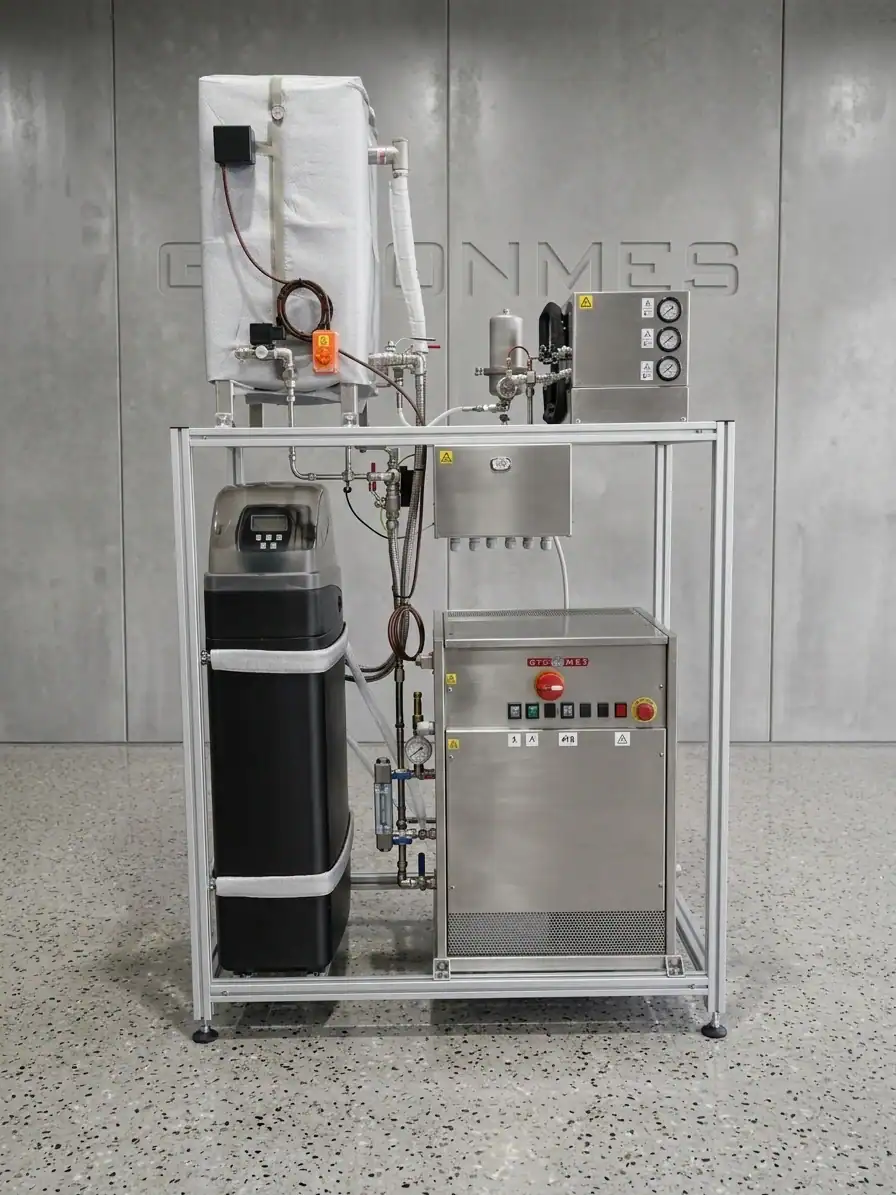
All components—generator, superheater, water treatment system, filtration system, condensate tank, and control elements—were interconnected and assembled at the factory on a single skid platform, delivered ready for connection. This configuration follows the standard established in the previous project, allowing the manufacturer to replicate the solution in future lines without the need for redesign.
Regulatory Compliance
The generator was manufactured in accordance with the Pressure Equipment Directive 2014/68/EU (PED CE), transposed by Royal Decree 709/2015 and subject to Royal Decree 809/2021. The pressure vessel was designed and manufactured in accordance with UNE-EN 13445, with quality certificates that ensure the traceability of the steel for a minimum of ten years. The quality of the feedwater complies with the requirements of UNE-EN 12952-12.
The result is a compact, hygienic, and fully integrated system capable of continuously and consistently supplying clean, superheated steam throughout the entire packaging cycle, with the level of stainless steel finish required for food-contact applications.
Technology used:
- NGV-3022 steam generator, 22 kW, up to 30 kg/h and 7 bar, with dual heater (15 + 7 kW)
- GI-6000 SS superheater made of AISI 304, adjustable between 100 and 300 °C
- 5-micron filter and water treatment system for food-grade steam
- 80-liter DRC0083 condensate recovery tank with automated return
- 4–20 mA integration, status and safety relays, signal beacon, and complete skid-mounted assembly
CHALLENGES
We meet our clients’ requirements
The installation fully met the objectives set by the client. Among the key results are:

Food-grade steam. 5-micron filtration and a dedicated water treatment system ensure that the steam is safe for direct contact with the product, with no risk of contamination.

Entirely constructed of stainless steel. The boiler, water-contacting components, casing, and superheater are made of AISI 304 stainless steel, which is resistant to humid environments and intensive cleaning routines.

Energy efficiency. The recovery and reuse of condensate reduces the system’s water and energy consumption, and the dual-heater configuration adjusts electricity consumption to actual demand.

Standardized and replicable solution. A factory-assembled and wired unit mounted on a skid, ready to connect, that the manufacturer can reproduce in future production lines without the need for redesign.
Do you need a customized solution?
We help you define what type of installation you need
There are no emissions beyond those produced during the electricity production process. Consequently, emissions can be neutral depending on the electricity mix. Electric steam boilers are the present and the future.
Absolutely. In fact, it is recommended to achieve maximum efficiency. There is no problem with remote control as long as it complies with current regulations.
A steam generator is a pressure vessel that, together with the piping network, is subject to regulatory control and complementary technical instructions, according to the regulations published in Royal Decree 809/2021, of September 21. Maintenance is divided into a part that can be easily fulfilled by the owner:
- Understand and follow the manufacturer’s instructions regarding use, safety measures, and maintenance.
- Do not put the installation into service or allow pressure equipment to operate if the requirements of the Regulation are not met.
- Having at least the following documentation for the pressure equipment while they are installed: Declaration of conformity, manufacturer’s instructions (if applicable), and, if necessary, installation certificate, along with other supporting documentation (such as installation project, record of the last periodic inspection, certifications of equipment repairs or modifications, and any other documentation required by the relevant technical instruction complementary to this regulation). For detailed contents, refer to Annex IV of the regulation. Making this documentation available to the competent authority of the autonomous community and the companies responsible for maintenance, repair, or periodic inspections.
- Use pressure equipment within the operating limits specified by the manufacturer and take it out of service if it no longer meets the necessary safety requirements.
- Maintain facilities, pressure equipment, safety accessories, and control devices in accordance with operating conditions and the manufacturer’s instructions, and inspect them at least once a year.
- Arrange for the corresponding periodic inspections to be carried out in accordance with the provisions of Article 6 of the regulation.
- Having and maintaining an up-to-date record of pressure equipment categories I to IV, as defined in RD 709/2015, of July 24, or equipment similar to these categories according to Article 3.2 of the regulation, as well as their installations.
It is known that by applying heat to water, it transforms into steam at the boiling point and atmospheric pressure. From there, depending on the required saturation degree of steam for its proper application, we need to increase the pressure to obtain a higher temperature. To change the temperature and saturation degree of steam, we always need to modify the pressure.
It is a unit of pressure equivalent to 1 kg/cm2, 0.98 atmospheres, or 14.50 PSI.
Haven't found the answers to your questions?
Send us a question or download all the information
USES OF STEAM IN INDUSTRY AND OTHER BUSINESSES
Other similar success stories involving the use of steam

The use of steam is gaining popularity in various industries due to its effectiveness and environmental benefits.
In our “Success Stories” section, you can learn more about companies that have adopted this technology and achieved successful results in terms of efficiency and sustainability. Click on the success stories to learn more.
Situación original ¿Qué retos nos planteó el cliente? Un cliente del sector agrícola se planteaba la puesta en marcha de un nuevo vivero y necesitaba incorporar un sistema para la desinfección térmica del sustrato antes de su uso en la producción de planta. El objetivo era eliminar patógenos, semillas de malas hierbas y organismos indeseados […]

Situación original ¿Qué retos nos planteó el cliente? Un fabricante de chocolate y derivados del cacao contaba en su planta con un transportador de lona de gran longitud (cerca de 50 metros) cuya limpieza era una de las operaciones más exigentes del proceso. Los residuos de chocolate, cacao y grasas se adhieren con fuerza a […]