



Success stories
Precision vaporization for solar hydrogen: from 25 g/h to 100 g/min
Project description
A green hydrogen developer needed to inject steam as a reactant into a solar reactor, with highly precise control of flow rate, pressure, and temperature. The challenge was to operate within a range of 25 g/h to 2.5 kg/h using a flexible solution that could adapt to the project’s evolution.

Original situation:
Challenges posed by the client:
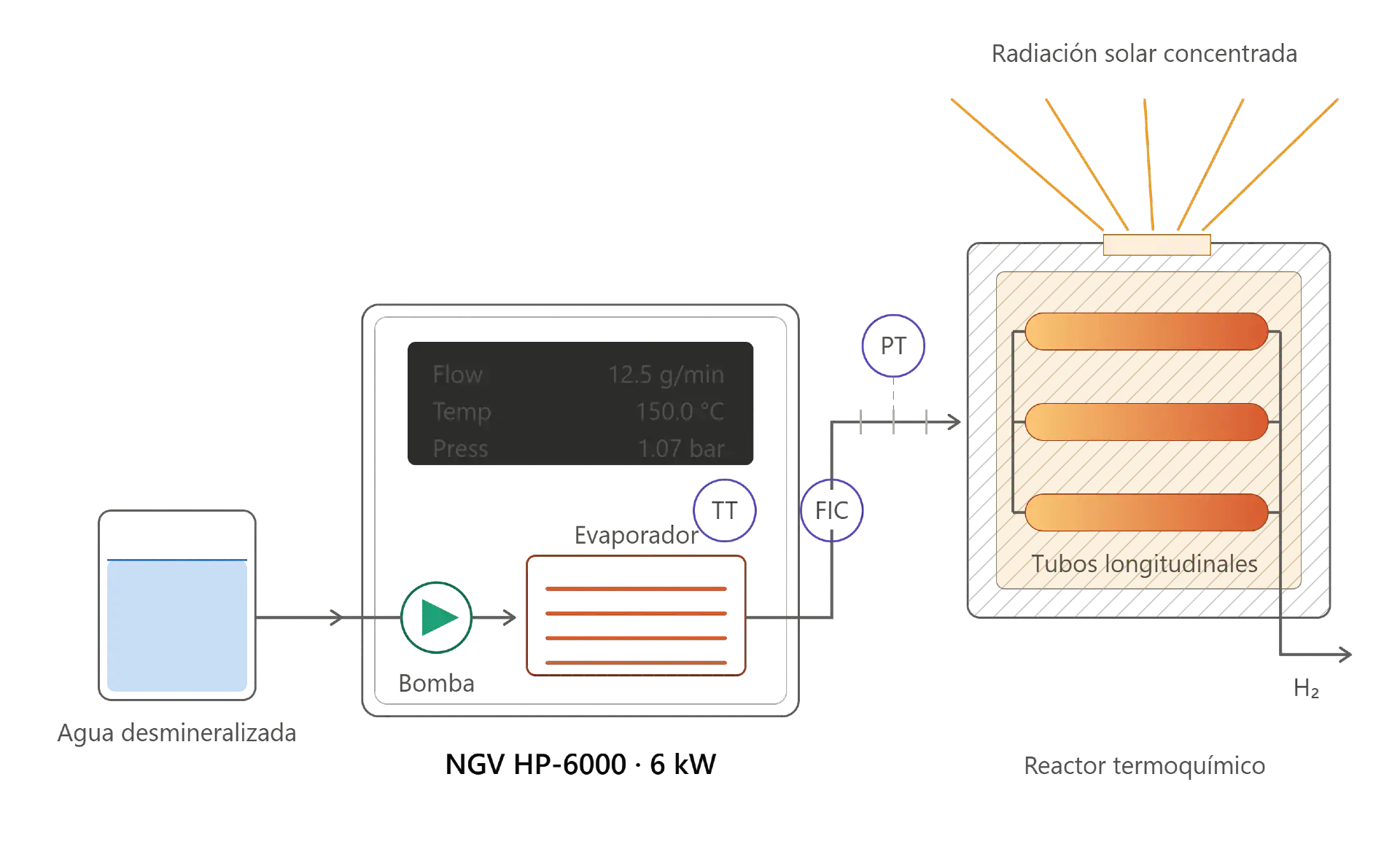
A technology developer specializing in the production of green hydrogen using concentrated solar power approached Giconmes with an unusual request: to inject water vapor as a reactant into a thermochemical reactor heated by concentrated solar radiation directed onto longitudinal tubes.
Here, steam is not a process fluid, but a process reagent. And that was the real challenge: achieving highly precise and simultaneous control of flow rate, pressure, and temperature while operating at extremely low flow rates.
The requirements initially ranged from 3 kg/h at 1 barg to 7 kg/h at 3 barg, but as the reactor design progressed , they were drastically reduced to a minimum of 25 g/h and a maximum of 2.5 kg/h.
These values are two orders of magnitude below the typical range of an industrial steam generator. At that scale, any conventional equipment with heating elements and a boiler is ruled out: the thermal inertia of the accumulated water volume prevents the precise control required by a chemical process, and the pressure and temperature fluctuations associated with heating cycles are unacceptable when the steam is a reactant.
Added to this requirement was a challenge typical of an ongoing R&D project: the design parameters continued to evolve. The client needed a system compatible with different scales of work, capable of supporting the project without falling short in the next iteration, and, at the same time, a proposal that would serve as a technical and financial reference for the overall sizing of the facility.
Proposed solution:
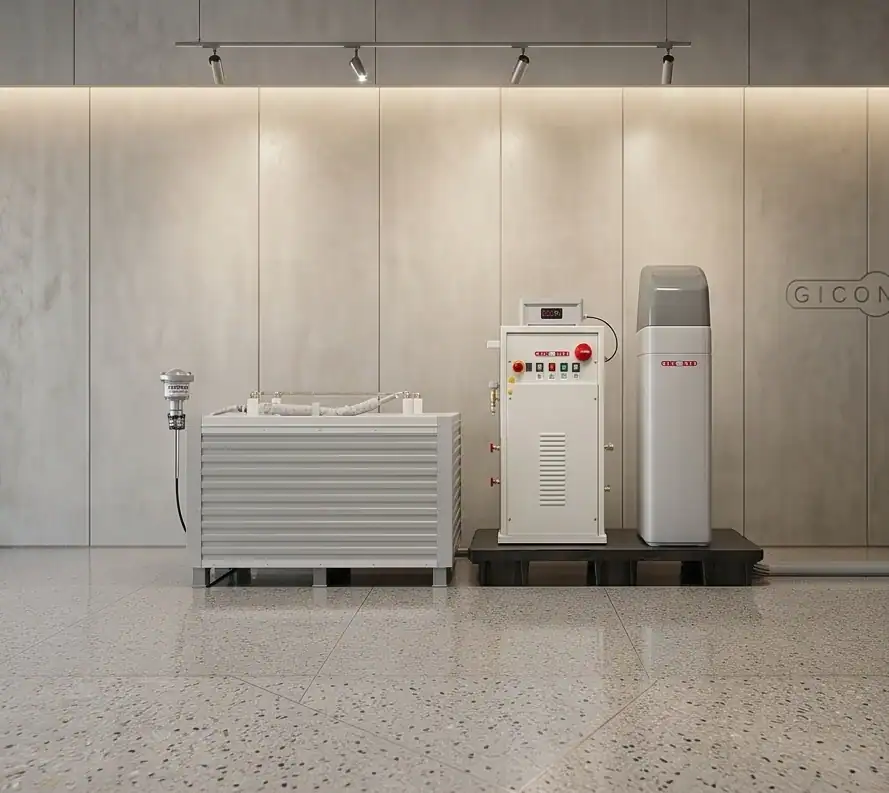
Customized steam solution developed by Giconmes.
Proposed solution:
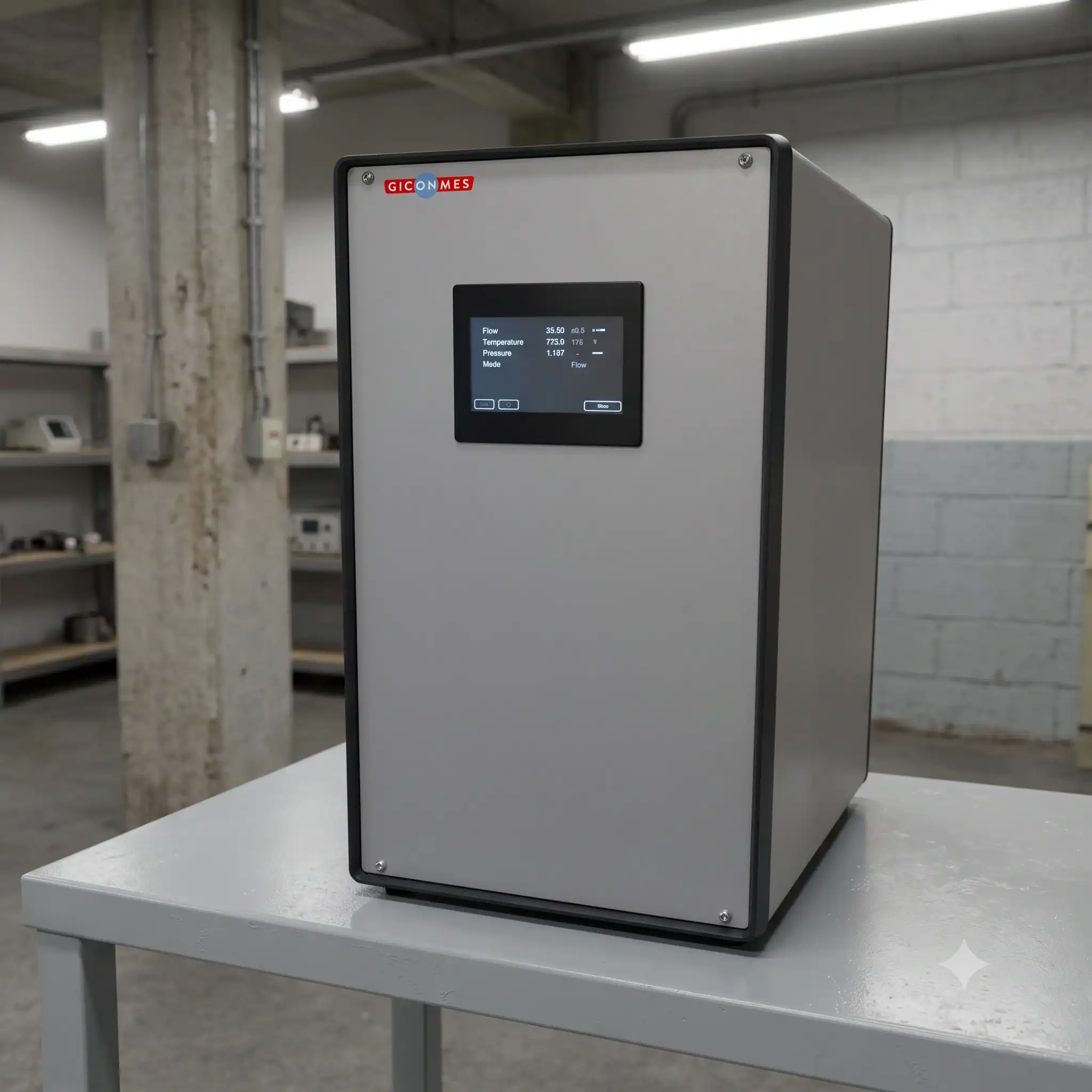
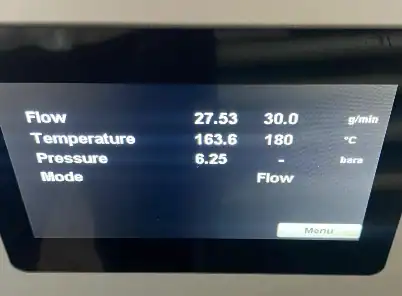
Giconmes introduced the NGV HP series, its line of precision steam generators, designed specifically for low-capacity scientific and industrial applications where steam must be delivered with strict control of flow rate, pressure, and temperature.
A operating principle different from that of a conventional generator. The NGV HP series does not use a boiler: a high-precision pump dispenses water directly onto an evaporator, where vaporization occurs instantly at the exact rate of water inflow.
Since there is no accumulated volume, the thermal inertia that prevents precise control disappears, and the steam flow rate is determined directly by the setpoint.
The system, which is controlled by a microprocessor-based controller, achieves the following:
- Flow rate: control range from 0.1 g/min to 100% of full scale, with an accuracy of ±1% under steady-state conditions and ±5% of full scale under transient conditions. Flow measurement is independent of back pressure.
- Temperature: superheated steam adjustable between 100 and 200 °C (expandable to 400 °C), with an accuracy of ±2 °C.
- Pressure: Standard operating range from 1 to 6 bar (abs), with options ranging from vacuum to 15 or 20 bar (abs).
The steam produced is pure, requiring no carrier gas, and the system is fully operational within five minutes.
Although the expected flow rates were very low, the NGV HP-6000 model (6 kW, up to 100 g/min) was selected.
The reason is strategic rather than thermal: since the control range starts at 0.1 g/min, the equipment easily covers both the initial 25 g/h and any subsequent reactor scaling, without compromising accuracy at the low end. The customer receives a single unit compatible with different operating ranges, avoiding the need to replace it in later phases of the project.
The generator features open-source control software written in Java and standard Modbus TCP connectivity (with Modbus RTU, RS232/RS485, and a 4–20 mA analog signal available as options), allowing it to be operated and monitored remotely and integrated into the reactor control system.
The materials in contact with water are PTFE, stainless steel, PEEK, and EPDM, and the fittings are Swagelok®, consistent with the standard equipment found in an experimental setup.
Technology used:
- NGV HP-6000 6-kW steam generator, without a boiler and with instant steam generation
- Microprocessor-based control, Java software, and Modbus TCP connectivity
- Swagelok® Fittings for Experimental Integration
CHALLENGES
We meet customer requirements
The installation fully met the objectives set by the client. Among the key results are:

Accuracy that ensures test results are comparable. Steam is metered with a flow rate accuracy of ±1% and a temperature accuracy of ±2 °C: reagent variability is no longer a factor in the experiment.

A single unit for the entire project. The range of 0.1 to 100 g/min covers both the current experimental phase and the planned scale-ups, eliminating the risk of having to replace the unit in the event of future revisions to the specifications.

Immediate response. With no accumulated water mass, setpoint changes are nearly instantaneous, and startup is complete in five minutes—a key factor when testing campaigns depend on the availability of solar radiation.

Direct integration. Modbus TCP connectivity and open-source software allow the generator to be integrated into the reactor control system without any additional development.
Do you need a customized solution?
We help you define what type of installation you need
There are no emissions beyond those produced during the electricity production process. Consequently, emissions can be neutral depending on the electricity mix. Electric steam boilers are the present and the future.
Absolutely. In fact, it is recommended to achieve maximum efficiency. There is no problem with remote control as long as it complies with current regulations.
A steam generator is a pressure vessel that, together with the piping network, is subject to regulatory control and complementary technical instructions, according to the regulations published in Royal Decree 809/2021, of September 21. Maintenance is divided into a part that can be easily fulfilled by the owner:
- Know and apply the manufacturer’s instructions regarding use, safety measures, and maintenance.
- Not to put the installation into service or prevent the operation of pressure equipment if the requirements of the Regulation are not met.
- Having at least the following documentation for the pressure equipment while they are installed: Declaration of conformity, manufacturer’s instructions (if applicable), and, if necessary, installation certificate, along with other supporting documentation (such as installation project, record of the last periodic inspection, certifications of equipment repairs or modifications, and any other documentation required by the relevant technical instruction complementary to this regulation). For detailed contents, refer to Annex IV of the regulation. Making this documentation available to the competent authority of the autonomous community and the companies responsible for maintenance, repair, or periodic inspections.
- Use the pressure equipment within its intended operating limits as specified by the manufacturer and take it out of service if it no longer meets the necessary safety requirements.
- Perform maintenance on the installations, pressure equipment, safety accessories, and control devices in accordance with the operating conditions and manufacturer’s instructions, and examine them at least once a year.
- Arranging for the necessary periodic inspections as required by Article 6 of the regulation.
- Having and maintaining an up-to-date record of pressure equipment categories I to IV, as defined in RD 709/2015, of July 24, or equipment similar to these categories according to Article 3.2 of the regulation, as well as their installations.
It is known that by applying heat to water, it transforms into steam at the boiling point and atmospheric pressure. From there, depending on the required saturation degree of steam for its proper application, we need to increase the pressure to obtain a higher temperature. To change the temperature and saturation degree of steam, we always need to modify the pressure.
It is a unit of pressure equivalent to 1 kg/cm2, 0.98 atmospheres, or 14.50 PSI.
Haven't found the answers to your questions?
Please send us a question or download all the information
USES OF STEAM IN INDUSTRY AND OTHER BUSINESSES
Other similar success stories using steam

The use of steam is gaining popularity in several industries due to its efficiency and environmental benefits..
In our "Success Stories" section, you can discover more about companies that have adopted this technology and have achieved successful results in terms of efficiency and sustainability. Click on the success stories to learn more details.
Situación original ¿Qué retos nos planteó el cliente? Un cliente del sector agrícola se planteaba la puesta en marcha de un nuevo vivero y necesitaba incorporar un sistema para la desinfección térmica del sustrato antes de su uso en la producción de planta. El objetivo era eliminar patógenos, semillas de malas hierbas y organismos indeseados […]

Situación original ¿Qué retos nos planteó el cliente? Un fabricante de chocolate y derivados del cacao contaba en su planta con un transportador de lona de gran longitud (cerca de 50 metros) cuya limpieza era una de las operaciones más exigentes del proceso. Los residuos de chocolate, cacao y grasas se adhieren con fuerza a […]