


What Is a Fire-Tube Boiler
A fire-tube boiler (also called a smoke-tube boiler or, in Latin America, a caldero pirotubular) is a piece of equipment that produces steam by burning fuel, typically natural gas, diesel, or biomass. Its name comes from the Greek word *pyr* (fire): the fire and smoke travel inside the tubes, while the water is on the outside, filling a large cylindrical vessel.
It is the most widely used industrial boiler in Spain. It is found in bakeries, dairy plants, canneries, and the chemical, pharmaceutical, and textile industries, as well as in industrial laundries. Its success can be attributed to three factors: a robust design, a large water reserve (which absorbs peaks in demand), and a reasonable manufacturing cost for capacities ranging from 1 to 25 t/h.
In industrial boiler rooms, the terms “fire-tube boiler” and “fire-tube steam generator” are often used almost interchangeably, although strictly speaking, a steam generator typically has a smaller water capacity and starts up more quickly.
How a fire-tube boiler works
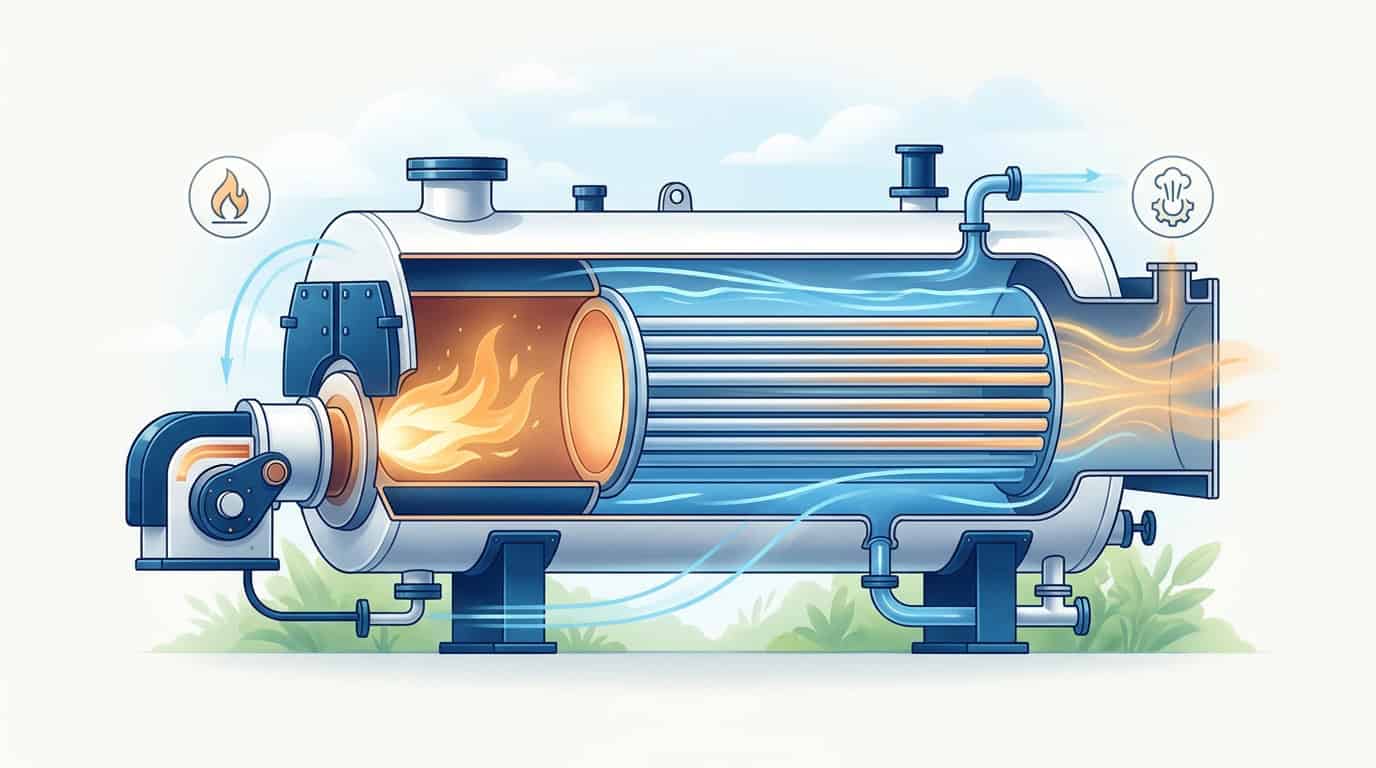
The principle is simple: the burner produces a flame inside a large-diameter tube (the firebox). The hot gases then travel through several bundles of narrow tubes, transfer their heat to the water surrounding them, and exit through the chimney. The water boils, and the steam accumulates at the top of the unit, from where it is fed into the process.
Most modern fire-tube boilers have a three-pass flue system: the gas passes through the boiler three times (firebox → first tube bundle → second tube bundle) to maximize heat recovery before exiting.
Main Parts
- Burner: mixes fuel and air to produce the flame. Its design largely determines NOx emissions.
- Firebox: a large-diameter tube where combustion takes place.
- Flue chambers: front and rear chambers where the gases change direction between passes.
- Tube bundles: tubes through which the flue gases circulate, transferring heat to the water.
- Body or shell: the pressure vessel that contains the water and the steam chamber.
- Chimney and, optionally, economizer: The economizer recovers heat from the flue gases to preheat the feedwater, increasing efficiency by several percentage points.
- Safety and control equipment: safety valves, pressure switches, level control, bottom and brine drains, and a feed pump.
Actual performance
A well-tuned fire-tube boiler yields between 85% and 92% of the fuel’s calorific value, and slightly more with an economizer. In practice, this efficiency drops due to radiation losses from the boiler body, blowdowns, start-ups and shutdowns, and part-load operation. Its large water volume has a downside: cold starts take time, and keeping it hot on standby consumes fuel even when steam is not being used.
Fire-tube boiler vs. water-tube boiler vs. electric steam generator
The difference between fire-tube and water-tube boilers lies in where each fluid flows: in fire-tube boilers, the fire flows through the tubes; in water-tube boilers, water circulates through the tubes, surrounded by the flame. Water-tube boilers are reserved for high flow rates and high pressures (power plants, refineries, paper mills). For most process plants, the relevant comparison today is between fire-tube boilers and electric generators.
| Criterion | Pyrotubular (gas) | Water-tube (gas) | Electric generator |
|---|---|---|---|
| Typical range | 1–25 metric tons per hour | More than 20 metric tons per hour | Up to ~3 t/h (modular units) |
| Typical pressure | Up to ~25 bar | High pressure | Up to ~10 bar in standard process |
| Performance | 85–92% | 85–92% | ~99% (excluding flue gas losses) |
| Cold Start | Slow (large volume of water) | Medium | Fast (minutes for low-volume systems) |
| Direct Emissions (CO₂, NOx) | Yes | Yes | No |
| Fireplace and Fuel Supply | Required | Required | Not required |
| Maintenance | Burner, pipes, chimney sweeping, emissions monitoring | Similar, but more complex | Heating elements, water control and treatment |
| Energy Cost | Gas + CO₂ fees | Gas + CO₂ fees | Electricity (best with a PPA or flexible rate) |
Electricity (preferably with a PPA or flexible rate)
These figures are for guidance only; each installation must be sized according to its actual demand and operating conditions.
Regulations Affecting Fire-Tube Boilers
NOx Emissions: The 2030 Target
Directive (EU) 2015/2193 on medium-sized combustion plants, transposed in Spain by Royal Decree 1042/2017, limits emissions from boilers with a thermal capacity between 1 and 50 MW. For natural gas boilers:
| Installation | NOx Limit | Effective as of |
|---|---|---|
| New (any capacity from 1 to 50 MW) | 100 mg/Nm³ | December 20, 2018 |
| Existing capacity of more than 5 MW | 200 mg/Nm³ | January 1, 2025 |
| Available from 1 to 5 MW | 250 mg/Nm³ | January 1, 2030 |
A 1- to 5-MW fire-tube boiler is, in practice, a boiler with a capacity of approximately 1.3 to 6.5 t/h—exactly the size of many boiler rooms in the food and chemical industries. Many facilities with older burners will have to replace the burner, add flue gas recirculation, or redesign the boiler room before 2030. An electric boiler has no direct emissions and is not subject to this issue.
Boiler Operator and Inspector
The Pressure Equipment Regulation (Royal Decree 809/2021) and its technical instruction ITC EP-1 govern the installation, periodic inspection, and operation of boilers. Depending on its classification (which is based on pressure and water volume), a boiler may require a licensed industrial boiler operator, in addition to periodic inspections by a regulatory agency.
Due to their large water capacity, tubular boilers are typically classified in the most stringent categories. Rapid-vaporization electric steam generators, with a small water capacity, generally simplify these requirements. The specific classification must be confirmed for each unit with the manufacturer or the regulatory agency.
When Should You Replace a Fire-Tube Boiler with an Electric One?
- The actual steam demand is less than about 3 t/h. In this range, electrification can be achieved using low-voltage equipment and, in many cases, without upgrading the medium-voltage service.
- The boiler is oversized. This is very common: it was installed for a production capacity that no longer exists and operates at partial load, resulting in poorer efficiency.
- Operation is intermittent—shift-based, with downtime on weekends or short peaks. The fire-tube boiler loses a lot of energy during startup and while maintaining its temperature; an electric generator starts up in minutes.
- Your boiler is nearing the end of its useful life or is due for a major inspection or repair: this is the natural time to shop around.
- It must meet the 2030 NOx limit, and the current burner doesn’t meet it.
- The plant has solar self-consumption, a PPA, or a rate plan with off-peak hours. The cost per thermal MWh of steam generated from electricity drops significantly.
- The company has decarbonization goals or customers who are demanding that it reduce its carbon footprint (Scope 1).
When Is It Best Not to Change It (Just Yet)?
- Very high continuous demand (several dozen metric tons per hour) with no available electrical capacity.
- Operating pressures well above normal process levels.
- A recent boiler, properly tuned and equipped with a low-NOx burner already installed.
In these cases, a middle ground is the hybrid solution: keeping the fire-tube boiler as a backup and meeting the base load with electricity-generated steam.
How to Approach the Transition to Electric Steam
- Measuring Actual Demand
Before choosing equipment, you need to know how much steam is actually consumed: average flow rate, peak flow rates, operating pressure, and hours per year. As a reference, 1 t/h of steam is equivalent to about 700–750 kW of electrical power. Often, the actual demand is much lower than the rated power of the installed shell-and-tube boiler.
- Check the available electrical power
The contracted power and the transformer’s capacity set the limit. Below about 3 t/h (just over 2 MW), most medium-sized plants can supply the generator at low voltage (400 V) without stepping up to medium voltage.
- Choosing Between a Large Boiler and Several Modular Ones
Instead of replacing a fire-tube boiler with a single equivalent electric boiler, it is usually more efficient to install several modules in parallel. In a recent project for a food processing plant with a demand of 600 kg/h, Giconmes proposed three 150-kW generators instead of a single large boiler. Advantages of the modular approach:
- Redundancy: If a module is undergoing maintenance, the plant continues to produce.
- Better performance at partial load: only the necessary modules are activated.
- Phased expansion: Modules are added as demand increases.
- Simpler installation: smaller, lighter equipment that fits into existing rooms.
Giconmes manufactures the NGV series (stationary generators up to 180 kW per module) and the HGV series (high-power, up to 3.5 t/h), both of which are PED-certified.
- Evaluate the hybrid option
Keeping the tubular boiler as a backup or for peak demand and covering the base load with electric steam allows for electrification with less investment and without supply risk. In addition, an electric boiler can take advantage of off-peak electricity rates and participate in flexibility markets, generating additional revenue.
Frequently Asked Questions
What is a fire-tube boiler?
It is a steam boiler in which combustion gases circulate through tubes submerged in water. It is the most common type of industrial boiler for steam production ranging from 1 to 25 metric tons per hour.
What is the difference between a fire-tube boiler and a water-tube boiler?
In a fire-tube boiler, the flue gases flow inside the tubes and the water flows outside them. In a water-tube boiler, it’s the other way around: the water circulates through the tubes and the flame surrounds them. Water-tube boilers are used for high flow rates and high pressures.
What is the efficiency of a fire-tube boiler?
Between 85% and 92% under nominal conditions, slightly higher with an economizer. In actual operation, with starts, stops, and partial load, seasonal efficiency is typically lower.
Can a fire-tube boiler be replaced with an electric one?
Yes, especially when steam demand is less than about 3 t/h and electrical power is available. This can be achieved using a single high-power unit, several modules in parallel, or a hybrid configuration with the existing boiler.
How much electrical power do I need to replace my steam boiler?
As a reference, about 700–750 kW per metric ton of steam per hour. A 2 t/h fire-tube boiler operating at full load is equivalent to about 1.5 MW of electrical power, although the actual demand is usually lower than the rated capacity.
What NOx limit must existing fire-tube boilers meet?
In Spain, according to Royal Decree 1042/2017, natural gas boilers with a capacity of 1 to 5 MW must comply with a limit of 250 mg/Nm³ as of January 1, 2030, and those rated at more than 5 MW must comply with 200 mg/Nm³ starting in 2025. New boilers must comply with 100 mg/Nm³.
Who manufactures electric steam generators in Spain?
Giconmes Ibérica, headquartered in Zaragoza and founded in 1957, manufactures stationary (NGV series), mobile (RGV), and high-capacity (HGV, up to 3.5 t/h) electric steam generators for the food, pharmaceutical, chemical, and process industries.
Are you thinking about upgrading your boiler room? At Giconmes, we analyze your actual steam demand and recommend the electrical, modular, or hybrid configuration that best suits your needs. Contact our technical team.