


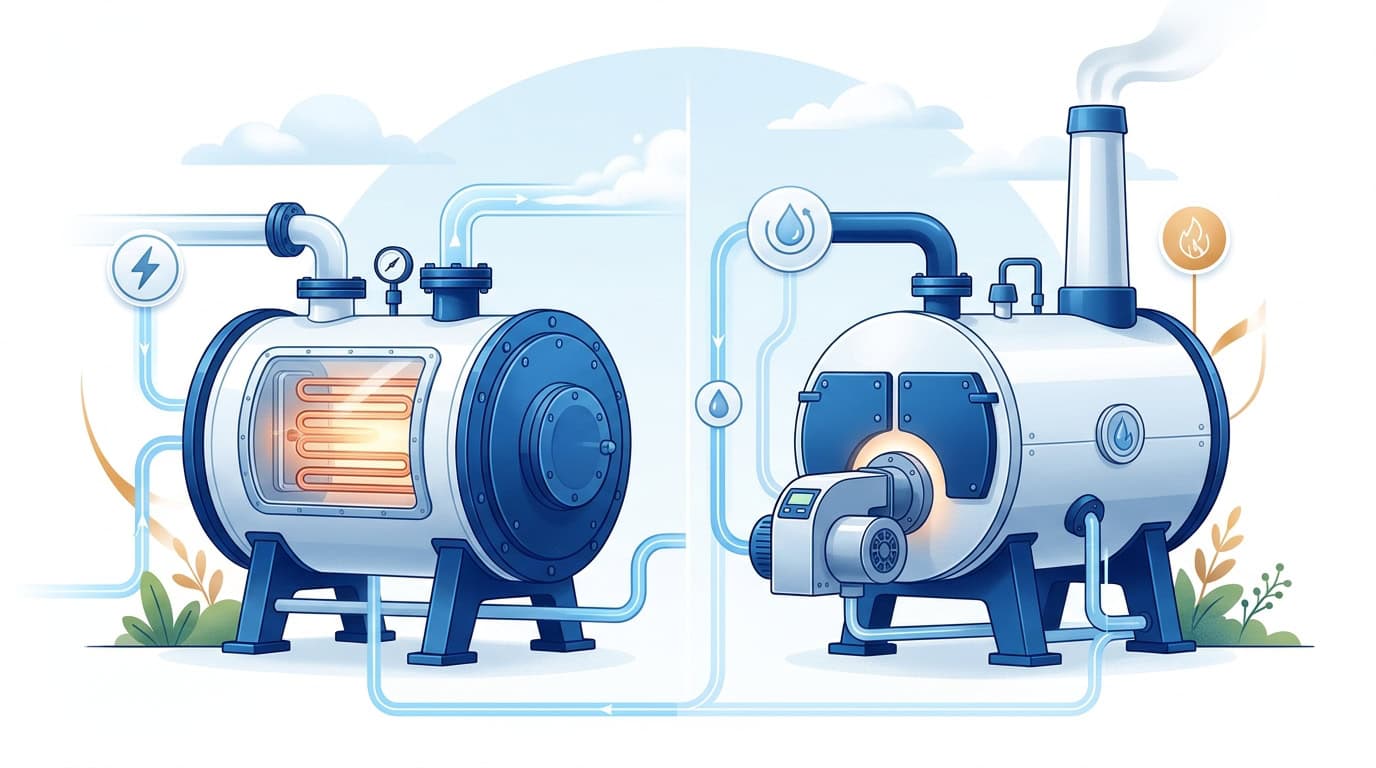
A combined-cycle power plant produces tens of metric tons of steam per hour. And yet it still needs an auxiliary boiler. The reason is simple: that steam is only available when the gas turbine is running. When the unit is shut down or starting up, the plant still needs steam and has to get it from somewhere else.
In this post, we’ll review what that steam is used for, why more and more hours per year are needed, and when it makes sense for the auxiliary steam boiler to be electric.
What Is an Auxiliary Boiler in a Power Plant?
It is a steam generator that operates independently of the main cycle. It does not generate electricity. Its function is to supply steam to the plant’s auxiliary systems when the recovery boiler cannot do so: before startup, during shutdowns, and during overhauls.
It is a small piece of equipment compared to the power plant, but without it, the steam turbine cannot start properly.
What Is Auxiliary Steam Used For?
Here are the five common uses in a combined-cycle plant:
| Usage | When it’s needed | What it requires of the team |
|---|---|---|
| Turbine Sealing Steam | Before each startup and during shutdowns when a vacuum is maintained | Low pressure, low flow rate, and very stable |
| Feedwater Degassing | Before startup and with the plant operating at very low load | Low pressure, immediate availability |
| Keep the heat recovery boiler warm | Nighttime and Weekend Shutdowns | Continuous service for hours or days |
| Preheat lines and turbine | The Hours Leading Up to Startup | Rapid response |
| Storage and Frost Protection | Extended Downtime | Unattended operation |
Steam Sealing. The steam turbine operates against a vacuum condenser. To prevent air from entering through the shafts, the seals are sealed with steam. Without that steam, a vacuum cannot be created, and without a vacuum, the system cannot start up.
Degassing. The feedwater must enter free of dissolved oxygen to prevent corrosion of the boiler. The degasser requires steam to perform this function, even when the cycle is not yet producing steam.
Hot boiler. A heat recovery boiler that is kept hot and under pressure starts up sooner and experiences less thermal fatigue than one that starts from a cold state.
Preheating. Heating lines and casings before introducing main steam prevents condensation and water hammer.
Preservation. During extended shutdowns, steam keeps equipment dry, warm, and free from the risk of freezing.
Why More Operating Hours Are Needed Than Before
Combined-cycle plants were designed to operate for many hours at a time. Today, they fill the gaps left by wind and solar power: they start up in the afternoon, shut down at night, and sometimes go days without operating.
Every shutdown means time during which the recovery boiler is not producing steam. And every rapid startup demanded by the market depends on the plant being hot and under vacuum. Auxiliary steam has gone from occasional use to many hours of operation per year.
The Problem with the Traditional Auxiliary Boiler
The traditional auxiliary boiler runs on gas or diesel and is sized for cold start-up: several metric tons of steam per hour.
For maintenance consumption, which is a fraction of that, it is disproportionate:
- It’s operating well below its capacity, with poor performance.
- It must be kept warm so it responds in time.
- It has a burner, flue, and fuel line, all of which require maintenance and inspections.
- It operates at a plant that is not currently in production.
When Is an Auxiliary Electric Boiler Appropriate?
An electric resistance steam generator is suitable when steam consumption is low and steady: shutdowns, degassing, and hot standby.
- It starts up in minutes—no hearth to sweep or refractory to heat.
- It adjusts to consumption. 200 kg/h of steam is about 150 kW.
- No additional combustion is required. No burner, no chimney, and no gas supply to the unit.
- It operates unattended, with its own controls and signals to the control room.
- It requires minimal maintenance: heating elements, blowdowns, and water quality. We explain this in the maintenance guide.
It does not always replace the large boiler. If a cold start requires several metric tons per hour, a different scale is needed: an electrode boiler or keeping the combustion boiler running just for that moment. The usual approach is to combine the two: the small electric boiler covers maintenance hours, and the large one is not kept hot at all times.
An example: two 150-kW generators in a combined-cycle plant
In 2026, we supplied two NGV-60 generators for a combined-cycle power plant in Spain. The specifications give an idea of what this application requires:
- Two units , each with a capacity of approximately 200 kg/h and 150 kW, operating at 2–3 bar.
- Skid-mounted and constructed of stainless steel.
- Automatic purge with discharge below 45–55 °C.
- Dedicated PLC and status signals for the plant control system.
- Assistance with installation, commissioning, and regulatory approval.
What to Decide Before Requesting a Quote
- Actual usage and flow rate. Shutdowns, degassing, or hot maintenance require different flow rates. Here we explain how to calculate the generator size.
- The electrical connection point. 150 kW at 400 V is approximately 217 A. It’s a good idea to check early on whether the panel or switchgear can handle this.
- Available water. The quality of the feedwater determines the treatment required.
- Signals. What the control room needs to see and who will handle the integration.
- Regulatory approval. Since this is pressure equipment, you must decide who will handle the approval process.
Not just in combined-cycle plants
The same problem occurs in any plant with a steam turbine that experiences frequent shutdowns: cogeneration plants, biomass plants, waste-to-energy plants, and solar thermal plants. It also occurs in process plants that shut down their main boiler at night or on weekends and require a minimum amount of steam to avoid a cold start.
If your auxiliary boiler spends more hours on standby than in operation, tell us about your situation and we’ll work with you to determine the right size.